Wednesday, August 31, 2011

Playland Letters

Coney Island's old Playland is losing its letters. One by one as the years go by.


Summer 2010

They're mid-century neon letters. One has to wonder if they're being taken by ordinary vandals or by Coney Island history buffs terrified that this, too, is about to vanish into the hungry maws of Thor and Zamperla.


Summer 2011

In Forgotten New York, Kevin Walsh tells us that Playland began in 1930 as Silver's Penny Arcade. It was run as Playland from 1957 until it closed in 1981. Horace Bullard bought it and left it to rot. The ruin's guardian was a man named Andy Badalamenti. He recently passed away. A small tribute to him hangs on the fence outside Playland.


For a peek inside the ruins of Playland, see photos by Lindsay Wengler and Nathan Kensinger.

Tuesday, August 30, 2011

Ruby's

My last drink at Ruby's on the boardwalk at Coney Island.


I don't have much to say about it.


It's been here, "a Brooklyn treasure," since 1934.


After this summer, it will crumble under a corporate tsunami, along with the rest of the boardwalk.


How can I ever go out there again?

Monday, August 29, 2011

Glimpse the Future Coney

Assuming Hurricane Irene didn't suck Zamperla out to sea, there's not much time left to say goodbye to Coney Island as we've long known it.

We all know the devastation that is coming after this summer. The company that Bloomberg has handed this city treasure over to has a vision to make the place "refined, cleaner...with sit-down restaurants and sports bars." And so everything on the boardwalk, except Nathan's and Lola Star, will be bulldozed. They want to turn it into a place where you can "sit in nice comfortable chairs and have a nice cappuccino or ice coffee."

Sitting down is key. So is niceness. "Nice" is an epidemic that's killing the city. What will "nice" look like at Coney? It's already arrived.


We've got a good idea of what's to come thanks to the new Luna Park's Cyclone Cafe. It looks like it was born from a plastics extruder, a cookie-cutter design with none of the joyful messiness of Coney's traditional snack bars with their hand-written signs and paintings of food--vivid corn dogs, clams, and funnel cakes.

What do they serve at the Cyclone Cafe? Salads. Farmer's Market salads. Who goes to Coney Island for a salad? I don't go out there for "healthy dining." I go free of such burdens. I go for fried and salty evils. For glorious amusement-park junk. And certainly not for an "Over the Top Salad Experience."


And guess what else you can get at the Cyclone Cafe. Starbucks coffee. That's right--the Cyclone Cafe "proudly" brews it, just for you. Isn't that nice?


The same people have also brought Coney's Cones to the boardwalk. As you can see, this means more salads, along with panini and gourmet coffee. "Gourmet"? Don't they know the new code word for nice is "artisanal"?


To make room for the Cyclone Cafe, that paragon of lifelessness, we lost two treasures--Gregory & Paul's snack bar and the Bonanza Shooting Gallery.


2008, silversalty's flickr

The Gregory & Paul's was sold and its contents auctioned off in 2009. It was a delightful cacophony of hand-painted signs and artifacts from its over 40 years in business.

Still remaining on the boardwalk, but not for long, is Paul's Daughter, formerly the other Gregory & Paul's. Zamperla is giving them the boot, too. They've been there since 1962. Said Paul's daughter to Amusing the Zillion, "I wanted so much to be a part of the New Coney Island but they didn’t even offer me a tiny little spot on the Boardwalk." Instead, the spot is going to a multinational corporation.


2006, ConeyHOP's flickr

I don't know how long the Bonanza Shooting Gallery was here, but I'd guess since the 1960s. I absolutely loved it. It was typically my first destination when arriving at Coney Island.

What happened to all the great stuff they had in the shooting gallery? The saloon piano player who tickled the ivories when you shot him the ass, the bear that stood up and roared, the chickens that clucked in their cage? We can hope it was recycled, sold off to another amusement park, and that someone, somewhere is still enjoying it--now that we can't anymore.

But, hey, at least we've got some nice salads.

Friday, August 26, 2011

Gallo's Fedora

Still on exhibit at the Mob Scene Gallery in Little Italy, "Crazy" Joe Gallo's fedora, the one he was wearing on the night he was gunned down and died in the street outside Umberto's Clam House.


Before opening this storefront museum in Little Italy, proprietor Arthur Nash kept his gangland collection in his room, formerly Bob Dylan's room, at the Chelsea Hotel.

That is one haunted hat.

Thursday, August 25, 2011

*Everyday Chatter

Jason Shelowitz (aka Jay Shells) offers a sneak peek of his latest urban etiquette street-art project--heads up texting zombies!


In Bed-Stuy: "This is not the kind of neighborhood people like us move into." [NYT]

Mmmm...the urban jungles of the Flower District. [SNY]

8/26: Take a walking tour with Greenlight Books and Literary Brooklyn author Evan Hughes. [FB]

Bottled Brooklyn sells "vegan-friendly" test-tubes full of Brooklyn dirt--for $24. [BB]

More on how the deal was done to sell the Chelsea. [CN]

Why 316 E. 3rd must be saved. [EVG] & [OTG]

Remembering The Dom. [ENY]

Greenwich Village poet Samuel Menashe has died [NYT]. He was someone I once knew in another life, long ago. This is the poem of his I remember best:

Here and there
White hairs appear
On my chest—
Age seasons me
Gives me zest—
I am a sage
In the making
Sprinkled, shaking

Brooklyn Eats Manhattan

We know that nouveaux Brooklynites, following their Manifest Destiny, are "blessing the Hudson Valley with hipness," turning Philadelphia into "the next borough," and changing the Rockaway boardwalk into another Bedford Avenue. This is how gentrification travels outward into more affordable locations. But what about the increasing Brooklynization of Manhattan?

Most recently, Stone Street Coffee of Gowanus fame opened shop on 9th Avenue in Chelsea:


Pop's of Brooklyn has come from Williamsburg to 8th Street near NYU:


There are lots of examples over the past year--like the Brooklyneer restaurant on West Houston and how the Guggenheim Lab, when they set up shop in the East Village, opted to have the food served by Roberta's of Bushwick. And this year's Lower East Side Ideas Fest showcased a plethora of Brooklyn-based vendors--as Bowery Boogie commented here, it looked like "a Brooklyn takeover."

It's a kind of reverse gentrification, but more twisted, a sort of Mobius Strip of gentrification in which the New Brooklyn, which exists because it was priced out of Manhattan 10 years ago, and which sort of (but not really) resembles the old Manhattan, is coming back to Manhattan, extruded through the New Brooklyn ringer, like artisanal sausage, a kind of monster-mash of flavors, so that it feels nothing quite like Manhattan ever did and only like parts of Brooklyn have come to be in recent years. Which is to say--it feels like somewhere not New York at all.

It feels like Portland on the Lower East Side.

It feels like Nantucket by way of Bergen Street.

It feels like Wisconsin pickled in Brooklyn brine then moved to Greenwich Village.


Brooklyneer menu art

It's someone's fantasy of Brooklyn as a quaint small town, where everything is safe and clean, where people frolic in backyards, leave their doors unlocked, etc. You know the story--and what happens when the story goes terribly wrong. But it's so much more than that.

The Observer recently got to the dark heart of it, writing: "It’s as if the tumor of hipster culture that formed when the cool kids moved to Williamsburg had metastasized into a cluster of cysts pressing down on parts of the borough’s brain... Brooklyn is producing and consuming more of its own culture than ever before."

There's something powerful going on here. This is Greek-sized stuff, the mythic story of maternal cannibalism, only in reverse. Manhattan's cast-off children are getting big enough to eat the mother that rejected them. No wonder so much of this phenomenon comes obsessed with food and oral pleasure.

So what happens when Manhattan is finally devoured by New Brooklyn? You know what they'll tell us: "It's better than a bank."


James Campbell Taylor

Wednesday, August 24, 2011

*Everyday Chatter

Oh, the ups and downs of the Chelsea Antiques Garage. Pat writes in to say, "I just emailed a vendor I keep in touch with and she told me the Garage was originally going to close August 28th but they're on a month to month lease again. For now!"

Along with Steve Cuozzo, we're worried about El Quijote, too. [NYP]

Can't get enough of the egg cream? Check out this ultimate guide--it also gives you good ideas for where to find a diner. [JCT]

Marty buys a pile of books at St. Mark's Bookshop. [MAD]

8/30: Meet the last of the live nude girls with Arthur Nersesian at St. Mark's Bookshop:


Swank Highline-hugging Avenues School writes letters to rejecting parents, saying it's in their child's "best interest" to accept Avenues' acceptance, and "By the way, it should be clear our motives are not economic.” [NYT]

Video of yarn-bomber Olek. [BB]

Jazz musician Giuseppe Logan is alive and well and back in Tompkins Square Park. [EVG]

Is a good restaurant review "the final nail in Bushwick's coolness coffin"? [Gothamist]

Those Williamsburgers and their kissing booths!

Albanese Still Butchering

Now and then, I like to check in on Albanese Meats & Poultry on Elizabeth Street to make sure it's still there. And so far, I'm always relieved and happy to report that Mr. Albanese is still at work, cutting meat on his table by the open door.


All around this Last Mohican, Elizabeth Street is still the ruined road it's been for the past few years, another vapid luxury shopping mall like Bleecker Street. But, here and there, some holes have appeared in the golden fabric.

Right next to Albanese Meats, the former Coco de Mer is shuttered and empty. Once your home for "erotic luxury" and "designer sex toys," they sold penis salt and pepper shakers--for $210. Awhile back, they featured them in a window display that riffed on a meat theme: "You bring the meat. We've got the sauce!" Perhaps a cheeky comment to the 88-year-old shop next door?


And directly across the street from Albanese Meats, the Trust Fund Baby boutique space remains closed, empty, its window covered with gathering graffiti. Call it luxury blight. Another sign of how briefly these newcomers last.

Wrote a Yelper on this shop's listing in 2008: "Not too long ago this neighborhood was filled with wanna-bee mobsters and kooky, interesting characters. Now it's just a playpen for spoiled rotten American and Euro trustafarians, entitled mamatellas and their un-cute loinfruit. What a bloody bore!"


These new places might vanish, but the old places will never return. And every time we walk by Cafe Habana, we still miss Bella's Luncheonette.

Tuesday, August 23, 2011

*Everyday Chatter

Yes, that WAS an earthquake. Did you feel it? [Gothamist]


Check out the film "Last Summer at Coney Island" free until 9/1. [BSr]

John Penley announces a protest at the office of Ira Meister, seller of the Bialystoker Nursing Home: 9/1 at 3:30 at 127 E. 59th. [FB]

Central Park Boathouse employees reveal the eater "has been serving filtered tap water disguised as bottled H2O for a whopping $8 for years." [NYDN]

Empire Diner message in Chelsea--any idea what this is about?


A collection of ugly NYC buildings. [Restless]

The demolition of an East Village "dream home." [EVG]

Reasons to save another EV dream home from demolition. [OTG]

Olive and the Bitter Herbs: A play about a woman "washed up in a rent-controlled apartment in Kips Bay" whose neighbors are driving her "crazy with the scent of artisanal cheeses." Sounds good to me. [CNY]

Messing with the Egg Cream

In the New Yorker's Talk of the Town last week, Shake Shack czar Danny Meyer messes with the egg cream at his Whitney Museum restaurant, making it with "organic chocolate from San Francisco" instead of Fox's U-Bet, giving it "a more leathery, berry sweetness." A leathery egg cream?

The Atlantic also gave it a try. Meyer's restaurant manager "boasted of the house-made chocolate syrup and the 'hand-crafting' of the egg creams," writes Corby Kummer. "But the syrup? A bit faint in flavor, ever so slightly chalky on the aftertaste. I asked for another with Fox's U-Bet syrup."


Meyer's Whitney Museum Egg Cream, Serious Eats

I don't understand why people keep messing with the egg cream. It started around 2008 when Chocolate Bar in the East Village aimed to "reinvigorate" the supposedly dying delicacy with flavors like hazelnut and cappuccino. As we saw here, the egg cream was alive and well. Still, the devolution had been set in motion.

Since then, the egg cream has endured many humiliations at the hands of so-called artisans. This spring, we heard about the egg cream "course" at swank 11 Madison Park: "made with malted milk syrup and vanilla beans, Battenkill Creamery milk and seltzer from one of the last suppliers in the city that refills old-school bottles. In a four-star flourish, a splash of olive oil is added with a silver oil can from Tiffany & Company."

(Watch the precious procedure here.)


11 Madison Park, NY Times

Even when egg creams are made in the traditional style, the attitude surrounding it can impact the experience. Die Hipster doesn't like Brooklyn Farmacy's approach, writing, "How dare you fly in from Hawaii and start judging how an old Brooklyn diner makes their egg creams."


Brooklyn Farmacy

If you're looking for a good, authentic, non-"artisanal" egg cream, go to Eisenberg's, where they use U-Bet and no other. Or just head over to Ray's Candy for a plain old chocolate in a paper cup--cheap!

More egg creams:
Egg Cream Tour 1
Egg Cream Tour 2


Monday, August 22, 2011

*Everyday Chatter

Sunday 8/28: Join David Freeland and Poor Baby Bree for a free historical musical tour of the LES. [PBB]

Pulino's bathroom design so confusing, one man urinated in the sink. [EVG]

Cooling off with the Lemon Ice King of Corona. [LC]

"It is an indelible, if sorta pervy, memory: going over to the Bowery loft a couple of doors down from William ­Burroughs’s place to talk to Blondie guitarist Chris Stein about Japanese monster movies and seeing Debbie Harry’s underwear spread out across the uneven wooden floor, half a dozen pairs of panties and maybe a bra or two." [NYM]

Welcome to the mysterious Box House Hotel, just "a used-condom’s toss from the Newtown Creek Waste Water Treatment Facility." [NYS]

San Gennaro Feast to get gourmet offerings. [Eater]

Catching up with Literary Brooklyn. [P&W]

This year, over 40% of thefts in NYC involve cell phones. [RS]

A visit to Chinatown's Wo Hop. [MAD]

Patti's Allerton

I wrote about the Allerton Hotel when it vanished in 2007 to become part of the Gem Hotel chain, but it is only now, after finally getting immersed in Patti Smith's excellent memoir Just Kids, that I get a full picture of what the Allerton was really like in its rock-bottom days.


verplanck's flickr

Smith recalls taking Robert Mapplethorpe to stay there, sick and broke, with nowhere else to go. She remembers their room: "The place reeked of piss and exterminator fluid, the wallpaper peeling like dead skin in summer." And the "lumpy pillow was crawling with lice."

"There was nothing romantic about this place, seeing half-naked guys trying to find a vein in limbs infested with sores. Everybody's door was open because it was so hot, and I had to avert my eyes as I shuttled to and from the bathroom." She says, "Never had I seen so much collective misery and lost hopes, forlorn souls who had fouled their lives."


today

She made friends with a morphine addict, formerly a ballet dancer, who drifted "through the hall like Isadora Duncan with chiffon streaming as he sang an atonal version of 'Wild Is the Wind.'"

Smith calls this character "the morphine angel" because he urged her to get herself and Mapplethorpe out of the purgatory of the Allerton and back to life. They escaped down the fire escape, hopped in a cab, and found a room at the Chelsea Hotel, where everything happened next.


circa 1950s

Post Script: The poet James Schuyler stayed at the Allerton in 1978, before he also escaped to the Chelsea Hotel, like Smith and Mapplethorpe before him.

Poet Charles North recalled visiting him there. In an interview, North called the Allerton "one of the most depressing places I have ever been in in my life... It was pretty horrifying, the fleabag of fleabags. [Schuyler's] room consisted of a bed, on which, at least the few times I saw him there, he lay surrounded by a sea of dirty laundry that reached just about to the height of the bed. And of course the smell was pretty bad. Moving to the Chelsea, with the help of his generous friends, I'm sure changed his life."


You can buy Just Kids at St. Mark's Bookshop--they've got plenty--and the works of James Schuyler, too.

Friday, August 19, 2011

*Everyday Chatter

I've been nominated for CBS New York's "Most Valuable Blogger" award. Vote for me here.

"I remember The Chelsea Hotel. Sometimes writing things down can make everything a little more bearable." [WIC]

Ozzie's 7th Avenue location in Park Slope to close--the rent is too damn high. [BSr]

Are we about to lose the forlorn little buildings on 3rd between 11th and 12th? (They were once the tallest on their block.) [EVG]

Where are we? Two banks, two cell phones, a tub of fro-yo:


In Bed-Stuy: Stop the eviction of Mary Lee Ward. [O4O] ...At today's rally.

The neon cows of Corona. [LC]

Dog & Cat Hospital signage--reminds me of the lost "All Pets Go to Heaven" funeral home sign. [OMFS]

Is Meatpacking's Balasz taking over the Cooper Square Hotel? What will the Backsiders make of this? [Curbed]

Do you have sidewalk rage? Maybe it's because the sidewalks are more crowded now than in past years. Maybe it's because people don't know how to walk. Robert Selsam proposes a Pedestrian Code of Conduct. $50 fine for not staying to the right! [NYDN]

Timeshare Wet T-Shirt

In all the media excitement about the Timeshare Backyard, we've heard plenty about their Slip 'n Slides, BBQ grills, greenery, kiddie pools, pogo sticks, lounge chairs, and other "adult-child," family-friendly, suburban fare. And while we're now hearing about noise complaints and water complaints, we've seen few mentions, and no complaints, about their wet t-shirt girls.


That's surprising, because it's no secret. The website advertises the service in large type: "A girl in a white tee to spray with a hose," and the yard's menu of add-ons includes, right at the top: "2 hot girls in white tanks that you can spray with a garden hose" for the price of $300.

You can also get "2 hot dudes in white tanks that you can spray with a garden hose," but somehow that's just not the same thing, is it?


American Apparel ad

The origins of the wet t-shirt and its attendant contests are murky. Earliest accounts put it on the ski slopes of Aspen in 1971. Since then, they've become, as Wikipedia says, "a staple of college spring break celebrations at locations such as Daytona Beach and Cancún."

This is the stuff of Girls Gone Wild.


spring break somewhere

This is different than burlesque. It's different than stripping. Maybe it's the aggressive male participation that makes it so mean. The wet t-shirt is not about a woman dancing, turning men into passive observers. The wet t-shirt is about men taking an active role to shoot, soak, and expose the women.

That's the money shot.


biker chicks

The images of wet t-shirt contests conjure the obvious fantasy behind it all. Ejaculation aside, it's more an expression of urethral aggression. It's a pissing contest. And women are the targets.

If you've ever been to a wet t-shirt contest, you know the feeling of animal hostility in the room, the anxious, pawing sense that mob violence could break out at any moment.


somewhere in the Heartland

So what does it mean that this staple of Spring Break has come to the Lower East Side?

Read Ariel Levy's Female Chauvinist Pigs, the book that explains "why young women today are embracing raunchy aspects of our culture that would likely have caused their feminist foremothers to vomit." Sex & The City plays a part in that trend and brings the problem right to our door.

In losing our young, radical feminists, New York City has lost so much. Feminism is allied with socialism, civil rights, queer sexuality, political action, egalitarianism, anti-consumerism--systems and movements that could have helped preserve the city in its diversity. Instead, New York's young women spent the 2000s taking pole-dance classes, shopping 'til they dropped, eating cupcakes, and puking drunk at bachelorette parties.

Meanwhile, girls are getting hosed on Ludlow Street.

Thursday, August 18, 2011

*Everyday Chatter

Bloomberg has become unpopular at last--and this great bunch of comments shows how the tide has turned. [NYT]

August 22: Stand Up, Speak Out against anti-LGBT violence in Williamsburg and Greenpoint. [NYS]

Bostonian Bowery Beef moving off the Bowery--they were robbed by junkies 4 times in one week--and we might get a new bookstore out of the deal. [EVG]

Washington Square Park's new fountain design may be killing the trees. [WSP]

Advertising on the High Line gets classy:


The end is near for what was one of the largest meatpacking plants in town--a demolition permit has been filed. [OTG]

Park Slope's Henington Press shop, long empty, has a new tenant and it's not a wine shop--it's a framer. [OMFS]

Will renovation ruin the Fortune House sign in Brooklyn Heights? [LC]

Frances Bean has a tattoo of Quentin Crisp on her back--mom Courtney Love says, "I was incredibly impressed. I was like ‘Awww, that’s my daughter!’" [NYO]

Another Andrews Gone

Last August I visited the last of the remaining Andrews Coffee Shops in the city. There were two at the time. And now--there is one.

This week, in an Eater post about a new "dark dining concept from Paris" and its "fall arrival at a former Andrew's Coffee Shop," I recognized the blue sign above the papered windows as the lovely little Andrews on 38th. Apparently, it has closed, I guess sometime this past year.


August 2010

It's regrettable. It was a good, out-of-the-way place, cheap and neighborly. As I described it last summer: "It had a slightly desultory air about it. No one was pumping happiness into the place. There were no flatscreen TVs screaming and no bouncy music. The song on the radio when I walked in was singing from 1990, 'If you don't love me, why don't you let me go?' Here, they let you eat in peace."

So much for all that.

At the time, I wrote, "If I had to bet which Andrews will be next to vanish, I'd say it's 38th Street, for all of the above reasons. It's not loud enough, not obnoxious enough to survive."

Sorry to win that bet, but those are the hallmarks of doom--agreeable and quiet? Doomed.


August 2010

As for what's to come, writes Eater: "they will serve a $65 prix fixe" and "have diners enter the room via a conga line... Also there are panic buttons."

I feel panicky just thinking about it.


Read more about Andrews:
Andrews Remainders
Andrews Coffee Shop

Wednesday, August 17, 2011

*Everyday Chatter

A look inside Goorin Hat Brothers of Bleecker, formerly the Etc. Grocery (and porn magazine) shop:


Surprise--Timeshare Backyard noise gets neighbor complaints. [TLD]

"Nolita" pizzeria moves to EV--owner expects to make the neighbors nervous. Wonderful. [Eater]

Enjoy the vintage East Village photos of Michael Sean Edwards. [EVG]

Chinatown is falling: "Sitting in a tiny kitchen, with a view across Delancey to one of those silver, faux-industrial-style million-dollar condos with rooftop birch trees, Mrs. Zheng, 58, smiles and waves her hand as if to bat away flies. 'It is battles all the time here; lots of people are leaving,'" she says while her landlord schemes up new ways to get her out. [NYT]

Greenwich Village fashions of the 60s--suburban! comfortable! corduroy! [LS]

8/23: Rally to save the Bialystoker Nursing Home. [BB]

The absolute nightmare that is Bryant Park movies--where the doucheoisie rule again. [NYT]

Battle for Astor Place

Now that 51 Astor is getting prepped for demolition, with its tall trees chopped down, so a new glass tower can rise on its site, let's take a look at its role in the battle for Astor Place--and how Cooper Union helped hatch the plan to turn Astor Place into a suburban office campus.


The City's Department of Transportation and Cooper Union are unfolding their plan to turn Astor Place into what they call a public park, but what is clearly an amenity for more condo and office towers, setting the stage for further upscaling of the East Village and Bowery. In the plan, there will no more street called Astor Place.

Preservationists, like GVSHP, oppose the plan because Astor Place, the street, is very old, dating back to a Native American trail from the 1600s. That's a good reason. Another good reason is that the city should not be taking away our streets to give green plazas to private developments and calling them public parks.

This isn't the first time powerful forces have tried to erase Astor Place as it stands. Cooper Union pushed the effort back in 2001, and early reports connected the restructuring of Astor with the development of what became Gwathmey's undulating condo tower there. Somehow, in more recent reports of the grand plan, what began as a private interest has been repositioned as a purely public work--and Cooper Union is no longer mentioned as the mastermind behind it.


Let's go back a decade ago. The New York Times reported on the neighborhood response when Cooper Union "put forth an ambitious and controversial plan...that would radically alter a main gateway to the neighborhood. The plan includes eliminating some streets, enlarging a public park and rezoning the area to permit two new structures." Said a neighborhood activist at the time, "Cooper Union is engaging in a real estate shell game in which the East Village will be the loser.''

J.A. Lobbia at The Village Voice wrote in 2001, "What Cooper Union wants is a major redevelopment that will replace low buildings with taller ones, expand a park, encroach on two city streets, alter traffic, and, along the way, disturb a literal rat's nest."

A major piece of Cooper Union's upscaling plan included leasing their Astor Place parking lot to hotelier Ian Schrager. Wrote Lobbia in that 2001 Voice article: "the city is considering revamping Astor Place, possibly removing traffic lanes to form a plaza joining the hotel to the Cube sculpture."

Jim Knipfel reported in the NY Press in 2001, "Some reports also claim that the hotel will simply envelop and 'de-map' Astor Place itself, though Cooper Union officials deny this." The opposition, he wrote, worried that "it’s one more step toward strangling the very nature of the East Village."


In 2002, the city approved Cooper Union's new building plans, including the hotel. At the time, the school's president promised "a set of design constraints to fit the neighborhood."

The hotel would evolve into the Gwathmey condo tower. In 2005 Paul Goldberger in The New Yorker called it the "Green Monster," saying, "it doesn’t belong in the neighborhood." It was the first of the big shiny beasts to take the East Village, arguably paving the way for more out-of-scale buildings like the Cooper Square Hotel.

From Cooper Union, we not only got the Green Monster, but also the outsized hive building, and soon Astor Place will have that new office tower--several stories of gleaming glass box made to house "high-tech companies, investment banks, insurance and advertising firms."


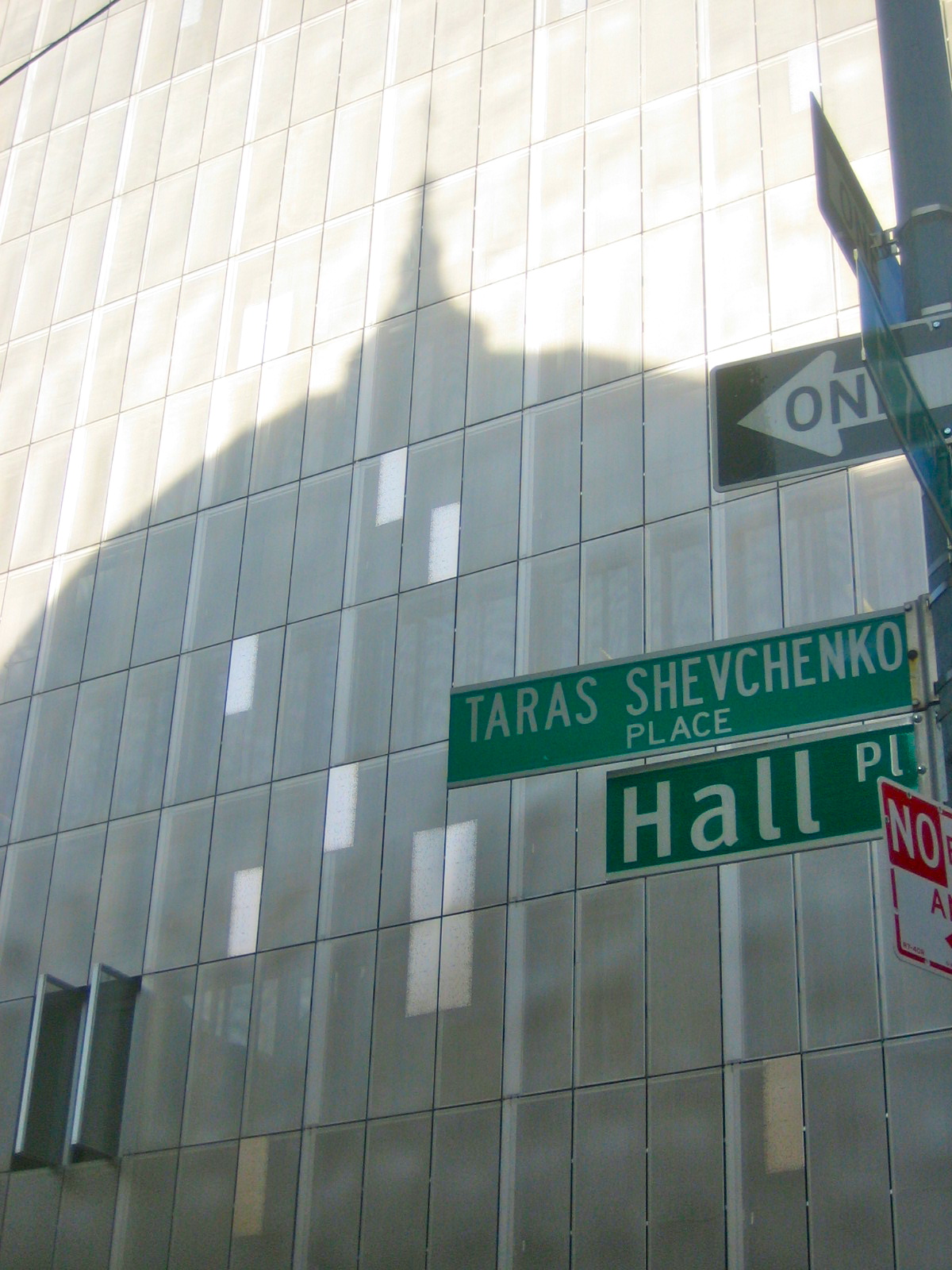
Cooper Union is no stranger to de-mapping, either. In the set of plans to build up Astor Place, the school asked the city to de-map Taras Shevchenko Place, which now runs behind their silver hive building. Local Ukrainians fought back against that plan, but what do we make of the second-naming of Shevchenko Place with Hall Place? Known as Hall since the early 1800s, it was renamed Shevchenko in 1978, but the Hall sign suddenly appeared in the fall of 2010. Is Shevchenko on the way out?


As for all that innocent, unassailable greenery, earlier this year, the City released a handbook for "High-Performance" landscaping of the city. Katharine Jose at Capital NY called it "a window into the brain-center of Bloomberg's New York." She wonders if Bloomberg is "running the city, or using the law to influence the private decisions of New Yorkers, especially its wealthiest class, to execute the Bloomberg program?"

The redesign of Astor Place is part of the Bloomberg program to remake the East Village into a haven for the upper classes and safety-seeking suburbanites. When considering what's about to happen to Astor Place, we must look beyond the pretty green trees to the motivations behind the plan. Why is it really being done and for whom? Who will benefit the most from it? What will the East Village lose in the long run?

East Villagers fought the plan in 2001, saying they "might as well live in Midtown if Cooper Union has its way." They fought it in 2002, worried that "the large-scale development would turn their eclectic, artistic neighborhood into a sterile business campus."

In the bike lane-loving, eco-friendly, ultra-green New York of 2011, where has that fighting spirit gone? It's as if the sight of lush greenery has wiped out our ability to think critically about this. As in the architect's renderings, we will be nothing but ghosts, haunting the granite slabs of Cooper Union's suburban-style office park.


I'll end with some words by William H. Whyte, Jr., from his 1958 book The Exploding Metropolis:

"Everybody, it would seem, is for the rebuilding of our cities... But this is not the same as liking cities...most of the rebuilding under way and in prospect is being designed by people who don’t like cities."

"what is the image of the city of the future? In the plans for the huge redevelopment projects to come, we are being shown a new image of the city—and it is sterile and lifeless. Gone are the dirt and the noise—and the variety and the excitement and the spirit. That it is an ideal makes it all the worse; these bleak new utopias are not bleak because they have to be; they are the concrete manifestation—and how literally—of a deep, and at times arrogant, misunderstanding of the function of the city."

Tuesday, August 16, 2011

*Everyday Chatter

We just asked what's coming to the shuttered Etc. Grocery on Bleecker. And the answer is: It's a Goorin Brothers hat shop:


Is the media brainwashing us? Programming the Nation comes to the Quad Friday.

The city's oldest bagel shop felled in part because "Now, people make coffee at home and have a Pop Tart." [CR]

"In New York, they saved" on everything, until they didn't. [Nonetheless]

Jerry's Astor Place newsstand gets a reprieve--for now. The city still wants him gone in November. [EVG]

Brooklyn's Department of Finance will now be a shopping mall. Dystopia, anyone? [RS]

Riots: "This is what happens when people … have their noses constantly rubbed in stuff they can’t afford, and they have no reason ever to believe that they will be able to afford it." [NYM]

Hello, elusive white rat of Tompkins Square Park. [NMNL]

Remembering Merlin.

Film Center Cafe

VANISHED

Todd in Hell's Kitchen tipped us to Michael Musto's report that the Film Center Cafe has closed--it's been here since 1933. Musto writes, "it's kaput... The sign outside thanks patrons for their years of support and urges them to go to the other eateries in the chain."


trishylicious' flickr

The cafe's Facebook page, as of August 7, says they're closed for renovations and will reopen in the fall.

I could not get a confirmation from the cafe owners and their telephone didn't answer--no "disconnected" message, no voice mail, it just rings and rings. The website remains up. But a call to their sister restaurant, Cara Mia, confirmed: "They're closed for good." So what happened between renovation plans on August 7 and closing for good? 78 years is a long time to survive and then just suddenly vanish.


Now this has me worried about the whole block.

Ninth Avenue between 44th and 45th has long been a haven of old New York in the shitstorm of the new. This block is also home to the Poseidon Bakery (since 1923), Rudy's Bar & Grill (since 1933), and Piccinini Brothers meats (since 1922). Combined with the Film Center Cafe's 78 years, that makes at least 333 years of small business history all together on one block.

Too often, when one falls, more follow, like teenagers during a suburban suicide cluster. Is it time for a death watch?