Showing posts with label neoliberalization. Show all posts

Monday, March 18, 2019

Visiting Hudson Yards

For its opening weekend, Hudson Yards, aka Dubai on the Hudson, is crammed with people. They walk the glistening floors of the luxury shopping mall and climb The Vessel, aka The Giant Shawarma (h/t Eater). They stand in line for free ice cream and ransack a refrigerator full of foul-tasting beverages that may or may not be free. They pose for Instagrammable photos with the mega-development's corporate logo and pay $28 to visit Snark Park, an "art theme park" where the creators have seized an opportunity to "literally control and curate everything," which pretty much sums up everything about Hudson Yards.


In my 2017 book Vanishing New York: How a Great City Lost Its Soul, I predicted that Hudson Yards would be: "A dreamworld of exclusion...one of those places Mike Davis describes in Evil Paradises: 'where the rich can walk like gods in the nightmare gardens of their deepest and most secret desires.' It will be what Norwegian urbanist Jonny Aspen calls zombie urbanism, a neat and tedious stage set, regurgitating global clichés about modern urban life, 'in which there is no room for irregularity and the unexpected.'"

Now the taxpayer-backed mega-development has met its major critics and the verdict is in.

New York magazine called it "a billionaire's fantasy city" as Justin Davidson reported that it feels like a faux New York: "Everything is too clean, too flat, too art-directed." At the Times, Michael Kimmelman said the place "glorifies a kind of surface spectacle -- as if the peak ambitions of city life were consuming luxury goods and enjoying a smooth, seductive, mindless materialism."


Perhaps nowhere is this more evident than in the gilded room that hawks the Residences at Hudson Yards. Just outside, in the hall of the mall, a massive video screen shows scenes from the lifestyles of the super-rich to a captive audience of tired parents and tourists beached on benches.

Inside, behind 3-D renderings of the towers, visitors watch a film about the love story between Marcus, "the titan of industry," and Viv, "the fashion mogul." They are affluent, glaringly white, and well seasoned, sweeping around their tower while sucking down lattes and green smoothies. In the background plays I'm back in the "New York Groove," which Hudson Yards is decidedly not.

Among the viewers in the real world, a woman asks her friend, "Is this a parody?" The question could be asked again and again while walking through the mall.


For example, when a worker hands out Hudson Yards temporary tattoos so you can brand your body with the corporate logo. Or when a piece of video art, curated by a luxury boutique, praises itself for including "gender nonconforming artists."

Or at the Avant Gallery, showing "art for the new New York" in a show called, no kidding, "There Goes the Neighborhood," filled with riffs on luxury brands like Louis Vuitton and Chanel, mixed with images of homeless people and downtown artists.


Is it parody when a crowd crashes the unguarded refrigerators of the Hudson Yards Drug Store and grabs every bottle in sight, swigging down concoctions containing charcoal, rose petal, and turmeric? People gag on the drinks, re-cap the bottles, and leave them on the floor.

Someone says, "It tastes awful."

Someone says, "I don't think these are really free."


Then there's the schedule for The Shed, Hudson Yards' hotly awaited performance space, bringing a lefty radicalism incongruent with the one-percenter playground. The opening season includes "a women-centered celebration of radical art," a work about "the relationship between art and the politics of space," and a lecture on Art and Civil Disobedience by Boots Riley, the African-American Communist behind the film Sorry to Bother You. (It's part of their DIS OBEY program.)

Will young communists soon fill this billionaire fantasy anti-city--and will they be disobedient?

Finally, there's The Vessel, that walkable "stairway to nowhere" that the billionaire developer of Hudson Yards called "the social climber." To walk it, you'll have to agree to an acknowledgment of risks that "may include, for example, slipping, being knocked off balance, falling, exposure to heights (which may cause vertigo, nausea, or discomfort), exposure to flashing or intermittent special effects or lighting, personal injury, or death." One other risk: If you appear in any photos, including your own, you sign away "the unrestricted, worldwide, royalty-free, perpetual right and license (with the right to transfer or sublicense) to use my name, likeness, voice, and all other aspects of my persona."


The Vessel's hornet's nest logo is on everything, but nowhere does its silhouette most excite me than when it accidentally appears on the side of a nearby food truck--The Giant Shawarma mirrored by an actual shawarma.

As I escape Hudson Yards, I point out the similarity to the vendor inside the truck. "Yes," he calls out, seeing the joke, "the same! It is the same!" And he has a good laugh. In the end, it all seems like one big joke.


Read all my Hudson Yards coverage here

Friday, February 15, 2019

Amazon Folds

Today I wrote an essay for The Atlantic on the folding of Amazon in New York City and the activists' celebration party last night in Queens.


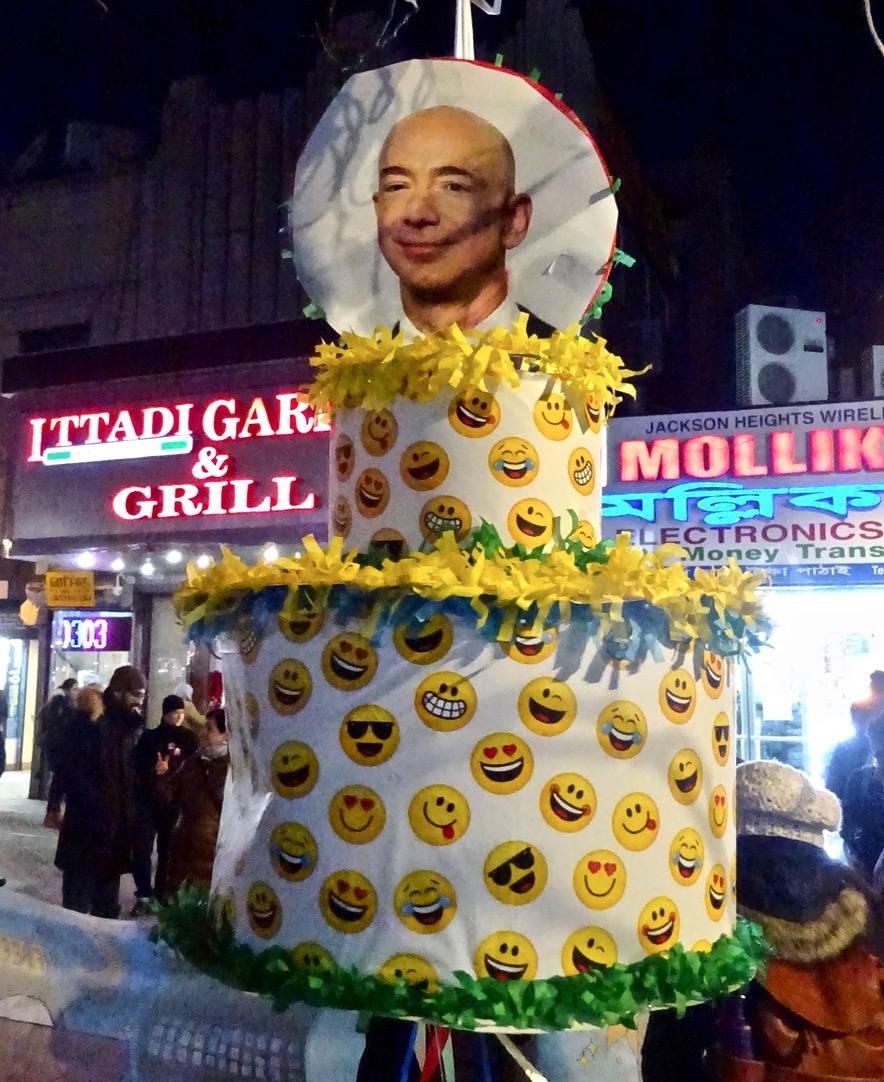
It begins, "A piñata hangs from a tree on Diversity Plaza in Jackson Heights, Queens. It is decorated with the face of Amazon CEO Jeff Bezos and by the end of Thursday night it will meet the fate of all piñatas."

Read the rest here


Saturday, July 21, 2018

Targeting the East Village

Jane Jacobs is rolling in her grave today. The Target chain has opened a store on 14th Street and Avenue A, and for their grand celebration they have committed what might be the most deplorable commodification of local neighborhood culture I’ve ever witnessed.


Along the first floor of Extell’s luxury monster, known as EVGB for the Trumpian claim of “East Village’s Greatest Building,” Target has constructed a simulacrum of the hyper-local New York street--the sort of street that is being wiped out by corporations and developers--and it comes complete with all the signifiers.

The façade is draped in vinyl sheets printed with images of tenements, the same sort of buildings that get demolished to make room for such developments. Here they sit, hollow movie-set shells, below the shiny windows of the high-end rentals. They are the dead risen from the grave, zombies enlisted to work for the corporation.


A red newspaper kiosk announces the opening of the store with a fake newspaper (decorated with a bull’s-eyed water tower, as if hunters have it in their sights), and it brings to mind the lost kiosks of the vanished Village Voice.

There’s even a fake fire hydrant and red-painted park benches.

In front of an Alphabet City bull’s-eye mural, you can pose for pictures with props—a guitar, a record album, a slice of pizza printed on foamcore--the stuff of the once iconoclastic East Village.


Who are the people in your neighborhood?

There’s a storefront gypsy telling fortunes with Target-branded Tarot cards.

And on a pseudo stoop is a hip-hop dancer, his leg encircled with a Target-branded bandanna. At his feet are red buckets, marked with the Target logo, maybe for someone to later play with drumsticks in the style popularized by bucket drummer Larry Wright.


But worst of all, there’s a simulated CBGB, the celebrated punk club shuttered by a rent hike in 2006, replaced by the luxury John Varvatos store, and replicated in the Newark Airport as a theme restaurant for tourists.

This one boasts the famous awning, but it's printed with TRGT -- in the club’s iconic typeface, the western-style lettering created by owner Hilly Kristal’s ex-wife. (Restaurateur Daniel Boulud tried this in 2007 with DBGB on the Bowery, and the CBGB estate’s lawyer sent a cease-and-desist letter.)

Inside, TRGT is printed on t-shirts, but you can't buy those. You can only get free "bands."


However, it's not rock music bands they’re giving out, it’s hair bands, Band-Aids, and resistance bands.

I asked, “What kind of resistance?” thinking of the political climate at the moment, and the woman answered, “They’re resistance bands for doing exercise.”


This Potemkin Village from Hell is guarded by three private security guards, all dressed in black suits with Secret Service-style earpieces, and one officer from the NYPD. All the workers are relentlessly sunny, like actors at Disneyland.

And people are streaming in for the free stuff—who doesn’t want free stuff?—happy to adorn themselves with the red sunglasses and branded bandannas as they rush into the store, where the commodification continues.

An East Village-themed mural provides a backdrop for the cash registers, decorated with street signs and hot dogs, more tenements, "NYC Nuyoricans," Theatre 80 St. Marks, and a book with the words “Poets Café.”

To see the artifacts of my own life, my cultural and spiritual awakening, my home, displayed above the cash registers in a Target store is to be cast into a state of confusion and dystopic dysphoria. What am I seeing? Who are these people? What happened to the world?


Meanwhile, down the block, EVGB has spray-painted the sidewalk with ads promoting their amenities and their worldview with the slogans:

GREATEST BUILDING
GROUP BONDING
GORGEOUS BATHROOMS

GET BUFF
GET BUSY
GO BIG


They’ve constructed a bright arc of balloons and they're giving out free cotton candy with "snappy toppings" like Pop Rocks, Sparkle, and Mango Pixie Dust.

Many of the people in line can't afford the apartments here, which start at $3,695 per month for a studio. They are neighborhood residents who've lost a number of affordable local businesses to this development, places like the Stuyvesant Grocery, a laundromat, a hair salon, the Rainbow discount store, Bargain Express, and the Blarney Cove.

But today there is a bright and shiny simulation of the real and the local. There is cotton candy and free trinkets. Bread and circuses that appease--and even win over. And everyone is having a terrific time.

As Margaret Thatcher said, "Economics are the method; the object is to change the heart and soul."


Monday, August 29, 2016

Vacant New York

If you look around the city, or follow this blog, you know that New York's small businesses are being wiped out by unregulated sky-high rents. The spaces then sit empty for months, sometimes years, warehoused by landlords who let the streetscape die while they wait for big chains to move in. At #SaveNYC, we've been pressuring City Hall to do something about a problem that Tim Wu at The New Yorker dubbed "high-rent blight."

Now Justin Levinson has added ammunition to the fight--an invaluable tool called "Vacant New York." It's an interactive map that shows where the high-rent blight is. In short, it's everywhere.


Justin is a 34-year-old computer programmer who has lived in the city for 11 years. He and I chatted over Facebook:

JM: What prompted you to do the project? What was your "final straw"?

JL: I think the anger and upset that you and I feel about the changes in the city were an undercurrent and a driver, but the last push was curiosity. I had been digging through the open data sets that the city puts out, and saw all the building footprints. I had been wandering around and saw favorite places that were closed and replaced with nothing. I wanted to see if it was really as bad as it looked.

JM: How has the response been since Vacant New York went out to the public?

JL: Surprisingly positive. I've gotten e-mails from the usual news outlets and such, but also from a lawyer, a chef, store owners. It's clearly something people are already aware of and passionate about. The project has been kind of a lightning rod for the issue, but it's clearly in the air. I just saw the Tribeca Citizen's new crop of vacant storefront photos, and the Times just put out an article (quoting you) after Tekserve went.

JM: People are frustrated about it, but no one knows what to do. One of the myths I've been trying to fight is this idea that it's just "natural," due to "market forces."

JL: I ran up against the not knowing what to do problem as well. Early feedback I got in a sneak preview was: “Right, but so what? What do we do?” And I didn't have a great answer. “Write your senator” seems ineffective.

JM: I do believe something can be done. But I can’t figure out how high-rent blight can make sense financially for landlords. What’s the incentive? I’ve heard there’s a tax break for commercial vacancies.

JL: I haven't heard about a tax break per se, but I do know that if you have a portfolio of properties bringing in revenue, offsetting it with anything you can find brings your tax bill down. So those “losses” on the vacant storefronts would reduce the company's net income, but I'm not sure how that's calculated.

JM: So the empty storefronts are “losses” that reduce income and that reduces the taxes? I am no accountant.

JL: I have a couple of accountant friends. I should buy them lunch and go over this. I'm sure it's a specialized and esoteric set of tax laws. The other possibility is they've got enough free cash to weather the minor maintenance of an empty property in the hopes that a bigger fish coming in later is going to make it all worthwhile.

JM: We're not talking about the mom-and-pop landlord, but major developers and hedgefunds.

JL: If you happen to own one building, your approach is very different. The landlord of the place where I work and run a community space is an incredibly stand-up guy who inherited the building from his father and is hell-bent on creating a real community in his building. He 100% could not weather more than a couple months without a tenant in the retail space.


JM: So what do we do about high-rent blight? London, I think, might be trying something.

JL: That is the multi-billion-dollar question. There's obviously not an amazing, simple answer, or we would have done it. I come from a startup and tech background, so I'm a big fan of small experiments. Trying to make a sweeping regulatory change across the city is going to be hard and politically difficult, so I'm wondering if there's a way to give something a shot in a district or two and see how it goes.

I think the blight is also different in different areas. The reports I got from readers about Smith Street in Brooklyn say it's common there, but I bet the ownership looks different than SoHo. We'd need to tailor a solution to the neighborhood.

JM: It seems like it's happening in neighborhoods where hyper-gentrification happened first--or fast. SoHo, the Village, the Upper West Side. I'd like to see a city-wide tax on storefronts left vacant for longer than, say, 6 months. But you're right, the administration isn't going to go for that. We are in a political and economic climate that is hostile to small business.

JL: It's happening lots of other places, too. My girlfriend grew up in Toronto and I went to school in Rochester, so I've seen some pretty sweeping changes there. The downtown core is a canyon of glass and steel.

JM: It's definitely global. In the course of writing my book on Vanishing New York, I've come to the conclusion that this is the impact of globalized neoliberalism--the whole anti-regulation, "free market," "trickle down" problem that's caused such a mess in the world. It convinces people that "this is natural and inevitable," when it is really the result of specific policies.

JL: I really want to see something tried. Start with some place that already has a strong sense of community--Park Slope, the East Village, Tribeca--and see if we can swing the tide backwards. Put in a vacancy tax, give breaks to businesses who own less than X outlets, something.

There's only a couple of tools that I see the administration having--taxes and regulation. And regulation takes forever to implement and always gets watered down.

JM: Regulation gets watered down in this anti-regulation system we're in. But it wasn't always that way.

JL: When was it different?

JM: Things really changed in the 1980s. The city was restructured after the crisis of the 1970s. Before, New York took care of its people. After, New York took care of big business, developers, and tourists. That's a very different approach.

The economic environment we're in today is not the only one we've ever had. There is an alternative. When I've suggested commercial rent control, people flip out. “You could never!” But we did. New York City had commercial rent control for years after World War II.

JL: Wow, I did not know that.

JM: The city implemented commercial rent control as an emergency measure to protect businesses. Do you think, after making your map, we're in an emergency today?

JL: Not an emergency in the four-alarm fire sense. More of a climate-change emergency. It's been a long, slow process to get where we are, and we're tracking towards a disaster if we don't shift course.

A problem is that, while nobody is fine with sea-level rise and major storms, there are plenty of people who seem to be fine with nothing but bank branches and chain restaurants.


JM: How would you characterize that coming disaster? What future do you see for New York if we don't make a change?

JL: Having unaffordable vacancies is effectively the same as having no vacancies as far as small business is concerned. There's no space to get a foothold. So nobody can take risks, and we get nothing but the tried-and-true businesses (i.e., chains) that seem to be taking over. It's like Hollywood. Movies are so incredibly expensive to make that we just get reboots and sequels.

There’s a strange dichotomy between the image of New York as a place where you can be your own weird self, and there's space to do that, versus all of the weird and unique stuff slowly being squeezed out.

JM: What brought you to New York? I'm guessing it wasn't the chain stores.

JL: Gravity, I think. I grew up not far away, and I remember coming into the East Village in the ‘90s to see shows, shopping at Yellow Rat Bastard, and taking a class at SVA where the teacher suggested we steal our books. To a teenager from the suburbs, that all seems awesome. I moved here after graduation for a terrible corporate job, but I could do what I wanted after hours: midnight bike races, weird DVDs from Kim's Video, and Reverend Jen's Anti-Slam in the basement of Cake Shop.

It was the fact that, no matter what you were into, there were a few hundred other people that loved it, too, and you could be part of that community.

JM: I think sometimes that many people come to New York now because there's a Starbucks on every other corner. People seem to want that.

JL: It really is weird to me--coming all the way here and spending insane amounts of money to stay in a hotel and eating at the same Olive Garden as back home?

JM: That is something I'm trying to get my head around. Okay, last question: What do you hope your project will achieve?

JL: Ideas are much harder to grasp than concrete examples. We're seeing isolated reports and grumblings from around the city about the blight problem, but it's easy to dismiss that as existing in isolation. If this project can get people--citizens and government--to say, "Wow, that does look pretty bad. We should fix that," it's a big step. If there's a push at the policy level to implement changes, even on a trial basis, and they point to evidence that includes this map as their reasons for doing so, I'd be ecstatic.

It's hard to not throw your hands up and say it's unfixable, there's too much money, etc. But that seems like tossing in the towel, and the encouragement I've gotten from just a couple of small business owners in response to this says it's not time for that yet.


Get involved. Visit Vacant New York and go to #SaveNYC where we've made it easy for you to write the mayor and more.

Monday, August 15, 2016

Zombie Urbanism

Jonny Aspen, Associate Professor at the Institute of Urbanism and Landscape in Oslo, Norway, coined the term "Zombie Urbanism" in 2013 to describe the way many urban environments are being designed today. I like the term, so I got in touch with Aspen and asked him about it--and how it applies to the redesigning of New York City, including the High Line, Hudson Yards, Times Square, and the new Astor Place.


Astor Place


Q: Can you give a definition of what you call "zombie urbanism"?

A: I’ve coined the concept in order to encircle what seems to be an increasingly more prevalent, and increasingly more worrying, phenomenon in contemporary urban development, namely the cliché-like way that many developers and designers talk about and deal with urban environments in general and public areas and places more specifically.

On the one hand I use it as a reference to what seems to have developed into an increasingly more homogeneous discourse, globally speaking, on what is believed to be important features of the so-called “creative city.” It’s a discourse that highlights the importance of cultural institutions, state-of-the-art architecture, and well-designed public places.

The concepts in use remind me of what the famous German sociologist Ulrich Beck has labeled “zombie concepts,” with reference to the social sciences. They are concepts that still are very much in use, but actually no longer fit the reality they intend to describe. As such the concepts are like the living dead, they are alive in our heads and our language, but not any longer useful for making precise propositions about the reality of the city.

On the other hand I use the concept of “zombie-urbanism” as a reference to how I experience many of the urban environments that come out from such a discourse, as built environments. What we can see is a kind of staged urbanism in which there is no room for irregularity and the unexpected, a well-designed, neat, and tedious urbanism based on a simplified understanding of the urban combined with more ideal aspirations about creating “living” and “people friendly” cities. You can see it in quite many urban redevelopment projects all over the world. Other examples can be found in strategies for remaking public places and plazas, such as for instance the recent developments of Times Square in New York.


Times Square


Q: What do you think is allowing zombie urbanism to spread across western cities today?

A: In general, the phenomenon is related to the current regime of neoliberal urban development and planning. This is a regime in which both developers and urban politicians quite shamelessly use urban features such as public squares and plazas as means for selling, marketing and branding. As such quite many aspects of “urbanism” have become subject to strategies of commercialization and capital manipulation. This development is of course also related to the seemingly never-ending spread of gentrification, or to what Neil Smith calls “generalized gentrification.”

The same goes, of course, for tourism, as an increasingly more important global industry.

Another important aspect, if not a cause in itself, is that quite many planners, architects, and designers seem to profit from such a development. They seem to have found themselves a new niche in designing urban tableaus of various kinds.


High Line, via urban75


Q: Where did you see these developments during your time in New York City?

A: I saw such developments most clearly in newly built areas, and especially in ones that contain public spaces and facilities. One such development is the Hunter’s Point South Park in Queens. I am particularly thinking about the promenade along the East River. Everything here looks clean, tidy, and civilized. The promenade is also equipped with well-designed chairs and benches. So everything seems in order, everything seems to make for a lively urban area. But even though the scenery is outstanding, especially the view towards Manhattan, the whole area feels dull and boring.

This is what I mean by zombie urbanism. Everything looks nice and urban, but in terms of social life, it’s rather sterile and dead.

A similar example can be found a bit further down the river, on the Manhattan side--the East River Waterfront Esplanade, especially the new Pier 15 that opened in 2011. The whole development is imbued with a well-meant rhetoric of making the waterfront accessible for all people, improving qualities of life, sustainability, and community programming. But again, the end result seems rather lackluster and limited. My impression is that most of the esplanade primarily is made to attract conventional recreational interest of tourists and middle-class groups that now seem to have taken over most of Manhattan.

Much of what’s here said also goes for the High Line and the Times Square redevelopment, though those stories probably are a bit more complex.

Besides such examples, the most obvious features of what I call zombie urbanism can be seen in many plans and prospects for future buildings and developments, especially when it comes to visualizing all the splendid qualities that the project allegedly will bring to the area when completed. Visualizations of public space qualities seem to have become increasingly important in this respect. In this way planners and developers deliberately use public space qualities as a way of both legitimizing and branding a future project. By highlighting all the fantastic urban qualities a development will bring to the neighborhood or to the city as such, any objections and criticisms that people might have towards the project are also curbed. Because who could really be against the planning of a new public space or a playground?

This has become a global trend. Just take a look at the plans for the new development at South Street Seaport or Hudson Yards in Manhattan.


The "Seaport of Tomorrow"


Q: What are the hallmarks of zombie urbanism? How do we recognize it when we see it?

A: This is harder to answer, because it’s not so that zombie urbanism is something that can be clearly pointed out as something that exists like a thing in the world. Zombie urbanism is a theoretical concept that, in the way I seek to use it, represents an effort to capture and put into words some important changes in the way our urban environments are produced as well as experienced.

For me, the latter issue of how we experience the urban world is especially important. This is what I’m trying to find ways of describing. Issues of feelings, affects, and atmospheres then become important, though they are not easily captured or put into words. I don’t want to become too philosophical about this, but the issues here at stake also relate to what each and one of us believe to be more or less genuine and authentic.

Why does the new Starbucks on the corner seem to be less authentic than the old coffee shop that it has replaced? It’s easy to pinpoint a range of issues and features that makes it so, but what it is that really makes the big difference might be harder to identify. Much the same goes for the topic of zombie urbanism. In general, my argument is that our urban life world increasingly seems to be staged in accordance with global clichés about urban environments and urban living. This is what worries me, and this is what needs to be further explored.


Astor Place


Q: Recently, in the East Village, Astor Place has been redesigned. This was years in the making. They removed part of the street, widened the central square, planted trees, put in concrete slab seating, and tables with umbrellas. It is now used by corporations like IBM and Citibank to hold “advertainment" events.

I'm pretty sure this is a prime example of zombie urbanism. But some would argue that it's a good thing--those slab benches and tables are full of people. How do we claim this is not an authentic and lively urban scene?


A: I agree that the remaking of Astor Place seems to be a good example of zombie urbanism. I would have to make some reservations due to the fact that I haven't seen the end result myself. But from what I can see from pictures and descriptions on the net, the makeover of the area resembles much of what I would call zombie urbanism. So what makes it zombie-like?

The most telling point is that the overall design solutions seem to be very generic. The whole place seems to play up design schemes for public places that are quite similar in many parts of the world. It is the same ingredients that are replicated all over: widened sidewalks, new seating, more plantings, upgraded lighting and so on, plus an attraction or two, may be an artwork or something, that apparently is to make the area stand out as something unique and special. My experience is that such places more often than not make for a fairly limited spectrum of public uses and activities.

City life is about encountering the unexpected and the unfamiliar. I'm not quite sure Astor Place will be the right place to visit in that respect.

Such forms of public design, even though many might see them as improvements, are damaging in that they block more creative ways of going about making public places. Instead of taking on the challenge of really involving people and working seriously with how to make places that are both socially mixed and inclusive, one settles with established urban design solutions, often prescribed by international consultancies.

When it comes to New York it might be that it's such a dynamic city, one can live or cope with a few zombie-like design solutions, such as at Astor Place, just because the places often will be put quite extensively to use. As such, the places themselves will continuously be in a state of flux and change, despite the way they are designed.

It's comforting to know that people will overrule the prescriptions of planners and designers. That's what urban living is very much about.


Astor Place

Monday, July 18, 2016

Astor Place Farce

As I've written about here before, the redesigned Astor Place is shaping up to be a neoliberalized theme park disguised as an open public space. We've watched the process develop over the past few years, and now it's about to reach its hideous completion.


design rendering

Here's the latest scuttlebutt on the project from long-time reader Liberation:

"I was told by someone who works for Village Alliance that, when eventually complete, the new Astor Place will have a variety of food vendors, outdoor tables and chairs, and some type of lighting scheme. There's a large electrical box on the north east corner of Chase that will power all of this. The Village Alliance and some type of committee at the Sculpture for Living building decide who these food vendors are and, in general, decide what takes place in the area.

One bit of news I found shocking is that they have allegedly altered The Alamo sculpture so it will now include some type of lighting. According to the Village Alliance employee the sculpture will also rotate on its own now, as he said people have hurt their backs trying to spin it. Personally, I find it unethical to alter an artist's work to make it appear more like a theme park attraction."


Astor Place, 1998, photo by Alex at Flaming Pablum

It sounds like a joke. It has to be a joke, right?

The Alamo, the famous Cube, turned by skate punks and college students from the beginning of time, will now rotate robotically so the new East Villagers don't throw their backs out? A scrappy piece of public art that has been loved into realness by the rough hands of city kids, covered in graffiti, kicked, climbed upon, and even yarn bombed, will now be floodlit and mechanized, like a plastic ballerina turning in a music box? It is almost impossible to believe. Could it be true?

More egregious, however, is the report that "some type of committee at the Sculpture for Living building" will be making the decisions about who is allowed to occupy and profit from this supposedly public space.

The Sculpture for Living is the 21-story "green monster" luxury condo tower on Astor Place, the first in a set of massive, out-of-context new construction here. It contains a "limited collection of 39 museum-quality loft residences," originally priced between $1,995,000 to over $6,500,000. "It doesn’t belong in the neighborhood,” critic Paul Goldberger wrote at its opening. “...the architect has destroyed the illusion that this neighborhood, which underwent gentrification long ago, is now anything other than a place for the rich.”

And now those rich residents will dictate how the public will use Astor Place, historic site of riots and protests, over a century of dissent? If the report is true, it would represent a massive betrayal of the people by City Hall.

The betrayal began some 15 years ago, when the city and Cooper Union colluded to rezone and redesign Astor Place for the purpose of upscaling it and making it profitable for a very few. East Villagers fought back. Many said "the large-scale development would turn their eclectic, artistic neighborhood into a sterile business campus."

That's exactly what has happened. Now we have the 400,000-square-foot 51 Astor Place, known locally as The Death Star, full of chain stores and featuring a bland corporate plaza. Now we have real-estate brokers and developers calling Astor Place "Midtown South."


The Marxist urban theorist Henri Lefebvre wrote that a city is a “place of desire, permanent disequilibrium, seat of the dissolution of normalities and constraints, the moment of play and of the unpredictable.”

This is exactly what is being destroyed in New York today--and especially during the years of Bloomberg and Burden. From one end of town to the other, unpredictability has been steamrolled by the tight constraints of design. Our public spaces are being privatized in stealth--they may look open, but look closer and you'll see the mechanisms of closure and control. Security guards, surveillance cameras, corporate events, the uniformity of design elements; and, of course, the private committees of wealthy property owners that quasi-secretly dictate so-called public use of our space (see Washington Square Park, the High Line, etc.).

What have we allowed to happen to our city? Why are we not taking up cudgels and storming Astor Place? Oh, just eat another cupcake. I'll have another latte. Any feelings of injustice will soon fade.

To quote Luc Sante:
“The past, whatever its drawbacks, was wild. By contrast, the present is farmed. The exigencies of money and the proclivities of bureaucrats—as terrified of anomalies as of germs, chaos, dissipation, laughter, unanswerable questions—have conspired to create the conditions for stasis, to sanitize the city to the point where there will be no surprises, no hazards, no spontaneous outbreaks, no weeds… As a consequence of these and other changes, we have forgotten what a city was.”


UPDATE: William Kelley, executive director of the Village Alliance, writes to EV Grieve:

"The Alamo sculpture should return in August, and it is exactly the same as it was before. There are no lights and the spinning mechanism is human powered, just like before. It received a thorough cleaning and coating to protect it from the weather and will return in good shape. Also coming in August, there will be bistro tables, chairs and umbrellas for use by the public, much like you see in other plazas around the city.

Finally, there will be a single food concession in the north and south plaza spaces at Astor Place (not around Cooper Square or points south) pursuant to the license agreement with NYCDOT. No other vending will be allowed on the plazas."

Previously:
Astor Place Redesign
Battle for Astor Place