Showing posts sorted by relevance for query Yankees. Sort by date Show all posts

Monday, September 22, 2008

Yankee Stadium

The Yankees have left the stadium.

Fans today are grieving for the sacred soil as they look forward to the handsome new ballpark, which physically resembles the 1923 original, gut-renovated in the 1970s, though spiritually it will resemble something more like a luxury spa for the very wealthy.


Says one angry sports writer:

"The Yankees are blowtorching all this glorious history--not to mention the unmatchable history generated by Yankee Stadium I--for luxury boxes and premium seats. Those 8 million people passing through the Yankee Stadium turnstiles the past two years? The wrong kind of people.

Modern sports economics have no interest--absolutely none--in the common man. You do not matter. The Yankees are only interested in the kind of people who will populate the luxury suites and who will pay somewhere between $500 and $2,500 per person, per game, to sit in the first five to eight rows of the new ballpark. These are the kind of people who, as a Yankee Stadium website explains, will get 'an exclusive experience for those with discerning taste who seek the very best that life has to offer.'

In the new ballpark, people in the 1800 Legends Field Suite seats 'will delight in the premium amenities, including cushioned seats with teak arms, in-seat wait service, concierge services, private restrooms and a delectable selection of all-inclusive food and beverages.' For these people there will be, of course, a 'private entrance, elevator and concourse.'"

But that's from the Boston Globe.


new stadium images

For some reason, most New Yorkers just don't seem angry about what's happening in the Bronx. I went up for a visit to say goodbye this weekend. Fans were ebullient, drinking at Stan's, with no air of sadness or impending doom. I don't know--maybe people want seats with teak arms.

The old seats were nothing fancy. Not the ones from the original stadium and not the ones from the renovated stadium. When the original was gutted in 1974, the chairs were sold cheap--only $7.50 (plus 5 empty packs of Winstons) at Korvettes discount stores:


The new old ones are expected to go for $1,000 apiece at auction:


New York Magazine predicts the big yard sale will net $50 million. Think they'll pay back the taxpayers who are floating the demolition and construction?
  • For great pics of the old, old stadium, click here.

Thursday, November 5, 2009

Bella's Luncheonette

I've written here before about the feelings I have (and had) for Elizabeth Street. In this post about the street's massive hyper-gentrification, I mentioned the closure of Bella's luncheonette and its 1998 transformation to Cafe Habana as a watershed moment.

From my stash of non-digital photos, these are the only shots I ever took of Bella's, both from the exterior.


The ghost of the HOME COOKING sign remains today, but the rest is gone. "Drink Coca-Cola" and "BELLAS COFFEE SHOP" have vanished.

I wish I had pictures of the interior. I remember a counter with swivel stools and a clock on the wall that advertised St. Joseph aspirin.


I remember sitting at the window eating a cheeseburger after walking back from the 1996 Yankees victory parade and seeing Jim Jarmusch walk by--an event which was, in some ways, more exciting than the Yankees parade.

Tuesday, May 19, 2015

Tony's Park Barber Shop

Now and then, when I get the chance, I like to visit old barber shops in other neighborhoods and get my hair cut.


Tony's Park Barber Shop, on Fifth Avenue in Sunset Park, Brooklyn, has been here "over 100 years," according to owner Tony Garofalo, who has been with the shop for just over 50 of those years.


The place is beautiful, in the way that old places are beautiful, filled with antiques and souvenirs.

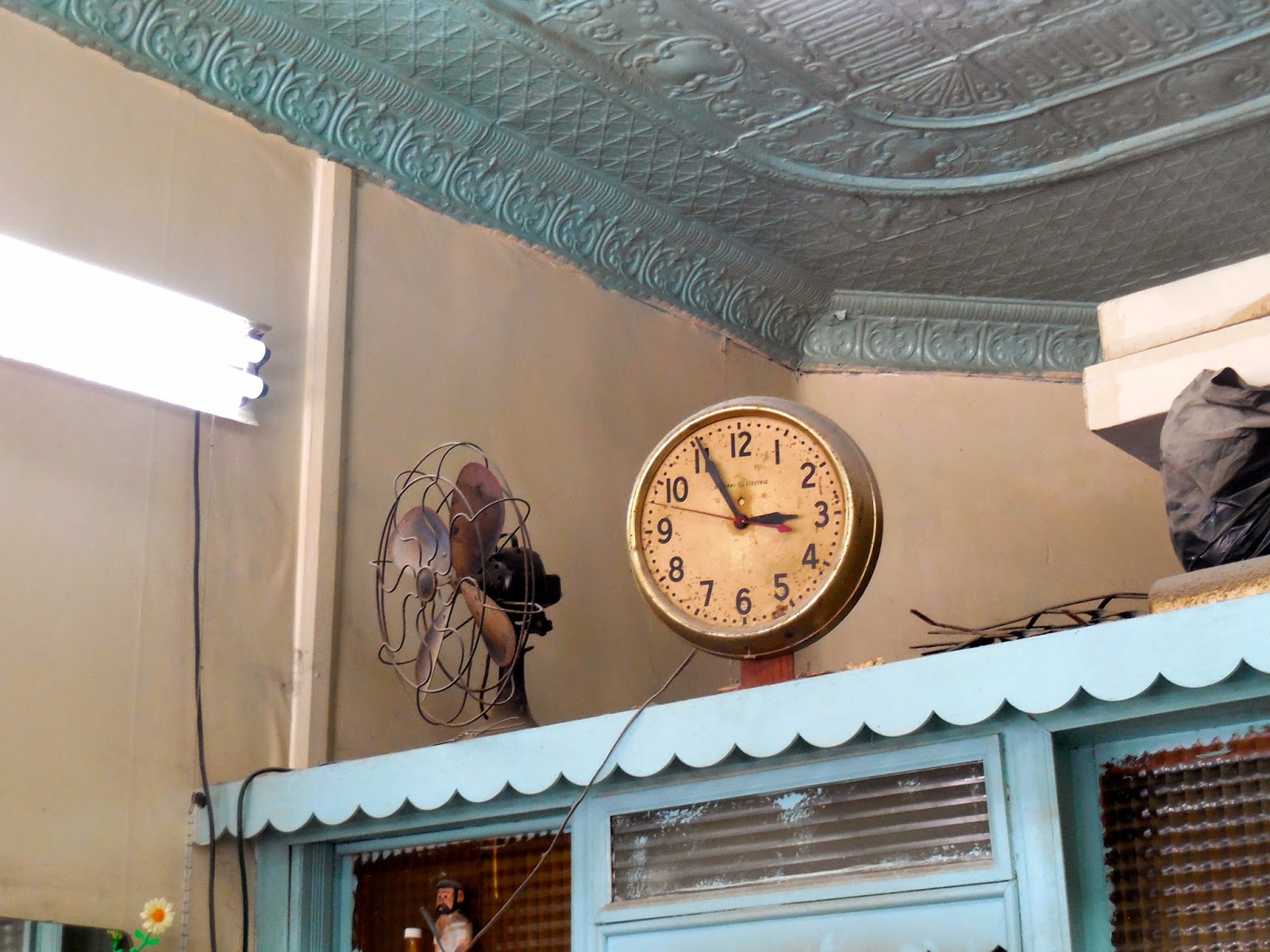
It's painted robin's egg blue and topped with an extravagantly detailed pressed-tin ceiling. The ancient green barber chairs match the cabinetry, where windows read: "Sterilizer."


A busted wooden cash register sits unused next to a Yankees cap, under a note for "No Refunds."

On one wall, above the chairs for waiting customers, a faded sign reads, "Please control your children."


Simon Doolittle at The Brooklyn Paper did a nice piece on Tony and his shop back in 2008:

"Tony 'Felice' Garofalo has done well for himself. He left Italy after World War II and stayed in Switzerland until he was 26, emigrating to Brooklyn in 1964.

Within a week of his arriving, Garofalo got a job in what is now his barbershop, located on Fifth Avenue between 44th and 45th streets. He bought it less than a year later, for $1,800, from another Italian immigrant.

Working a second job loading beer trucks, he bought the building several years later for $35,000. He now owns the salon and the seven apartments above it. Garofalo’s English today bears the imprint of both Italy and Brooklyn. Speaking of his customers who return for haircuts, he said, 'They still-a come here — from Staten Island, from New Joisey.'"


A haircut here still costs just $10. For that price, you get the feeling of being cast back in time.


Tuesday, January 29, 2008

Gino the Royal Tailor

For 40 years, Gino DiGirolamo had a busy, cluttered tailor shop on Avenue A near the corner of 12th Street. In late 2006, his landlord moved him out to a new space on 14th Street between A & B. That’s where you’ll find him now, at the Royal Tailor shop, chatting with customers in English so broken it’s utterly scrambled, peppering his talk with Italian words brought over from his native Palermo.


He wears a measuring tape around his neck. He has two televisions sitting one on top of the other. His walls are covered with pictures of the Italian soccer team, boxer Rocky Marciano, and a poster showing popular lengths of sleeves and trouser legs.


A gray-haired woman sits with him. While customers are present, she is silent. But after the customer leaves the shop, she gets up and berates Gino, telling him what he’s doing wrong and asking why can’t he do things the way she says. The tailor just smiles.

He seems happy with the way business is going on 14th Street, but he liked his old spot better. After a year, the abandoned shop is still empty, a FOR RENT sign hanging overhead. In fact, all four commercial corners of 12th and A have been empty for at least the past year. People wonder what’s happening there.


One Livejournaler who used to live on the corner noticed recently that his building has been almost completely emptied of residents. He also reminds us that Mary Help of Christians Church and flea market were sold “under rumors that the land was being bought for a condo development and/or NYU dorms.”

I asked a man I encountered emerging from the basement and he denied such rumors, saying Gino's old space would be rented soon. (*Read this update for the answer.)


Whatever is happening on those long-shuttered corners, Gino's tailor shop won't be returning. He'll be staying on 14th Street. For now.

Watch Gino on Youtube in these short films by Matthew Handal:

Wednesday, March 9, 2011

Billy Martin's

According to a press release, Billy Martin's upscale Western wear store, a favorite of celebrities like Billy Bob Thornton and Bruce Springsteen, is leaving the Upper East Side after 32 years.


New York Magazine

Opened in 1978, the shop was founded by former New York Yankees manager Billy Martin. Co-owner Doug Newton credits Mickey Mantle with the idea.

Newton, Martin, and Mantle were celebrating at PJ Clarke's, said Newton, and "Mantle was wearing cowboy boots because he was an Oklahoman and country boy at heart. I wore them because I came from Colorado, and Billy wore boots because Mickey did." Mantle noticed that none of the fans who came to their table were wearing cowboy boots. He figured the footwear would be a hit in New York City.


1979

Said Newton, "And when you add in 'extra sales and profits' from western shirts, belts, buckles and hats--Billy chimed in--we could be on easy street and George Steinbrenner, his boss and nemesis, can go herd cats, or something."

Then the "urban cowboy rage" swept into town and they were a success.


1980

In the recent press release, Mr. Newton said, "The closing is a result of several factors, but the bottom line is that our bottom line was not in the black."

Tuesday, March 22, 2011

Loews Mayfair

It's not just the secret porno theater at Playland Gifts that makes the block of 7th Avenue between 47th and 48th Streets a treasure trove of old Times Square for casual urban archaeologists. There's much more here. On my recent visit to the block I came upon some artifacts from the lost Loew's Mayfair theater.


NYPL, c. 1935

The marquee is gone, yet the terracotta remains, tucked up behind scaffolding and giant billboards above what is now the Phantom of Broadway souvenir shop.


But it's the interior that is most exciting. Like the nearby fossils of the lost Automat hidden in plain sight at another souvenir store, you can find bits and pieces of the Mayfair's lobby here. Right inside the door, look up through the cacophony of TV screens and glittery T-shirts--the ceiling is painted with stars and carved with scrollwork.


Each decorative spear comes down to a pointed church-like window, from which people must have looked out from the mezzanine years ago.


And each former window has a lavish grill, now used to house a ventilation system. Today the mezzanine is for storing stock and selling sports memorabilia. Mannequin heads in Yankees caps peer down on the tourists.


Upstairs, in the sports souvenirs section, the decorative scrolls of the mezzanine grills continue on a fragment of banister that might once have led to the balcony.


Here, the ceiling is painted black and obscured by hanging lights, making it hard to see the carvings.


At Gotham Lost & Found, author David Freeland discovered more parts of the Mayfair around the corner, inside Famous Dave's Bar-B-Que restaurant.

The Mayfair was originally a big theater, with a marquee that went from 7th Avenue and around along 47th Street. Writes Freeland, "Early in its life the theater was known as the Columbia [click for pic], a vaudeville house of 1910 vintage (you can still see some of the Columbia’s original decorations on the building’s exterior), but in 1930 famed architect Thomas Lamb revamped the interior with a striking Art Deco theme."


NYPL, c. 1935

At some point, the theater's massive marquee was cut down--the corner of 7th and 47th given over to a Fruit Drinks stand, a necktie store, and other businesses--so that the only piece of marquee remained at the entrance, where the Phantom of Broadway souvenir shop stands now.


c. 1954

Many photographs exist of the Mayfair's exterior corner where the impressive wraparound billboard announced the movie of the moment. Photographers must have loved it--especially when it featured a three-dimensional spectacular, like this one starring the buxom Jane Russell.


c. 1955

There aren't many images of the theater taken after the 1950s. When the Mayfair became the DeMille in the 1960s, photographers seemed to lose interest. But it does turn up, here and there, in general shots of the block.

In this rare photo of it as the DeMille it is squeezed between a karate school (formerly a billiards parlor) with Showtime topless go-go girls on the first floor and an electronics store. There's the original 1910 vaudevillian terracotta that remains hidden under billboards today.


1970s

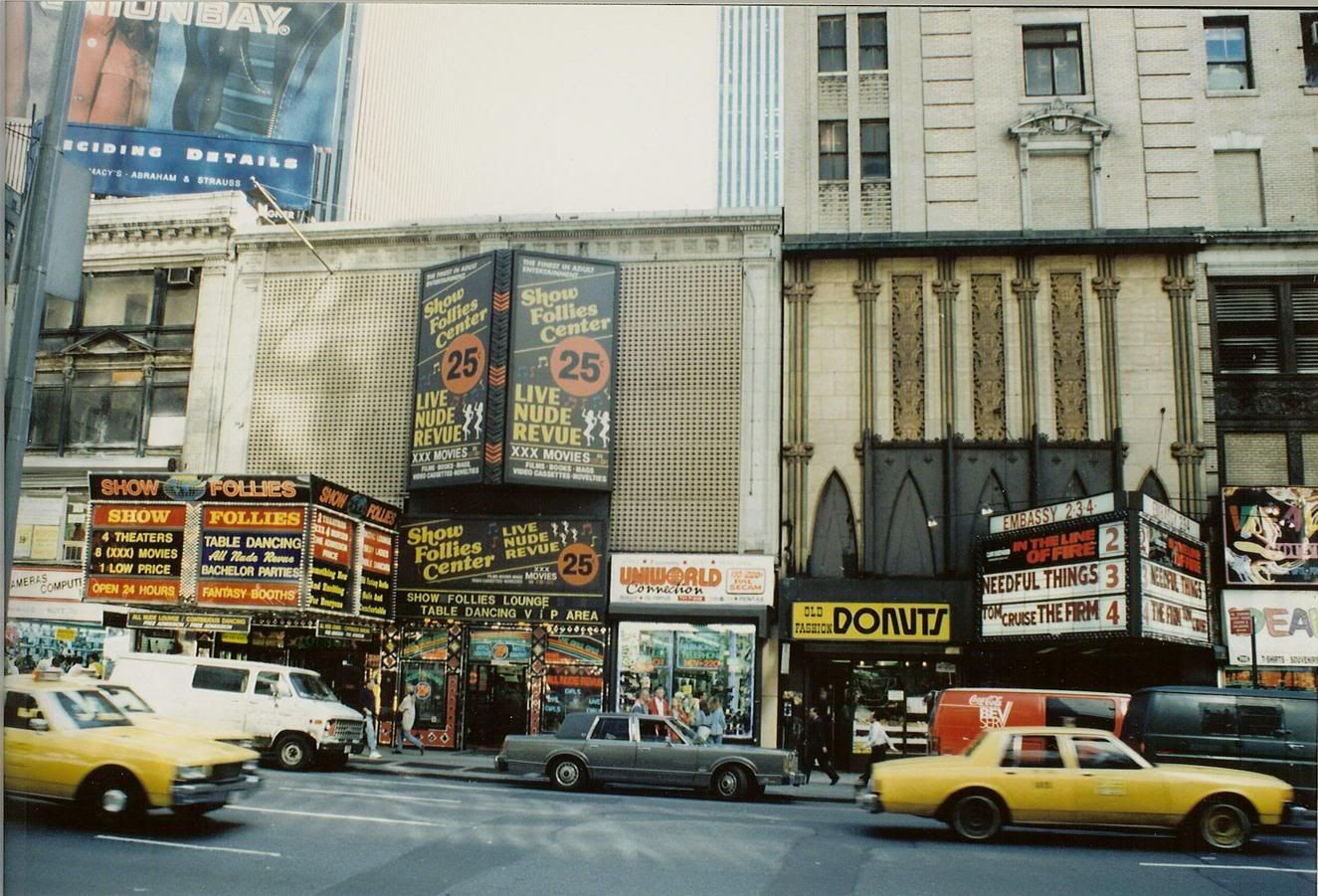
Finally, the Mayfair was chopped up into a triplex and became the Embassy 2-3-4, where in 1979 you could see The In-Laws, Dawn of the Dead, and Love at First Bite. By that time, it also housed a little doughnut shop, and its neighbor (the former karate school formerly a billiards parlor) had become the XXX Show Follies Center.


c. 1979

The Embassy was one of the last of Times Square's long-running movie houses to remain open, finally closing in 1998.

Amazingly, through all these changes, through many renovations and guttings, those artifacts still remain--the scrollworked ceiling, the grills, the bit of banister--all leftovers from Thomas Lamb's 1930 design, ghosts from another city.


photobucket, 1993

Friday, December 21, 2007

Julius' Bar


Now that Dick's bar has become the fratty 12th Street Ale House, where can you go for a gay dive-bar experience? The answer is Julius' bar on 10th and Waverly. In fact, go there for the vintage-bar experience, because Julius' is one of the oldest, unchanged bars in town.


No one seems to know when exactly it opened, but the best guess is 1867 -- the same year that the Jacob Ruppert Brewery opened in Yorkville, on the Upper East Side. Julius' tables, chairs, and bar are made from the brewery's wooden barrels and they're stamped "Jacob Ruppert." (The brewery was replaced by Ruppert Towers, an example of architectural "brutalism.") The footrail at Julius' bar is a string of beagles standing nose to tail and cast in brass. "We think the original owner liked beagles," the bartender told me. (Though the breed is debatable--some say those dogs are Bassett hounds).


One wall is covered with framed photographs of the once-famous. None of them were recognizable to me. They are slick-haired men and women in furs, a few naked burly-Q girls, a couple of boxers. The bar may have come out of the Civil War and gone through days as a speakeasy, but the feeling you get is very 1950s. On another wall, Walter Winchell tells you why he loves Julius' and Eddie Condon poses with '50s burlesque queen Lois DeFee.


There is little in Julius' that marks it as a gay men's bar. A softball trophy reads, "It's not easy being the queen," and the straw I got in my mug of Coke happened to be pink. If you go on a weekday morning (Julius' opens at 11:00), you'll encounter a few regulars, older men in Yankees caps who sit and talk about the weather. In the evenings, it's livelier and gayer, but no less gray. The kitchen, a grill in the corner, is cooking delicious burgers and fries, and the TV is tuned to Jeopardy.


Unlike other old bars, like McSorley's, Corner Bistro, and Chumley's, where you can only go during the day because the nights have been overtaken by frat boys, tourists, and girls with pointy shoes, Julius' has stayed authentic. I am sure that's due to the gay factor, which protects Julius' as one of New York's best-kept secrets. The patrons will not tolerate idiotic, yuppie behavior. These guys went through Stonewall -- they are not afraid to kick some hetero ass.


The bar is quiet enough and friendly enough that, if you're chatty, you can have fantastic conversations with men who knew the Village way back when. And who knows how long this will last? Julius' has survived building collapse and seizures, and the landlord seems to support the bar. Said the bartender, "As long as the owner of the building stays alive, Julius' will stay alive." He figures at least another decade.

Monday, April 6, 2009

Yankee Bars & Bowling

The Times just did a story about Stan's, the dive bar that has stood right outside the bleachers entrance of Yankee Stadium for 30 years. With the stadium rebuilt and moved, Stan's no longer has that prime real estate and the owners worry about losing business.


Stan's

Last fall, at the season's end, I visited the scruffy bunch of bars and souvenir stores outside the stadium, concerned that the change would leave them in the cold. It's not just Stan's we have to worry about.

What will happen to Ball Park Lanes?


the lanes


the front desk

Bowling alleys are vanishing all over town. One of the things that has kept this alley alive for so long is that it supplied fans with a much-needed bag check. Wrote the Times, "Ball Park Lanes has become the primary storage closet for Yankees fans carrying more than weighty expectations... John Gianos, the alley’s co-owner, figures that if someone is coming to check a bag, they might stick around for a beer. They might try a $4 burger at the grill. They might even think bowling is a good idea."

And at $5 a bag, in a world where people don't bowl like they used to, the baggage business must have been critical.


the lanes' lunch counter


the shoes

If I had to guess, I'd say the new, post-9/11 Yankee Stadium has its own bag check stations. And even if it doesn't, are people going to walk down to Ball Park Lanes to check their backpacks?

So, from the scrappy bars and souvenir shops of River Avenue, we may find another mass vanishing. They may shut down or adapt to the Stadium's upscale clientele, like the renovated Billy's, with its chandeliers and blue backlighting, attracting what another bar owner called "Midtown comes to the Bronx."


Billy's

See all my River Avenue pics here

Monday, June 14, 2010

Automat Fossils

In his invaluable book Automats, Taxi Dances, and Vaudeville, David Freeland of Gotham Lost & Found takes us into Times Square's Grand Slam, "the Number 1 tourist store in Manhattan." Next to the hideous new American Eagle Outfitters (replacer of HoJo's and much history), Grand Slam is three stories of New York souvenirs--snow globes, giant pencils, tons of Yankees stuff.

It also happens to be the site of the former Horn & Hardart Automat, the big one, the flagship, the glorious Times Square Automat. Most of its glories, however, have been covered up. Most of them, but not all.


Armed with camera, taking Freeland's words as a guide, I went inside to seek out the remnants of that lost landmark.


all color photos from my flickr

Of the smooth, brass-railed stairs, Freeland writes, “If the stairway appears proud, stranded amid the miles of tourist ephemera, it has a right. A genuine Broadway survivor, it can remember the days when ham sandwiches were sold instead of Zippo lighters, when troupes of matinee ladies in pillbox hats would sip coffee at front tables by the window, their conversation rising and falling against the happy squeals of children armed with nickels.”


Looking up, in all the clutter, you will see something remarkable.

Writes Freeland, “In the ceiling’s dead middle, clustered around a central pillar like a stalactite formation, twists a lovely design of blossoms and foliage, interspersed with tiny holes for the placement of incandescent bulbs…"


"...it is what’s left of the Art Nouveau centerpiece unveiled that long-ago morning of 2 July 1912, ignored but not yet willing to disappear."


Imagine taking away all the Big Apple sweatshirts, the "New York Princess" baseball caps, the yellow cab shot glasses and Wipe Out Terrorism rolls of toilet paper. Imagine replacing the racks of souvenirs with tables and chairs. Take the Derek Jeter posters from the walls and install automat dispensers of cream-cheese sandwiches and slices of key lime pie. You will see 1557 Broadway as it used to be:


from NYPL

For another Times Square artifact in a tourist shop, see: Secret Peeps.