Tuesday, February 4, 2014

Buttons and Art

At the He Zhen Snap Button Company at 166 Mott Street, Mr. Li (his name is He Zhen, but everyone calls him Mr. Li) has spent the past 32 years machine-stamping snaps, studs, and rivets into clothing. Any time I've walked by, there have been men inside, hanging out, talking, watching a televised soccer match. It's that kind of neighborhood place.


Recently, I went by to find an art gallery in the button shop's space. My heart sank, thinking that yet another gallery had taken over a mom-and-pop garment business, a trend that's been happening up and down the Lower East Side and into Chinatown. But something felt different about this one. I went inside and discovered a more compelling local story.

Above the paintings, stacked on shelves, are clear boxes crammed with buttons. Not props for authenticity's sake, this is the real thing. In the back room, Mr. Li still has his workshop, with a phalanx of stamping machines and a well-organized array of buttons on the walls and hanging in bags from the ceiling.


His daughter, Amy Li, runs the gallery. First-generation Chinese-American, Amy grew up on the same block as the button shop. She studied painting and art history at Hunter College, and recently received a master’s in arts administration from the Savannah College of Art and Design. Much of the work by artists in her current show, Karmic Play, takes off on images from popular culture: silkscreened Kim Kardashian heads done in Warhol style, Philip IV in a UPS uniform, t-shirts that read, "I AM BANKSY."

Amy opened her first show in September, planning to stop at just one and then relinquish the space back to her father. She was searching for a full-time job, but the artists' work sold so well, she took it as a sign to continue.
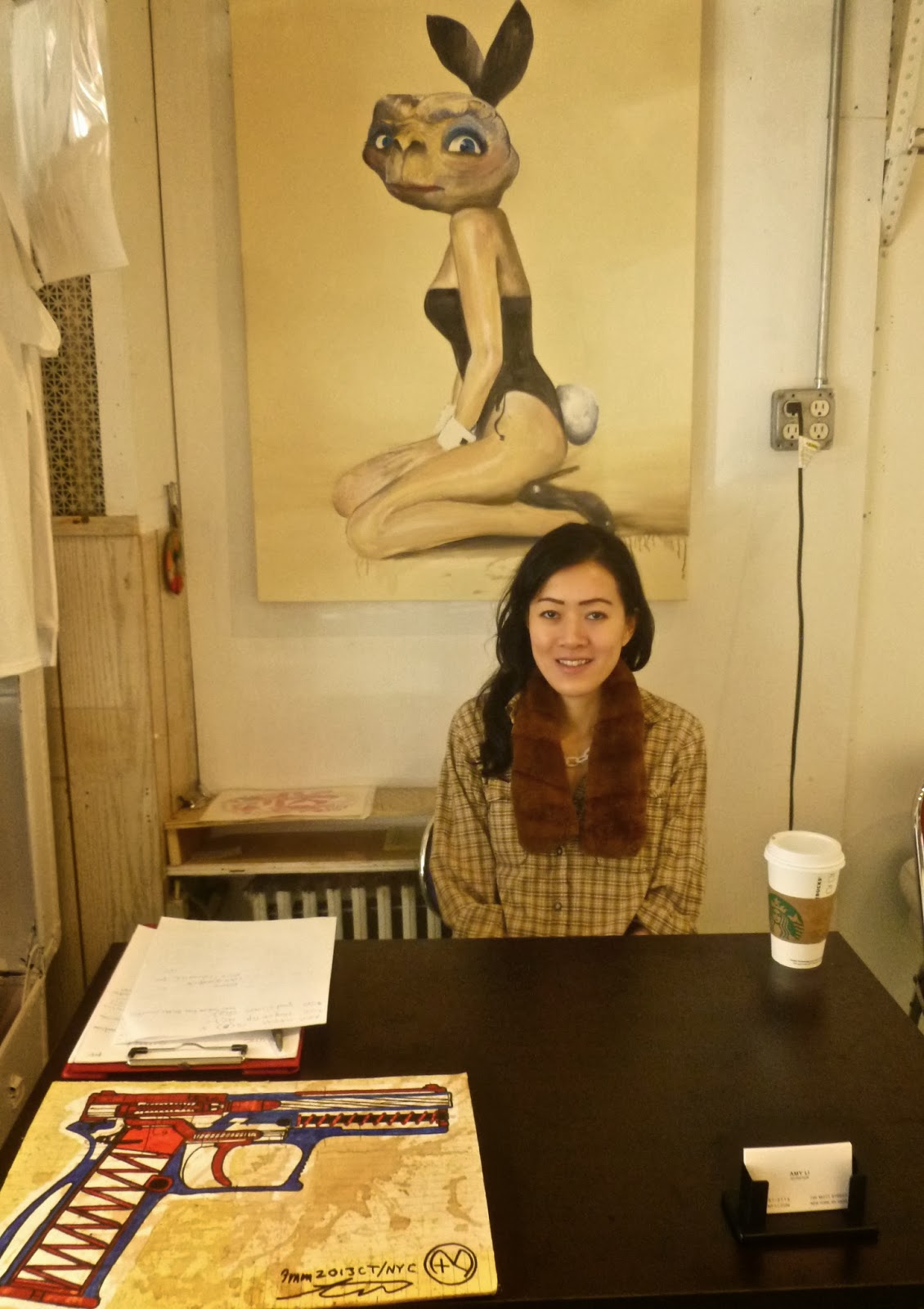


She and her dad co-exist peaceably in the shared space. At first, he needed some convincing to let her open shop. "I asked very nicely," Amy explained, "and promised not to do anything crazy. No performance art. I told him I wouldn't destroy the place."

"When I was growing up," she recalls, the shop "was packed with 6-foot-high piles of clothing. The clothes usually smelled like cat urine because the sweatshops that did the sewing beforehand raised cats. There were constant sounds of workers operating heavy machinery to apply metal buttons to the clothing. Today the business is mostly wholesale and small jobs applying buttons for fashion designers."


The button shop is known as a spot for neighbors to gather. Some might think it's a social club. As Amy said, "One of my friends always thought it was a club for old Chinese men to chain-smoke and watch television."

Though they can't watch TV in the shop anymore, the local community has been very supportive of Amy's endeavor. Some of her father's customers have worried that his business is closing. "I’ve had to do some explaining, but they like the idea of the gallery."


And selling art out of a functioning button shop has its advantages. "It has helped me stand out," says Amy, "and also provides character and personality. As a start-up, I would have failed if I sat in a white box. The button store attracts many visitors and allows me to have conversations with anyone who walks in. Artists think it’s a humble and cool space."

She hopes eventually to move to Chelsea or to open a second gallery there. She'd like a larger space for mounting solo exhibitions and bigger shows. Besides, she says, "I’ve been told that if I want to be anything, I can’t stay in a Chinatown button shop."


For more information about the gallery and its artists, please visit the Amy Li Projects online and at Facebook.

Monday, February 3, 2014

Slugger Ann

Reader Joe Preston writes in with photos of a vanished gem, "I thought you might find some interest in this photo of my Grandmother’s bar, Slugger Ann’s Bar & Grill, circa 1960 on the NW [correction: NE] corner of 12th Street & 2nd Avenue."


Slugger Ann's, photo courtesy of Joe Preston

Joe says, "She owned it from the early 50s until her death in 1980. She is also the grandmother of my first cousin and godfather, Jackie Curtis of the Warhol Factory. (Our Mothers were sisters.) Slugger Ann, as she is most famously known, was not only the super for this building, but the Village East Cinema diagonally across the street as well, where Jackie and Peter Hujar also lived. Jackie also lived in a small studio in this building, which has the address of 301 East 12th St. It was a first floor apartment."

He adds, "The Naked City TV series along with Kojak was filmed here many times."


shot from Naked City

After Slugger Ann's, the bar became Dick's, a gay dive that closed without warning in 2007. Now it's the fratty-looking 12th Street Ale House.

Melba LaRose recalled the bar to Warhol Stars, "It was a typical Lower East Side bar--this was before we called it the East Village. A lot of local characters hanging out, and Slugger was the biggest character of all. Jackie could often be found at the bar, in whichever gender. His doctor said it was amazing how his body survived going back and forth so many times with the hormones. I remember when he called and was on his way to visit me in LA, a friend said, 'Aren't you going to dress up?' I said, 'For Jackie? Are you kidding? I don't even know what sex he'll arrive in.'"

Jackie grew up with Slugger Ann, and often wore her clothes. Which made sense. Slugger was quite the glamorous lady.


Slugger Ann circa 1950, photo courtesy of Joe Preston

She was also tough as nails. Joe explained how his grandmother got the name Slugger:

"She worked as a taxi dancer in dance clubs, along with my mother and my aunt, in both the Times Square area and Union Square, and when the male customers got 'fresh' with putting their hands where they shouldn't have gone, she hauled off and let them have it. She also belted her female co-workers when they got out of hand. She continued this slug fame during the 50s and 60s, and even some of the 70s when she and my grandfather Joe would physically throw patrons out of the bar when they got drunk and disorderly. She was short in height, but made up for it with a tough Sicilian demeanor and fists like cured hams. Believe me, you didn't want to mess with her."


Slugger Ann circa 1955, photo courtesy of Joe Preston

Joe Preston produced and directed Jackie's play Glamour, Glory, and Gold at LaMaMa in 2003, and was the associate producer on the movie Superstar in a Housedress, directed by Craig Highberger, about the life of Jackie Curtis.

He hopes to make a film about his family, with their hundred-year history on the Lower East Side, his cousin and the Warhol scene, and his charismatic grandmother.


Slugger and husband Joe Verra, circa 1960, photo courtesy of Joe Preston

From Superstar, here's Leee Black Childers describing his first meeting with Slugger Ann, a tough "bleach-blonde woman with this marcelled hair" and "red, red lipstick and black, black mascara...with kindness and love in her eyes."


Update: Joe just sent in this article with Slugger Ann in boxing gloves:


Updated update: Here's Slugger Ann with her pet monkey, Rufus, circa 1970, in front of the bar. Writes Joe, "Notice that 2nd Avenue is still cobblestone. Every car you drove in rumbled over those bricks! Rufus was eventually confiscated by the ASPCA for biting someone. She never got over that, kind of heartbroken."


Thursday, January 30, 2014

Barnes & Noble Flagship

VANISHED

The Barnes & Noble flagship store on 5th Avenue and 18th Street closed for good on January 6, and while I generally don't bemoan the loss of chain stores, the death of bookstores makes my blood run cold. Also, this particular Barnes & Noble was special.


Bonus shot of Loehmann's goodbye sign

First, the store had been in this spot since 1932.

It was old and crummy, with the feel of a real bookstore, not a shiny shopping mall experience. The floors crackled when you walked on them. Their selection was vast--not just the bestsellers--you could find almost anything. They sold serious books. And textbooks.


When you followed one of the painted lines on the floor, you were led to the way, way back, to a room filled with textbooks arranged on old metal shelves that climbed to the high ceiling. Here, perusing professors' selections, you could find obscure titles on every subject. Students could also save money by buying used textbooks here. And you could sell your old textbooks back to the store, saving money again.

Bottom line: Yes, Barnes & Noble did their part to kill our independent shops, but this antique felt like a bookstore in New York City and not a place to pick up the latest mass market sensation and a kitten calendar at the Mall of America. (Not that I have anything against kittens.)


About a year ago, I went in to take a few photos, knowing this B&N could not last. It was too rundown, too old, too good. And just look at those bones! (You can hear the realtors gushing.) Greek columns that will look just spectacular in the new Victoria's Secret or American Eagle Outfitters or Abercrombie to come!

Reader George M. wrote in to say: "A store manager said that it will likely become a Duane Reade."

George continued, "When I moved to NYC in 1986 there were at least 30 academic-oriented bookstores spread out all over Manhattan and Brooklyn. Now there is arguably only one left (Book Culture near Columbia U) which is rapidly transforming into a general interest bookstore. As one of its employees recently commented, it's 'Out with Ovid and in with Oprah.'"


Around the corner from 18th and 5th remains the Barnes & Noble super-store on Union Square, a space that is rapidly filling up with crap--board games, stuffed animals, decorative candles, coffee mugs, kitten calendars--more crap and fewer books.

It's a grotesque process to witness, as bookstores become toy stores...


...and books become disposable.


Actual sign in the shuttered store

Wednesday, January 29, 2014

Park Place & Flatbush

Last month, One More Folded Sunset alerted us to the imminent closures of a group of old-school businesses at Park Place and Flatbush in Prospect Heights, Brooklyn. The landlord has sent letters of eviction, giving them weeks to vacate.


The Dominican restaurant El Gran Castillo de Jagua has been on the corner for nearly four decades, according to a Daily News piece on the closures. “We’ve lost our business,” 63-year-old Sergio Olivio told the paper, while holding back tears.


As of today, the restaurant is still there, but not for long. I went into El Gran Castillo de Jagua for lunch recently. It was some of the best food I have ever tasted. Chicken, plantains, avocados, rice and beans, washed down with Morir Sonando--"to die dreaming." All made perfectly, tasting fresh and clean.


El Gran Castillo de Jagua has a large dining room in the back, as well as a small lunch counter with swivel stools. People come and go, sit on the stools, wait for their take-out meals. The atmosphere is warm and friendly.

Coconut cakes sit on pedestals looking like ghosts from the past.


Next door, the Benoit barbershop has been there for over 40 years. I peeked in. I was not in need of a haircut, but wished I was. The barber dozed in a chair, his feet up. Music played from a radio. The smell coming out was that wonderful barber-shop smell--Clubman talc, osage aftershave, the works.


“I feel helpless,” Sylvain Benoit, the 62-year-old owner of barber shop, told the Daily News. “It just seems like there is nothing we can do about it. Only people who have the money make the law. There is just nobody to talk to for help. You work your whole life in one place, and then one day the landlord comes and just kicks you out on to the sidewalk.

This can happen easily in New York because there is no rent control for businesses, and no laws in place that would regulate how a landlord can negotiate rent increases and lease extensions.


Also to be evicted is Benoit's neighbor Little Miss Muffin 'N' Her Stuffin', a Trinidadian patty and muffin shop that One More Folded Sunset says has been serving some of the best patties in the city for 20 years. Miss Muffin has luckily found a new location, though in a less desirable spot.

Folded Sunset writes, "the whole deal here stinks--another story of small, family businesses pushed aside, replaced by the unremarkable, the unaffordable, the unspeakable. The true wealth of the city counts for nothing."

Tuesday, January 28, 2014

Save the Pavilion

People for the Pavilion is a group fighting to save the New York State Pavilion, a ruin of the World's Fair in Flushing Meadows park. Recently, they hosted a kick-off event to share their plans and engage in conversation with the community to strategize the future of this un-landmarked landmark.

I asked co-founder Matthew Silva a few questions about the project.


What's the story with the pavilion? Is it being torn down--and why?

The New York State Pavilion was built for the 1964 New York World's Fair and was meant to showcase "The best that New York had to offer." Basically, it was a showcase for New York industry. Some of the unique features were its three observation towers, the large elliptical tent of tomorrow, and its floor, which was giant Texaco road map made out of terrazzo. [See it here.]

It was meant to be retained as a tourist attraction after the fair but due to some unfortunate circumstances politically and economically, the building quickly became a low priority and essentially sat with little maintenance for decades.

At this point there is no order to tear it down, and I don't know of any governing body that WANTS to tear it down. The latest buzz came from results from a city-funded engineers report that was released in late November that provided cost estimate for the building's demolition, stabilization, and adaptive reuse. Basically, it will cost about $14 million to demolish it, and about $70 million to turn it into something new.

Why do you think it's worth saving?

Herbert Muschamp said "The essential feature of a landmark is not its design, but the place it holds in a city's memory." I think that sums it up. The building has become a symbol and a recognizable landmark of our city, especially Queens. Some argue that world's fair pavilions are only supposed to be temporary and that this should have been taken down years ago. Although that might be true, the fact is that it has endured, and has become a iconic building that people have come to recognize and admire. It's a part of the backdrop to so many people's lives, and to remove it would be to erase a part of their own history. Not to mention it was designed by world-class architect Philip Johnson, who was a major advocate for the arts and architecture. He was jointly responsible for saving one of New York's greatest treasures, Grand Central Terminal, and it's now our job to repay the favor.

How can people get involved?

People can get involved by staying informed and participating in the various events that our organization, People For the Pavilion (PFP), plan to hold in the new year. Visit our website, follow us on twitter, and like our Facebook page to keep up with the latest.


Matthew recently launched a Kickstarter campaign for his film, Modern Ruin, on the history and life of the Pavilion. Please visit the page, view the trailer, and give your support.


Monday, January 27, 2014

Famous Oyster Bar

VANISHING

Not the Oyster Bar in Grand Central, which is under dubious renovation, but the other one, the one with the fantastic neon sign on the corner of 7th Avenue and 54th Street, that one. It shuttered last night after 55 years in business.


Opened in 1959, the Famous Oyster Bar was run by the same Greek family until the owner, Angelo Agmonostopoulo, died in 2010, when partner Ajit Saha took over.

The restaurant's nautical theme includes a hand-carved model of the Titanic, brass port windows, an impressive seashell-filled ceiling lamp fixture, a lifebuoy printed with the name "Oyster Bar," sea captain statuettes, and a 20-foot oil painting of Greece.

All of which are up for auction today at noon, with a preview at 10:00 a.m. (more info below).


I'd never been in to the Famous Oyster Bar before, but always admired their vintage neon sign. Thanks to reader Charles for letting me know about the closure, I did not miss my last chance for a meal in this comfortable, friendly classic.


I talked to the hostess who'd been working there for 15 years, and she explained why they were closing.

She told me that their old landlord lived in South America and didn't bother much with them--over the years, they paid their rent and he renewed the lease. Then his daughter took over, and she didn't want the Oyster Bar anymore. According to the hostess, this new landlord refused to renew their lease, even when the restaurant's owner asked for a month-to-month agreement. "I think she'll keep it empty," the hostess told me. "I think the building is coming down."

Later, the restaurant put a sign in the window stating that the closure was "due to exorbitant rent prices." Update: The owner told DNA Info that it was the rent, saying, "Four years ago, the rent was $12,000. Now we pay more than $30,000."

One way or another, after more than half a century, the Oyster Bar was not permitted to endure.


I talked to a couple of regulars who'd been going to the Famous Oyster Bar for years. "It's sad," said one, "People grow up with a place. They fall in love with it. And then they just get rid of it, like it doesn't matter."


Thursday, January 23, 2014

Sweet Gifts at Video Cafe

VANISHING

A couple of readers have written in to let us know about the closure of Sweet Gifts at Video Cafe on 9th Avenue and 48th Street in Hell's Kitchen.


On their Facebook page, and in a note on the door, Sweet Gifts writes: "To our extended Family that have supported us for the past 20 years. We are sorry to inform you that we can no longer serve our beloved Community. It breaks our hearts to have to say these words, but as you can see from the changes to our Community and rising rents, we can no longer continue our operations. We thank you for your support, kindness and memories that will remain in our hearts forever."


Reader David M. writes: "This one hits hard for us as it's our neighborhood and we go there a lot after school with my kid. They were an old local video store that still rented DVDs and blu rays, but had tried to adapt in the past decade by adding candy, clothes, and toys. Everyone working there looked really sad and people coming inside seemed really heartbroken about the closure. The rent is just going too high."

Reader Roy S. says, "So sad to see this family-owned business going under. As a Hell's Kitchen resident for 20-some years, this store has been where I rented movies, bought candy, and chatted with the owners. If they didn't have it, they'd get it for you. Another victim of skyrocketing rents. I'm not sure how long they can hang on. Could you give them a little publicity and help them sell off their stock?"

Sweet Gifts' DVDs are currently on sale.


the old sign