Sprinkles, the cupcake chain that moved into Gino's, will now be dispensing cupcakes from ATM machines. [NYDN]
"in the past few months I have come face to face with the distinct possibility that I’ve finally morphed into the species of specious Brooklynite I’ve always mocked." [NYO]
First they took the old newsstands, now they want to get rid of "ugly" food carts. [AMNY]
Searching for the hidden coal ovens of NYC. [SE]
Inside Keen's pipe room. [NYT]
Museum of Reclaimed Urban Space coming to C-Squat. [EVG]
A story about tough New Yorkers and magical potions from Romy. [WIC]
Lucy of Lucy's profiled in the Times, as her East Village dive bar "braves the area's latest affliction: affluence." [NYT]
Are people getting stupider? [NYT]
In "the year without a winter" spring in New York City is fucked. [NYT]
A treasure trove of old neon signs. [NYN]
Monday, March 5, 2012


Cash Mob @ Odessa
Recently, we learned about cash mobs--they're like flash mobs, but their purpose is to infuse a local business with cash. The word goes out across social media, and a crowd (hopefully) shows up at a business to spend money. A little group of us started talking about this on Facebook and decided that our first cash mob destination will be Odessa on Avenue A.
Goggla did the legwork, running the idea by the diner's manager, and they'll be ready and waiting for a mob on Wednesday, March 7, at 6:00 pm. At that time, meet at the "light" Odessa for dinner, then go next door to the "dark" Odessa for drinks. Bring cash.

The "light" Odessa is at 119 Avenue A, and the "dark" Odessa is at 117.
Spread the word (tweet, facebook, blog, whatever) and support this local business!
What struggling small business in the city should we Cash Mob next?
Goggla did the legwork, running the idea by the diner's manager, and they'll be ready and waiting for a mob on Wednesday, March 7, at 6:00 pm. At that time, meet at the "light" Odessa for dinner, then go next door to the "dark" Odessa for drinks. Bring cash.

The "light" Odessa is at 119 Avenue A, and the "dark" Odessa is at 117.
Spread the word (tweet, facebook, blog, whatever) and support this local business!
What struggling small business in the city should we Cash Mob next?
Friday, March 2, 2012
Fridays
As I approach my fifth year of writing this blog, I'm noticing the negative impact of too much Internet on my brain. Like Nicholas Carr writes about in The Shallows, I find that my thoughts are becoming bouncy, hard to hold, and it's difficult to get through reading an entire novel. Halfway through a chapter, I'm distracted. I have a stack of books I want to read, but strangely lack the desire for. It feels like not me.
While I have considered stopping the blog, I'm not yet ready to do that. So I'm going to try a harm reduction approach and cut back. My first step will be no more Friday posts--unless something particularly newsworthy happens on a Friday that can't wait until Monday. I'm hoping this reprieve will hold off the complete zombification of my brain a little longer. (Let's see how long I can stick with it.)
Thank you--and my brain thanks you.

While I have considered stopping the blog, I'm not yet ready to do that. So I'm going to try a harm reduction approach and cut back. My first step will be no more Friday posts--unless something particularly newsworthy happens on a Friday that can't wait until Monday. I'm hoping this reprieve will hold off the complete zombification of my brain a little longer. (Let's see how long I can stick with it.)
Thank you--and my brain thanks you.

Thursday, March 1, 2012
Bill's Gay 90s
VANISHING
We've been hearing speculation for months that the wonderful Bill's Gay 90s would be closing. Now it's official. Marty visited this week and talked to the bartender and the owner. They confirmed that the last day for Bill's will be March 24.

Writes Marty, "It seems that the landlord isn't going to renew the lease and someone else is going to take over. The landlord hasn't revealed who this someone else is, but all bets are on John DeLucie, even though it's been denied in the press. My question is why would the landlord deny Bill's lease when they pack them in nightly."
Bill's has been on 54th Street since 1924. Tallulah Bankhead drank here. Their website says: "this jewel in the crown of Roaring Twenties nightlife continues to defy the powers that be (progress now and development) while holding its sacred ground for a clientele, in some cases, four generations old." But, as we know, the powers that be cannot be defied forever. No matter how popular and beloved a bar might be.

It's heartbreaking to lose yet another century-old classic, another unpretentious place where you can sit and have a drink in quiet, eat a burger at the bar, talk to decent people, and feel like you are someplace--someplace real and solid.
And what will happen to all the wonderful antiques? What happens to the Ziegfeld girls and the mustachioed boxers, to the wooden telephone booth and the stained glass saloon doors? What will happen to the green-shirted jockey guarding the entrance?

Owner Barbara Bart told Marty that "there will be a new Bill's in the future, not far from this location." She owns all the memorabilia in the place and plans to take it with her to the new spot, so we won't see a Minetta Tavern maneuver done here, all those treasures locked up for the swells.
But can Bill's last in a new space? Time and again we've seen long-term survivors, pushed out by greedy landlords, reopen in a new location, only to vanish again (and for good) a year or two later. Once displaced, most businesses just don't make it. I hope Bill's has a happier ending.
And a pox on whatever carpetbagger is about to swoop in to raid the corpse of this New York institution.
We've been hearing speculation for months that the wonderful Bill's Gay 90s would be closing. Now it's official. Marty visited this week and talked to the bartender and the owner. They confirmed that the last day for Bill's will be March 24.

Writes Marty, "It seems that the landlord isn't going to renew the lease and someone else is going to take over. The landlord hasn't revealed who this someone else is, but all bets are on John DeLucie, even though it's been denied in the press. My question is why would the landlord deny Bill's lease when they pack them in nightly."
Bill's has been on 54th Street since 1924. Tallulah Bankhead drank here. Their website says: "this jewel in the crown of Roaring Twenties nightlife continues to defy the powers that be (progress now and development) while holding its sacred ground for a clientele, in some cases, four generations old." But, as we know, the powers that be cannot be defied forever. No matter how popular and beloved a bar might be.

It's heartbreaking to lose yet another century-old classic, another unpretentious place where you can sit and have a drink in quiet, eat a burger at the bar, talk to decent people, and feel like you are someplace--someplace real and solid.
And what will happen to all the wonderful antiques? What happens to the Ziegfeld girls and the mustachioed boxers, to the wooden telephone booth and the stained glass saloon doors? What will happen to the green-shirted jockey guarding the entrance?

Owner Barbara Bart told Marty that "there will be a new Bill's in the future, not far from this location." She owns all the memorabilia in the place and plans to take it with her to the new spot, so we won't see a Minetta Tavern maneuver done here, all those treasures locked up for the swells.
But can Bill's last in a new space? Time and again we've seen long-term survivors, pushed out by greedy landlords, reopen in a new location, only to vanish again (and for good) a year or two later. Once displaced, most businesses just don't make it. I hope Bill's has a happier ending.
And a pox on whatever carpetbagger is about to swoop in to raid the corpse of this New York institution.
Wednesday, February 29, 2012
Vernacular Typography
Vernacular Typography is the creation of graphic designer and Brooklyn native Molly Woodward, who has spent the past decade taking photos of the city's "found lettering." All over the city, and the world, local signage is disappearing and being replaced with mass-produced signs and the brands of global corporations. Molly is trying to preserve it--and she has a Kickstarter campaign to help do that.
I asked her a few questions about "endangered local signage."

from Vernacular Typography
Q: How are you defining "Vernacular Typography"?
A: I guess it should technically be Vernacular "Lettering," but I define Vernacular Typography as the found lettering that exists in the built environment and surrounds us everyday. It doesn't have to be pretty or use an existing typeface, it's just any visual representation of language.
Q: How do you think New York City's vernacular typography differs from other cities around the country and the world?
A: New York's vernacular typography is unmatched in terms of intensity and variety of signage. On any given block, you can see the city's forgotten history through the layers of still-visible signage in basically any medium. The typescape is also much denser than in other places because the city evolves so rapidly and retail turnover is so high.

from Vernacular Typography
Q: Which New York City typefaces are your current favorites?
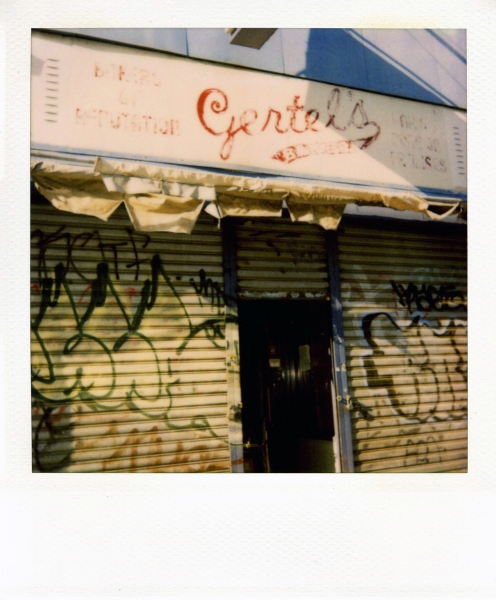
A: I'm partial to the type and signs I grew up seeing every day, most of which have disappeared (Gertel's Bakery) or whose surfaces seem to be slowly melting away (Ideal Hosiery).
I love any type that somehow still clings to life or relates directly to a time and place (Horn & Hardart Automat).
And of course, you can never go wrong with beautiful neon (Montero's).

from Vernacular Typography
Q: What do we lose when the vernacular typography of the city streets vanishes from sight?
A: A sense of the city's history, and also a precious visual resource. Typography can you tell you a lot about local culture and urban communication and when we don't see it, our sense of the city is diminished.
Q: What do you think might be the psychological impact of living in a city where the native typography is replaced by homogeneous corporate signage?
A: I think there's less of a personal connection to a specific place. With standardized corporate advertising, signs are no longer representative of a group of people or a neighborhood, just a business that could be anywhere in the world.
For natives, connections to the past are lost, so a sense of home or a memory of a place is devalued. And for visitors, there's less of the unique experience you get from traveling someplace new.
Vernacular typography is such an incredible marker of regional identity, spatial orientation, and even personal history. If we lose it altogether, we not only lose that individual and cultural connection, but also a physical map of the city, which is why documentation and preservation are so important.
I asked her a few questions about "endangered local signage."

from Vernacular Typography
Q: How are you defining "Vernacular Typography"?
A: I guess it should technically be Vernacular "Lettering," but I define Vernacular Typography as the found lettering that exists in the built environment and surrounds us everyday. It doesn't have to be pretty or use an existing typeface, it's just any visual representation of language.
Q: How do you think New York City's vernacular typography differs from other cities around the country and the world?
A: New York's vernacular typography is unmatched in terms of intensity and variety of signage. On any given block, you can see the city's forgotten history through the layers of still-visible signage in basically any medium. The typescape is also much denser than in other places because the city evolves so rapidly and retail turnover is so high.

from Vernacular Typography
Q: Which New York City typefaces are your current favorites?
A: I'm partial to the type and signs I grew up seeing every day, most of which have disappeared (Gertel's Bakery) or whose surfaces seem to be slowly melting away (Ideal Hosiery).
I love any type that somehow still clings to life or relates directly to a time and place (Horn & Hardart Automat).
And of course, you can never go wrong with beautiful neon (Montero's).

from Vernacular Typography
Q: What do we lose when the vernacular typography of the city streets vanishes from sight?
A: A sense of the city's history, and also a precious visual resource. Typography can you tell you a lot about local culture and urban communication and when we don't see it, our sense of the city is diminished.
Q: What do you think might be the psychological impact of living in a city where the native typography is replaced by homogeneous corporate signage?
A: I think there's less of a personal connection to a specific place. With standardized corporate advertising, signs are no longer representative of a group of people or a neighborhood, just a business that could be anywhere in the world.
For natives, connections to the past are lost, so a sense of home or a memory of a place is devalued. And for visitors, there's less of the unique experience you get from traveling someplace new.
Vernacular typography is such an incredible marker of regional identity, spatial orientation, and even personal history. If we lose it altogether, we not only lose that individual and cultural connection, but also a physical map of the city, which is why documentation and preservation are so important.
Tuesday, February 28, 2012
Little Rickie vs. Starbucks
About a week ago, a Starbucks opened on the corner of E. 3rd Street and 1st Avenue. As Grieve pointed out, it's a Starbucks "Reserve," which means it's special. Starbucks says it's there to remind us of "the early days of the specialty coffee business that we helped to create."
In other words, they want us to feel like we're in a real place and not a fake place. I guess that's why the signage is hand-painted on the bricks. It's more rustic that way. Maybe, if it looks authentic, it won't be egged or covered with GET THE FUCK OUT signs.

Before Starbucks came to this corner, and before its predecessor The Bean, there was Little Rickie.

Tom Perottet
Originally opened on First Street in 1985 by Phillip Retzky, Little Rickie moved to 49 1/2 First Avenue in 1987. They sold nostalgic, kitschy novelties--a lot of Elvis and Jesus, Mexican Day of the Dead skeletons, and vintage stuff. It was a great little place.
(You might argue that Little Rickie was an early gentrifier of the East Village, but then I'd have to repeat myself for the thousandth time about how the hyper-gentrification of today is very different from the gentrification of the 1980s and 90s, and how Little Rickie and Starbucks are not the same thing, and then I'd tell you to read the first chapter of Sarah Schulman's book The Gentrification of the Mind, and I'm really not in the mood for all that, to tell the truth.)

New York magazine, 1987
The Little Rickie people also had principles. When Pee-Wee Herman was arrested for indecent exposure in 1991, Retzky refused to raise the price on his Pee-Wee dolls--unlike many other merchants, he didn't want to profit from Mr. Reubens' penile misfortune.
Ironically, Little Rickie was sued by Starbucks in 1999 for selling stickers that changed the words on the Starbucks Coffee logo to say FUCK OFF.
Starbucks also sued a number of other local businesses for distributing the stickers, including Alt Coffee on Avenue A. Said the owner of Alt to the Times, ''New York City is being mallified and when you start to sterilize things and limit choices, people in the East Village don't like it.''

People in the East Village still don't like it--hence the eggs and GET OUT signs--but more and more people in the East Village do like it. Take a walk by the special new Starbucks today and you'll find it filled with customers.

New York magazine, 1987
What I miss most about Little Rickie is the vintage photo booth. I took many a photo in that booth and always enjoyed seeing the black-and-white strips taped to the front window. You never knew who you might find there--the famous and the semi-famous, including interesting characters like Punk Rock Pat.
There's a Facebook page for posting photos from the Little Rickie booth. Looking at them now is to see the past, the people who made up the East Village in the 1990s. Ghosts of the old neighborhood, they're a different breed.
If they were all still here, and still young, would this Starbucks exist?
If this Starbucks had a photo booth, what sort of personalities would fill it today?


In other words, they want us to feel like we're in a real place and not a fake place. I guess that's why the signage is hand-painted on the bricks. It's more rustic that way. Maybe, if it looks authentic, it won't be egged or covered with GET THE FUCK OUT signs.

Before Starbucks came to this corner, and before its predecessor The Bean, there was Little Rickie.

Tom Perottet
Originally opened on First Street in 1985 by Phillip Retzky, Little Rickie moved to 49 1/2 First Avenue in 1987. They sold nostalgic, kitschy novelties--a lot of Elvis and Jesus, Mexican Day of the Dead skeletons, and vintage stuff. It was a great little place.
(You might argue that Little Rickie was an early gentrifier of the East Village, but then I'd have to repeat myself for the thousandth time about how the hyper-gentrification of today is very different from the gentrification of the 1980s and 90s, and how Little Rickie and Starbucks are not the same thing, and then I'd tell you to read the first chapter of Sarah Schulman's book The Gentrification of the Mind, and I'm really not in the mood for all that, to tell the truth.)

New York magazine, 1987
The Little Rickie people also had principles. When Pee-Wee Herman was arrested for indecent exposure in 1991, Retzky refused to raise the price on his Pee-Wee dolls--unlike many other merchants, he didn't want to profit from Mr. Reubens' penile misfortune.
Ironically, Little Rickie was sued by Starbucks in 1999 for selling stickers that changed the words on the Starbucks Coffee logo to say FUCK OFF.
Starbucks also sued a number of other local businesses for distributing the stickers, including Alt Coffee on Avenue A. Said the owner of Alt to the Times, ''New York City is being mallified and when you start to sterilize things and limit choices, people in the East Village don't like it.''

People in the East Village still don't like it--hence the eggs and GET OUT signs--but more and more people in the East Village do like it. Take a walk by the special new Starbucks today and you'll find it filled with customers.

New York magazine, 1987
What I miss most about Little Rickie is the vintage photo booth. I took many a photo in that booth and always enjoyed seeing the black-and-white strips taped to the front window. You never knew who you might find there--the famous and the semi-famous, including interesting characters like Punk Rock Pat.
There's a Facebook page for posting photos from the Little Rickie booth. Looking at them now is to see the past, the people who made up the East Village in the 1990s. Ghosts of the old neighborhood, they're a different breed.
If they were all still here, and still young, would this Starbucks exist?
If this Starbucks had a photo booth, what sort of personalities would fill it today?


Monday, February 27, 2012
Manganaro's
VANISHED
It has happened. After 119 years in business, after being on the brink of closure in recent years, the great Manganaro Grosseria on 9th Avenue has shuttered.

all photos: my flickr, 2008
A reader alerted me this weekend, writing, "Walked by Manganaro's today and saw a sign that said they were serving their last Sunday lunch... The window display is bare and you can see the ancient glass and wood sliding doors. All of the photos are boxed up and on the floor. There are no more tables and chairs in the back. Out front, decades worth of paper signs, chairs, and baskets were in the trash. The place looks like a movie set now, empty and displaced from time. I fear the place will be gutted to make room for a Subway."
A call to the restaurant confirmed they are closed and their website has the following note: "As of February 27, 2012, Manganaro Foods will no longer be open in New York City. We will let you know when we re-open. Thank you for your many years of patronage. We look forward to serving you in the future."

One year ago, the family put their building up for sale, saying "We've had it." But they weren't quite ready to go. As co-owner Seline Dell'Orto told the Observer in March 2011, they were keeping the business open "Because it’s a hundred and twenty fucking years old and it’s beautiful."
And it was beautiful. From the hanging salamis to the big Toledo scale, to the wood paneling in the dining room with its old chairs and tables, to the photos hanging on the walls, it was beautiful.
The brusque greetings of the Dell-Orto sisters were beautiful. The way they refused to tolerate the bullshit of difficult tourists and such was beautiful (though some well-meaning folks got caught in the crossfire). Listening to them complain about Bloomberg and yuppies while you ate your tortellini was beautiful.

I absolutely loved Manganaro's and everything about it. When I was in the neighborhood recently, visiting the Elk Hotel, I thought maybe I should walk down for a meal. But it was late and I figured they'd be closed--and I thought I'd have another chance.
Now I'm kicking myself. Yet again.
The note on the website says they'll reopen and look forward to serving us in the future--so maybe there's hope. Maybe it's just a remodeling. Or maybe they're moving. Either way, it won't be the same and I'm just heartbroken over this one.

Further reading:
Manganaro Grosseria
Red Sauce Joints
It has happened. After 119 years in business, after being on the brink of closure in recent years, the great Manganaro Grosseria on 9th Avenue has shuttered.

all photos: my flickr, 2008
A reader alerted me this weekend, writing, "Walked by Manganaro's today and saw a sign that said they were serving their last Sunday lunch... The window display is bare and you can see the ancient glass and wood sliding doors. All of the photos are boxed up and on the floor. There are no more tables and chairs in the back. Out front, decades worth of paper signs, chairs, and baskets were in the trash. The place looks like a movie set now, empty and displaced from time. I fear the place will be gutted to make room for a Subway."
A call to the restaurant confirmed they are closed and their website has the following note: "As of February 27, 2012, Manganaro Foods will no longer be open in New York City. We will let you know when we re-open. Thank you for your many years of patronage. We look forward to serving you in the future."

One year ago, the family put their building up for sale, saying "We've had it." But they weren't quite ready to go. As co-owner Seline Dell'Orto told the Observer in March 2011, they were keeping the business open "Because it’s a hundred and twenty fucking years old and it’s beautiful."
And it was beautiful. From the hanging salamis to the big Toledo scale, to the wood paneling in the dining room with its old chairs and tables, to the photos hanging on the walls, it was beautiful.
The brusque greetings of the Dell-Orto sisters were beautiful. The way they refused to tolerate the bullshit of difficult tourists and such was beautiful (though some well-meaning folks got caught in the crossfire). Listening to them complain about Bloomberg and yuppies while you ate your tortellini was beautiful.

I absolutely loved Manganaro's and everything about it. When I was in the neighborhood recently, visiting the Elk Hotel, I thought maybe I should walk down for a meal. But it was late and I figured they'd be closed--and I thought I'd have another chance.
Now I'm kicking myself. Yet again.
The note on the website says they'll reopen and look forward to serving us in the future--so maybe there's hope. Maybe it's just a remodeling. Or maybe they're moving. Either way, it won't be the same and I'm just heartbroken over this one.

Further reading:
Manganaro Grosseria
Red Sauce Joints
Subscribe to:
Posts (Atom)