Thanks to Karen for calling our attention to the documentary "
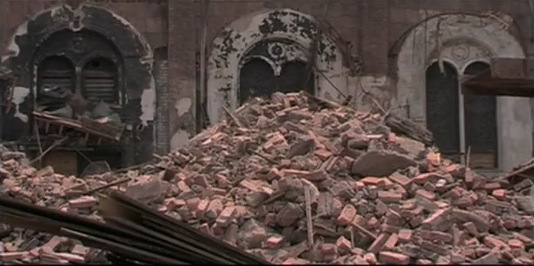
The Tao of 9 Second Avenue" by Michael I. Schiller. It starts with an image of Mars Bar before it was Mars Bar, but the film is really about the eviction and demolition of the buildings all around it--the rubble that
Mars Bar will join later this summer.
In the coming demolition, 9 Second Avenue will also fall--it is
the last piece of what was, for over a century, a thriving cultural center of the Lower East Side.
 Mars Bar as a coffee, tea, & spices shop
The film tells the story of 7-9 Second Avenue, which was the other side of
291-293 Bowery, and included a chapel on E. 1st St.
Built on the site of Gotham Gardens--according to
King's, "one of the most popular amusement resorts in the city in the '50s" (that's the 1850s)--the multi-building complex here began as Steuben House (some sources say its name was Volksgarten), later called the
Germania Assembly Rooms. In the late 1800s, they housed saloons, bowling alleys, ballrooms, and places to having meetings and conventions (the Horse Shoers' and Cigarmakers' unions met here).
 photo: rollingrck's flickr, 2003
It was a home to the German Anarchist movement in New York City and also served as a community center for the people of the Lower East Side.
photo: rollingrck's flickr, 2003
It was a home to the German Anarchist movement in New York City and also served as a community center for the people of the Lower East Side. There was a thriving Italian theater here in the 1880s. But it was all soon "given over to vaudeville, dances, and used as an evil resort"--McGurk's Suicide Hall was part of the complex--and thus got religion.
In 1904 it became the Hadley Rescue Hall and the East Side Parish Church of All Nations moved in, thus reclaiming the buildings "from the service of evil," according to the Minutes of the New York East Conference of the Methodist Episcopal Church:
 click to read
And so it remained as a community center, chapel, and mission for many years.
Wrote the
Times, "
The complex was a splendid place, with a gym, an assembly hall, classrooms, dorms, a swimming pool and a rooftop playing field... On boiling summer days, boys played baseball on the roof, and neighbors climbed to the tops of their tenements to watch them. Once, a man became so excited by a game, he toppled over into the street."
 from the film
In Schiller's film, we meet some of the women who played here as children, swimming in the pool and jitterbugging at the dances. Said one, "
Every race, color, and religion came through these doors and bettered their lives--in all ways."
 from the film
In 1974, the Green Guerrillas rescued the empty lot next door, full of dead bodies, garbage, and hypodermic needles, and turned it into what became the lush
Liz Christy Garden. Vines and flowers from the garden grew up along the brick wall of the community buildings and countless birds nested there.
 from the film: Liz Christy Garden is born
By 1975, the church moved out and a new community group (a "gang" to some) called CUANDO moved in. CUANDO stood for "
Cultural Understanding And Neighborhood Development Organization." In 1979 they erected a solar wall above the garden to cope with heating issues, and their innovation was written up in
Popular Science magazine.
 Popular Science, 1979
One of the groups that CUANDO housed over the years was Plexus International. In 1985, Plexus staged a three-hour "
cultural art adventure, billed as
The Artificial Time of the Purgatorio Show ‘85 New York."
The show ran from the roof of CUANDO down to the swimming pool, long empty since its years of giving lessons to local children.
 Plexus' Purgatorio
The Purgatorio show was a response to gentrification and its main thrust was the belief "that the current
East Village art explosion had to be enjoyed not only by the wealthy uptown patrons, but also by the local community and by the artists of the Lower East Side." This (misdated?)
French video shows it as a wild, cacophanous acid trip featuring girls in their bras and lots of papier mache. (Also check out their
Art Slaves show.)
CUANDO was evicted (some say they abandoned ship) in about 1989.
 Plexus' Purgatorio
In 1986, Kung Fu master and Taoist priest Sifu Jai (part Chinese, part black, part Jewish) moved in to the fourth-floor gym and opened a Taoist temple, the
Temple of the Ancestral Mother. Kung Fu practice and Taoist rituals, burnt offerings to the hungry ghosts that wandered the Lower East Side, happened on the caged roof where boys once played baseball on hot summer nights. (See more inside the temple and the building in
this video.)
After all the other tenants departed from the buildings, Sifu Jai remained inside the crumbling walls, now neglected by its new owners as they awaited demolition. Said one of Sifu Jai's students in the documentary, "
While it may look like a big, old abandoned building that no one cares about, people in this neighborhood know how important it is."
 image from the documentary, Kung Fu on the roof
The film tells the story of Sifu Jai's eviction in 2002. He sits on the sidewalk in front of 9 Second Ave., his belongings piled behind him, and explains, "
I was laying in bed and they used a battering ram to smash through the door, my bedroom door, and threw me out on the street. Literally."
He talks about the new development that will come, how the neighborhood will soon be nothing but glass buildings. "New is better? No, I don't friggin' think so."
 film still, Sifu Jai
In the end, the buildings are
demolished. You know what came next, the massive glass box of a building, the Bowery Wine Bar, Daniel Boulud's DBGB, the Hamptons boutique Blue & Cream, and all the zombies that flocked to them, despite the
Die Yuppie Scum protests.
What's coming next is the demolition of 9 Second Avenue, along with Mars Bars' building. The last piece of this long, colorful history is about to fall. What will take their place is
another dead tower.
What kind of city will we have if we keep exchanging buildings, neighborhoods, and people filled with meaning for these hollow boxes?
 from the film, demolition
See Also:
The Loss of Mars
Before Mars Bar
Bowery Tsunami