Tuesday, October 9, 2018

Pass the SBJSA

The Cafe Edison could have been saved. CBGBs could have been saved. Lincoln Plaza Cinemas could have been saved. Your favorite restaurant, bar, and bookshop is next--if you don't do something right now.

At long last, the Small Business Jobs Survival Act is getting a hearing. This is the moment we've all been waiting for. It's time to stop complaining and do something.


photo by EJ Berry


What you can do:

1. Write and/or call your local Councilmembers--your messages go into the record--and tell them to pass the SBJSA:
- Fill out this easy-to-use form to email the City Council
- Or find your individual Councilmembers here and contact them directly
- Councilmember Mark Gjonaj is Chair of the Council's Small Business Committee--write or call him, too. You can also contact the members of that committee: Diana Ayala, Stephen T. Levin, Bill Perkins, and Carlina Rivera.
- Find them on Twitter and tweet your request: Pass the #SBJSA

2. Write and/or call the Council Speaker Corey Johnson and tell him to pass the SBJSA:
- Fill out this simple form, already written for you
- Or you can call or write to him directly here
- Tweet him @CoreyinNYC

3. Spread the word:- Share this blog post on your social media--and not just once, share it multiple times, and every time a beloved business is forced out by rent hike or non-renewal of lease.
- Inform your local businesspeople. Tell your bodega people, your barber, your therapist, your dentist, your bartender, the people who fix your shoes and do your laundry, the folks who serve your lunch and pour your coffee. Tell them all that there is a solution, there is a protection, and we all can make it happen.
- Print out and share this flyer, available in English and Spanish

- If you are not a New Yorker, you can still write and call the City Council and the Speaker. Tell them you don't want to bring your tourist dollars to a city that's full of nothing but chain stores and luxury glass towers. Tell them to pass the SBJSA.

UPDATE: The hearing happened on October 22. For more information, read here.


About the SBJSA:
Legally vetted and deemed fully constitutional, the SBJSA gives existing commercial tenants a few basic rights, including: 1. the right to renew the lease, 2. a minimum 10-year extension, and 3. equal rights to negotiate a fair rent, with third-party arbitration if an agreement between tenant and landlord cannot be reached. In that case, the arbitrator may determine a reasonable increase, a decision based on multiple factors, including current fair market rates for similar properties.

-Read more about the SBJSA here and here and here.

If you've been complaining about the vanishing of New York, now is your chance to change things for the better. At this point, you really have no excuse. If you do nothing, then quit complaining.


Speaker Corey Johson Pledging Support for Small Businesses (WNYC Brian Lehrer) from Wheelhouse Communications on Vimeo.


New York From Behind

If you enjoy New York street photography and the unique character of this city, there's an Instagram page you should check out. New York from Behind is the creation of Bryn and Justin. I asked them a few questions about their project.

What is New York From Behind?

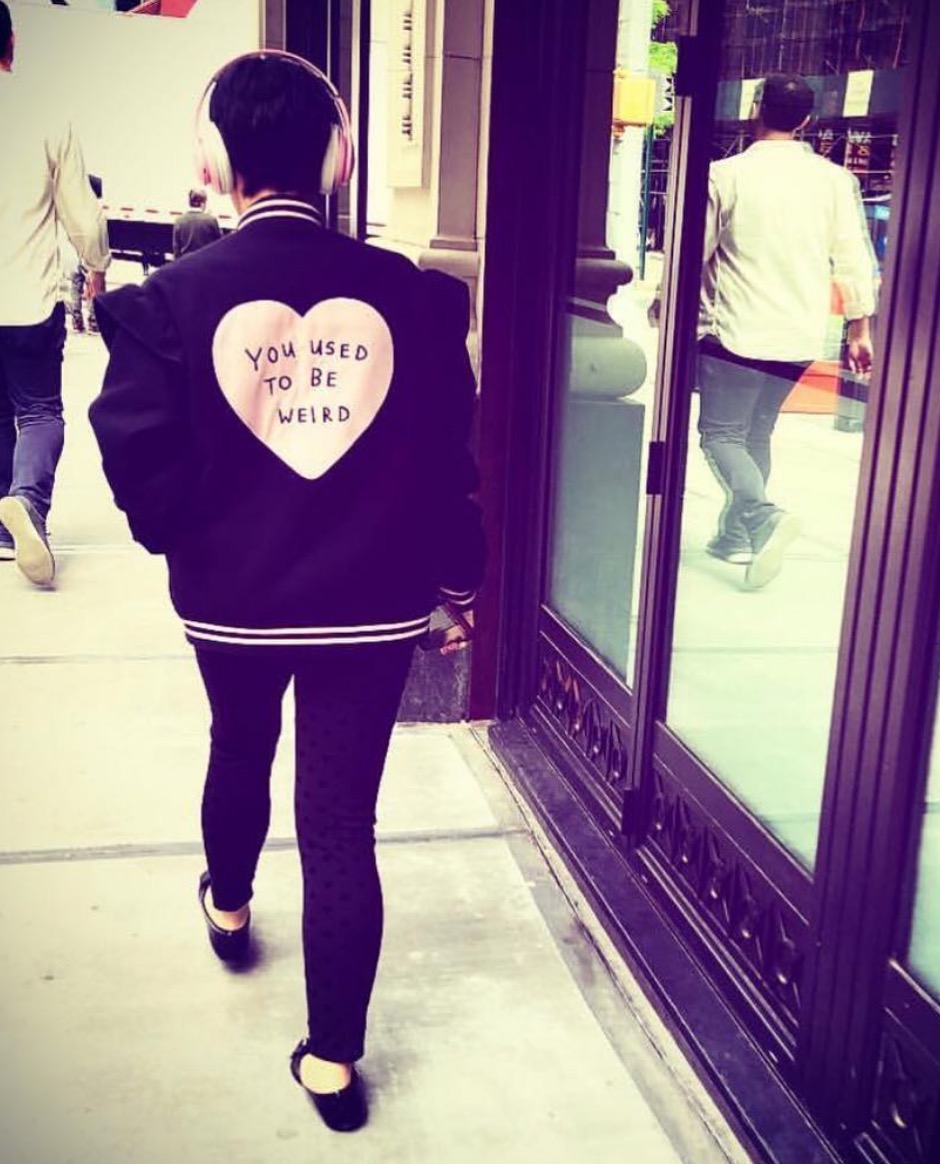
New York from Behind is a concept we created just by being citizens of this city. New Yorkers have a lot to offer visually and so often the most interesting thing is the person right in front of you. Usually the front of someone’s outfit is what’s most interesting. We notice every day that the reverse is not true. Since so much of fashion is forward focused, it sometimes proves hard for us to find interesting content. So the fun for us is to catch people who do something different and make their canvas their backs as well as their fronts.


all photos via New York from Behind

How'd you get started?

We’re two good friends who first got started by taking pictures around the city and sharing them with our friends and each other. Eventually, we started the page as a place to more easily share photos of people who were doing fashionable, interesting, and funny things on their backs. People started following the page. As a born East Villager and a young curmudgeon, we have a sense of NYC history and it’s fun to find the colorful people of the past, who are increasingly hard to find in generic New York.


Do you go out hunting for behinds, or just snap them as they come?

Usually our daily commute offers enough content, especially if you hit 14th street, Soho, Union Square, Washington Square, the West/East Village, and Chelsea. There are always events around the city and holidays that we can count on for good “behinds.”


What trends have you noticed?

When we started in 2016, few people had messages on their backs and most of the ones who did seemed handmade. Now so many retailers are selling clothes with words written across the back and it’s spread from high fashion, where it started, to mass retail.

The other trend we’ve noticed is that patterns on clothing were always forward focused. You’d see the person approaching and while their front is highly embellished, the back is solid. Lately we’ve seen more of designs continuing on to the back as well.


A lot of the behinds seem to be messages. Thinking over all the behinds you've captured, what are people trying to say?

From “never settle for less than your best” to “live fast eat ass” a lot of them are messages to onlookers — words of advice, lessons learned the hard way, or generalized warnings of toughness. And those are just the ones with words that makes sense.

Tuesday, September 25, 2018

The Taking of Bleecker: 1, 2, 3

The western end of Bleecker Street has gone through three major upheavals since the 2000s began.

1. Skyrocketing rents and non-renewal of leases on mom-and-pop shops created the luxury chain takeover, starting in 2001 with Marc Jacobs. Those blocks went from quaint and local to high-end suburban mall in just five years.

2. It took another five to die, as those big chains departed, emptying the storefronts and leaving the street in a state of high-rent blight.

3. Recently we heard that mega-developer Brookfield Properties would take over, spending approximately $31.5 million for several retail condos to convert them into a concept, a curated consumer experience, “with Brookfield orchestrating…rather than allowing each individual shop to pursue its own agenda,” reported New York magazine. “Let’s look at this as if it’s a mall,” said Brookfield’s head of retail leasing, “even though it’s not.”

Now we know what that looks like.


WWD reports on the program to curate the street. It's called "Love, Bleecker" and it has a creative director, fashion designer Prabal Gurung. There will be a leather "concept store" called Slightly Alabama, a florist/plant-based food shop, and a gallery space with prisms, among other "disruptive" and "innovative" and "creative" businesses.

Writes WWD, "Brookfield considers Bleecker to be a new kind of retail activation and platform for growing online digital native brands that may eventually populate its other properties." (And here I thought it was a neighborhood.) "We'll incubate them here and see them thrive and grow," says Sara Fay, VP of Marketing at Brookfield.

Brookfield, according to WWD, "plumbed Bleecker Street's history as a magnet for jazz and folk music and stomping ground for Beat poets such as Allen Ginsberg and Jack Kerouac."

Incubation, artwashing, and the co-opting of the neighborhood's counter-cultural history? Sounds like more invasion of the body snatchers.

The project kicked off yesterday. Do not miss the website.


Thursday, September 20, 2018

#SaveNYC Happy Hour

Sick of watching the small businesses in your neighborhood vanish? Here's your chance to do something about it. Come to the #SaveNYC Happy Hour:

- Wednesday, October 3, from 7:00 - 9:00PM
- Dream Baby Cocktail Bar, 162 - 164 Avenue B, NYC: Extended happy hour for #SaveNYC = $4 for beer and well drinks, $2 off everything else.
- View Facebook invite here

At long last, the Small Business Jobs Survival Act is getting a hearing. Come celebrate, meet and mingle, and strategize next steps for this important event and beyond.

Jeremiah Moss and others will be speaking on the importance of this historic bill. David Eisenbach, the anti-REBNY candidate for Public Advocate, will talk about his work and what we can do to get ready for the public hearing later in October.


Speaker Corey Johson Pledging Support for Small Businesses (WNYC Brian Lehrer) from Wheelhouse Communications on Vimeo.
Monday, September 17, 2018

St. Denis Coming Down

Earlier this year I wrote in detail about the death of the great St. Denis building on 11th and Broadway, a building that should have been landmarked but wasn't, a building full of vital history -- from Alexander Graham Bell to Ulysses S. Grant, Susan B. Anthony, and a whole lot of Socialists, radicals, artists, and psychotherapists.

The building was bought by Normandy Partners in 2016 and all of the tenants were removed--hundreds of small businesspeople, myself included, put out. Today, the empty building is being prepped for demolition.


Crain's reported last week that Columbia Property Trust is "paying more than $70 million...to purchase a roughly 50% stake" in the property with co-owner Normandy Real Estate Partners.

The plan is to tear down the St. Denis and replace it with a glass box, "182,000 square feet of boutique office space for New York’s most progressive and creative companies," according to the press release -- which calls this neighborhood below Union Square: "Midtown South."

Of course, the St. Denis was already filled with hundreds of truly progressive and creative businesses, but we weren't the right sort of commodities.


Last week, the awning over the entrance was stripped away, along with a pair of antique lamps.

The asbestos abatement notices have been posted and the asbestos dumpster has arrived, a typical precursor to the wrecking machines.


Back to that press release:

"The new 12-story, loft-style building will comprise 182,000 square feet of boutique office space and will provide a dramatic complement to this quintessential New York neighborhood. With floor plates ranging from 3,600 to 22,000 square feet, 799 Broadway will feature floor-to-ceiling glass, private terraces, and 15 foot high ceilings. This combination of highly desirable location and state-of-the-art design will appeal to New York’s most progressive and creative companies.

'We are seeking selective development opportunities in our target markets to provide value and growth to our high-quality, well-leased portfolio,' said Nelson Mills, chief executive officer of Columbia."


architect's rendering

When the St. Denis is felled, 165 years of real and rebellious history will be destroyed for this cold and soulless sarcophagus.

The Village will be much poorer for it.


architect's rendering

Post Script:

The above rendering shows the dead lobby to come. Here's what one frequent visitor to the St. Denis had to say about its lobby, which was often full of antiques from the first-floor business:

“I loved that every time I visited there were new objects in the lobby. They often seemed to reflect whatever mood I was in. Or they’d reflect the weather. I’d come in on a stormy day and the lobby would be full of dark paintings or bleak statues. On sunny days, there would be golden chaise lounges and chandeliers. There was this one chandelier, massive and dripping in crystals. It was there on a day when I felt really good and it was like the sun was on the inside of the building. This dazzling object.”

Read more about the St. Denis here.

Friday, September 14, 2018

Artwashing 14th and 8th

About a decade ago, I had a dream that the southeast corner of 14th Street and 8th Avenue was being torn down to make room for WalMart. That didn't happen. At the time, I checked with one of the business owners (there was a popular Korean deli, a bodega, and a liquor store). He told me that the owner of the buildings had turned down offers of up to $45 million for the whole lot.


But then, last year, it all went.

We learned that a 10-story office tower is coming, designed by architect Gene Kaufman and developed by the Chun Woo Realty Corporation.

Chun Woo Realty Corp, DNA reported last year, "has owned the two properties for around three decades...noting that redevelopment was something they’d 'been contemplating for over a decade.'"

“We’re not developers who moved in and are pushing small businesses out. We’re actually the longtime permanent owners of the building, and it was actually our business,” the developer said of the deli. He didn't mention the other two businesses or any residents upstairs, or the impact this high-end office tower will have on the neighborhood.


In the meantime, until demolition, they're doing a little artwashing with Bombay Sapphire.


I walked by yesterday to find "Art in Progress" signs on the deli. Bombay Sapphire says, "Stir Creativity."

Security guards policed the installation of several canvases.


The booze corporation has a message for us:

"Creativity has no boundaries. It can flourish in art galleries, and it can thrive on the streets outside them. With Art in Progress, Bombay Sapphire is transforming the city's construction sites into open air art galleries to inspire New Yorkers' own creativity."

This is artwashing.

Defined by Feargus O'Sullivan, artwashing is a "profit-driven regeneration maneuver" in which "the work and presence of artists and creative workers is used to add a cursory sheen to a place's transformation.... It often happens...when developers spot areas that have attracted residents from creative industries, then earmark them as ripe for investment and remarketing to a new kind of customer."


Artwashing attracts hyper-gentrification and it is also public relations. And murky advertising. If you're looking at this and thinking it's an unmitigated good, well, they've got you right where they want you.

This is not spontaneous creativity. It's not bohemian aliveness in the Village. It's the spoonful of sugar that helps the poison go down.

This is a corporate-development collaboration that artists have agreed to participate in, though it would be better if they did a little more critical thinking about that participation.

It reminds me of when luxury neighbor, One Jackson Square, went up next door in 2007. The developers wrapped that site in billboards that capitalized on the creativity and bohemian history of the Village. "To this day," said the ad materials, "the birthplace of bohemian culture is still home to an eclectic mix of artists, iconoclasts and cognoscenti."

On the billboard, it read, "The Spirit of Greenwich Village Is Alive and Well."

Today, One Jackson Square is home to a Starbucks and a TD Bank.


Monday, September 10, 2018

2nd Ave Deli Sign

Now and then, the lost artifacts of vanished New York will resurface.

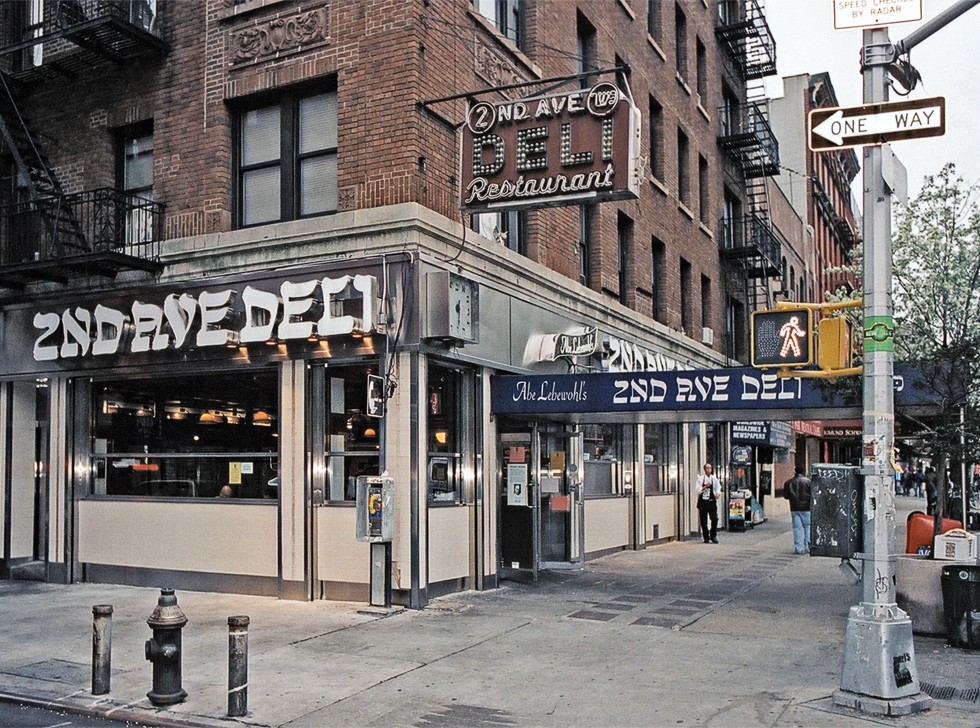
I heard from a painter who recently moved his studio into a former woodshop's space in the East Village. In the backyard, under piles of junk, he unearthed the double-sided neon sign of the old Second Avenue Deli.


Opened in 1954, the deli (and the sign) stood on the southeast corner of Second Avenue and East 10th Street until 2006, when it closed due to a rent dispute with the building's new owner.

Reported the Times, "Jack Lebewohl said he faced an increase in monthly rent to $33,000 from $24,000. The space also needed substantial renovations he was unwilling to invest in without a reasonable long-term lease. His landlord told The Times that Lebewohl owed $107,000 and that eviction proceedings had started. They settled for $75,000."

Comic Jackie Mason told the paper, "It's almost like wiping out Carnegie Hall. A sandwich to a Jew is just as important as a country to a Gentile."


photo by James & Karla Murray

A Chase bank moved into the space, installed just two blocks away from the next nearest Chase bank, and a block or two from several more banks.

As I wrote in my book, Vanishing New York, "Today, the Second Avenue Deli’s Yiddish Walk of Fame remains, out of context and rapidly fading. Carved in stone on the sidewalk are names from the days when this strip was the Jewish Broadway—Fyvush Finkel, Ida Kaminska, Lillian Lux, Ludwig Satz. The names are worn down, ignored and flattened by the crowds walking past, grabbing cash from the ATM before making a beeline for the next pitcher of beer and bucket of Buffalo hot wings...at one of the many laddish sports bars that have sprouted along the avenue."

A new Second Avenue Deli opened in Murray Hill, and then the Upper East Side, but the old signage did not go with them.

I came upon one, some years back, at the City Reliquary museum in Brooklyn.


at the City Reliquary

And now the other has been found and rescued. The painter who discovered it reached out to the Lebewohl family and they picked it up.

The painter says that Josh Lebewohl, grandson of deli founder Abe, was glad to get the sign back. "I think he's going to try and place it with the Jewish Museum," the painter told me, "or maybe the New York Historical Society or Museum of the City of New York."