1930s Land Book
At the Municipal Archives, you use Land Books to determine the block and lot numbers of the building you seek, then match them up with the tax photos on the microfilm. In these Land Books, here and there, a business is described in a word or two. The Land Book from the 1930s makes no mention of a diner anywhere at Mulry Square. But the updated 1950s Land Book shows a new addition.

1950s Land Book
In Block 613, Lot 62, on the corner where 7th Avenue South hits Perry Street, the 1950s mapmaker has drawn a rectangle and written the word DINER.
Sometime between the late 1930s and the 1950s, a diner appeared on the southwest corner of the Mulry Square triangle. Hopper painted Nighthawks in 1942.

close up of Mulry Square, 1950s
Excited to at last be on the verge of solving this mystery, I quickly locate the microfilm and scroll to the tax photo at Block 613, Lot 62. My eyes are bleary by the time I get to it, but all I see is the Esso gas station on the northernmost corner of the triangle. I check and recheck my numbers. I scroll back and forth, again and again. Nothing.
There is no photo on that microfilm showing the southwest corner--no photo of the spot where the mapmaker wrote in "DINER." The Esso station occupied Block 613, Lot 59—not Lot 62. Maybe someone screwed up the lots. Maybe the photo is missing.
I think, with an irrational tinge of paranoia, "Maybe someone removed the photo. Maybe they don't want us to know the truth!"

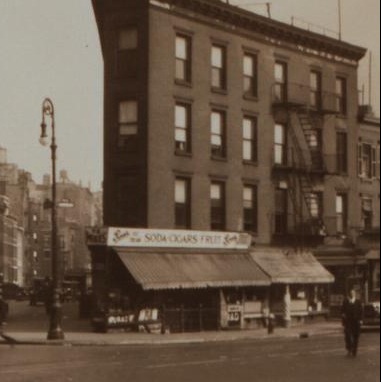
1933: SW corner of Mulry Square, no diner yet
I go to the 1980 tax photos, hoping the mystery diner will still be standing in those 30-year-old shots, but whatever diner was there at mid-century has already been demolished and replaced with the building that today houses Empire Szechuan Village.
In the 1940s and 50s, people coming out of the Village Vanguard would have looked right at the diner. They might have crossed the avenue to go in for a late-night bite. But lost between photographic documentations, the diner at 613 - 62 remains a ghost to us.

Southwest corner of Mulry Square today, Google
I hit a wall. The missing photo of Block 613, Lot 62 puts me in a foul, defeated mood. I go back to the drawing board. But nothing in the New York Public Library's 1930s photos, nothing in the Municipal Archives' 1940 and 1980 photos, and nothing standing today looks like a good match for Hopper's Nighthawks diner.
The one photographed restaurant in the Mulry Square triangle is a castle-shaped burger joint attached to the gas station on the northeast side--so very not Nighthawks.

NYPL, 1933
Could the Nighthawks inspiration have been the mystery diner at Block 613, Lot 62 behind the Esso gas station? Possibly. If the diner was built in time, Hopper might have decided to paint it in 1942 because it was new. He may have been attracted to the novelty of it. If only I could find some further evidence of its existence.
After my trip to the Archives, I go online and search for images of that corner. I come up empty, but I do find a Certificate of Occupancy from 1942. It states that a one-story commercial building went up in this spot, Block 613, Lot 62, also known as 173 7th Ave. So. The date of completion was February 26, 1942, the year Nighthawks is dated. But was it the Hopper diner?

Trying to fit the dates together, I dig through my bookshelves for Gail Levin's biography of Hopper. There she tells us that the painting was begun in December 1941, three months before the date on the Certificate of Occupancy for the mystery diner.
It's possible. The diner at Perry and 7th may not have been open for business, but it was standing when Hopper made his sketches.
Right? I'm not sure of anything at this point.

I look back at the 6 prow-shaped corners, at the paper print-outs and notes I took from the Archives. I zoom in on the photos from the NYPL. What did I miss?
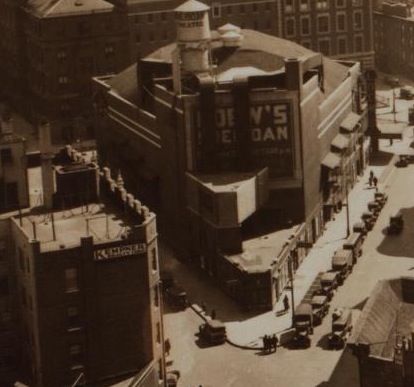
Could the Nighthawks diner have been in the narrow wedge that is today's West Village Florist? Could it also have been that little vanished slice behind the Loew's Sheridan theater? Yes to both, if Hopper took some liberties with the facades. And the backgrounds.

Christie's
In the charcoal studies for Nighthawks, you can see that the background is quite vague, messy pencil scribbles with details that appear and disappear from sketch to sketch. As Teri Tynes noted in an email to me, "Some people think Hopper essentially spliced in his Sunday Morning painting for the background."
We know that the woman in the diner is Hopper's wife, Jo. The brick buildings in back probably came from another painting. Maybe the diner, too, is a composite.

There is more evidence for this explanation than for any other.
In the Hopper biography, Levin tells us that a Vogue interviewer discerned that the diner was "based partly on an all-night coffee stand Hopper saw on Greenwich Avenue...'only more so.'" Hopper said, "I simplified the scene a great deal and made the restaurant bigger. Unconsciously, probably, I was painting the loneliness of a large city."
Partly. More so. Simplified.

As the truth becomes clearer, I am finding it difficult to bear this idea that, outside of Hopper's imagination, there was no Nighthawks diner at all.
Certainly, there was something of substance among those many triangular corners. I look through my muddy print-outs of the tax photos. Here’s a familiar-looking wedge. There’s a glassy corner. And that’s a background of dark bricks. The curved window may have belonged to that grocery store or that bakery. The cornice might have come from this shop that sold wines and liquors.
After all the searching, I know only one thing for sure: The Hopper diner never stood at Mulry Square’s northern tip. Until a photo of the lost diner at Perry and 7th appears, we have to assume that the Nighthawks diner stood everywhere, that it came from every possible corner, from bits and pieces of the city, the large and lonely city that Hopper's art holds for us.
And that should be the end of our story. It's poetic, a bit tragic. But I'm still not satisfied. More evidence is out there. Stay tuned for one last gasp in a final coda...
Go to Finding Nighthawks: Coda
*Thanks again to blogger Teri Tynes and singer/songwriter Don Everett Pearce, who emailed me with links to photos, quotes, and their own guesses, all of which helped put this whole thing together.
Read:
Finding Nighthawks Part 1
Finding Nighthawks Part 2