Showing posts sorted by relevance for query sex and the city. Sort by date Show all posts
Showing posts sorted by relevance for query sex and the city. Sort by date Show all posts
Wednesday, July 8, 2015


Tuesday, November 10, 2015
Goldsmith's Capital
This month, Verso Books publishes Kenneth Goldsmith's Capital, "a kaleidoscopic assemblage and poetic history of New York." Inspired by Walter Benjamin's Arcades Project, Goldsmith has spent the past decade researching and assembling a super-abundance of quotes on New York City, and then organizing them into categories like Celebrity, Danger, Graffiti, and Sex. The result is far from a simple quote book, however. Reading Capital feels like walking the city, through time and space, jumping neighborhoods, going in and out of buildings, slipping through wormholes. It's a kind of exuberant eavesdropping on the muttering, shouting narrative of the twentieth-century city.
I asked Goldsmith a few questions. He answered.

Q: I've been enjoying Capital, but is it meant to be enjoyed? You've called yourself "the most boring writer that has ever lived." Capital is not boring. Does this book feel like a departure from previous work?
A: I actually stopped being a boring writer almost a decade ago when I got bored of being boring. I’m known for a book called Day, which was a transcription of The New York Times of September 1, 2000 into a 900-page book. That was boring. When the book was reviewed, most people mistakenly thought I had transcribed September 11, 2001. I thought that was a great idea and went ahead and transcribed the 9-11 New York Times—the one that everyone carried to work that day, not the 9-12 newspaper, when you saw the planes crashing into the towers. And as I was doing the transcription, I found my keyboard soaked in tears. I mean, I wasn’t doing anything different than straight transcription, but the content was so emotional, that I produced an emotional text. After that I stopped being boring and wanted to find hotter and more emotional texts, which led to Seven American Deaths & Disasters, which are transcriptions of media broadcasts of national tragedies.
So, for Capital, I changed the lens again from tragedy and emotion to beauty and romanticism and have produced a beautiful and romantic text about New York City in the 20th Century. But the process is identical: this book is nearly 1000 pages long but I haven’t written a word of it.
Q: In a related question, you've also said, “My books are better thought about than read. They’re insanely dull and unreadable.” Capital is readable, but maybe not in the traditional sense of moving from point A to point B. How do you imagine Capital being read?
A: I think its unreadability is like the unreadability of the city itself: it’s too damn big to read New York City; perhaps the only way we can interact with New York is to browse it.
Q: How do you personally "browse" New York City? In the physical -- and maybe in the psychic -- sense. This book has a flaneur feeling about it, the walker in the city, capturing moments, observations, as he or she goes. That things that happens as one walks, fragments making up a whole. I think also of Mondrian's "Broadway Boogie Woogie." Do you identify as a flaneur, of the body and/or mind?
A: Walking the city invokes a text, one that is instantaneously written while, at the same time, one that is instantaneously read. The urbanist philosopher Michel de Certeau says, "They walk—an elementary form of this experience of the city; they are walkers, Wandersmänner, whose bodies follow the thicks and thins of an urban 'text' they write without being able to read it." Walking, then, is an act of reading the city with our feet.
The city itself is an epic novel: each building a word, each street a sentence, each block a paragraph. De Certeau's claim for unreadability is hinged upon three facts: the blur of motion, the speed at which the tale is unwinding, and the sheer of immensity of the text. When we speak of hypertexts, we usually mean those which exist online, but we might think of the city as the ur-hypertext, a dynamic, analog, predigital model of complex intertextuality.
Q: What does it feel like for you to walk the streets of the city today? In my experience, the feeling of it has changed dramatically in the past decade or so.
A: We are going to disagree here but I love the city today as much as I’ve ever loved it. Every moment in New York is the best moment. Yes, the city has changed dramatically, but that doesn’t mean that it’s less, it just means that it’s different. We can’t look to what New York was — that’s gone — but what it is now, which is still radically inspiring, energetic, and quite frankly, utopian.
I travel around the world constantly, and the whole world has gone the way of New York, so if New York was always more interesting than anywhere else, it still is today. While the city may not resonate the same way with me as it did 40 years ago — yes, I was here 40 years ago — I still find it intriguing, mysterious, and sexy in ways that I find few other places on earth. I adore this city, still, in the twenty-first century.
Q: We don't completely disagree. I wouldn't be fighting for New York if I didn't still love it. Though I sometimes hate to love it. Would you call Capital your love letter to New York? Apologies for the cliche, but the book does feel affectionate.
A: Yes, this book is a completely romantic love letter to the city. I was able to pen the ultimate love letter to this city without having written a word of it, which is pretty much what Walter Benjamin did to Paris with the Arcades Project, the inspiration for this project.
Q: Finally, the obvious question: What about the Arcades Project inspired you to do a New York version?
A: When Benjamin’s book was published in English in 1999, I found it to be the most profoundly emotional book I’ve ever read written about a city. It was a book that told what the city felt like, sounded like, and smelled like, instead of narrating official histories—god knows there are enough of those books about Paris. I wanted to write the same book for New York, a city I’ve lived in for my entire adult life. I’ve also seen the city drastically change, so I wanted to remember, for instance, the smell of Orange Julius. My book is 1000 pages of citation; I didn’t write a word of it, but it turns out to be the most autobiographical book I could write. This city has made me what I am today. It is, indeed, a love song to New York.
Q: Anything else I didn't ask that you'd like to answer?
A: Yes one more thing. I wrote much of this book in the New York City collection of the Jefferson Market Library, a place that I found about through your blog. I would spend the entire day, say, researching the blocks around the Library—Patchin Place, Eighth Street, Christopher Street, etc.— in the twentieth century. But when I would leave the library, I would enter a city that bore little resemblance to where I was reading about. I really might as well have been researching the book in, say, Switzerland, instead of in Greenwich Village.
I asked Goldsmith a few questions. He answered.

Q: I've been enjoying Capital, but is it meant to be enjoyed? You've called yourself "the most boring writer that has ever lived." Capital is not boring. Does this book feel like a departure from previous work?
A: I actually stopped being a boring writer almost a decade ago when I got bored of being boring. I’m known for a book called Day, which was a transcription of The New York Times of September 1, 2000 into a 900-page book. That was boring. When the book was reviewed, most people mistakenly thought I had transcribed September 11, 2001. I thought that was a great idea and went ahead and transcribed the 9-11 New York Times—the one that everyone carried to work that day, not the 9-12 newspaper, when you saw the planes crashing into the towers. And as I was doing the transcription, I found my keyboard soaked in tears. I mean, I wasn’t doing anything different than straight transcription, but the content was so emotional, that I produced an emotional text. After that I stopped being boring and wanted to find hotter and more emotional texts, which led to Seven American Deaths & Disasters, which are transcriptions of media broadcasts of national tragedies.
So, for Capital, I changed the lens again from tragedy and emotion to beauty and romanticism and have produced a beautiful and romantic text about New York City in the 20th Century. But the process is identical: this book is nearly 1000 pages long but I haven’t written a word of it.
Q: In a related question, you've also said, “My books are better thought about than read. They’re insanely dull and unreadable.” Capital is readable, but maybe not in the traditional sense of moving from point A to point B. How do you imagine Capital being read?
A: I think its unreadability is like the unreadability of the city itself: it’s too damn big to read New York City; perhaps the only way we can interact with New York is to browse it.
Q: How do you personally "browse" New York City? In the physical -- and maybe in the psychic -- sense. This book has a flaneur feeling about it, the walker in the city, capturing moments, observations, as he or she goes. That things that happens as one walks, fragments making up a whole. I think also of Mondrian's "Broadway Boogie Woogie." Do you identify as a flaneur, of the body and/or mind?
A: Walking the city invokes a text, one that is instantaneously written while, at the same time, one that is instantaneously read. The urbanist philosopher Michel de Certeau says, "They walk—an elementary form of this experience of the city; they are walkers, Wandersmänner, whose bodies follow the thicks and thins of an urban 'text' they write without being able to read it." Walking, then, is an act of reading the city with our feet.
The city itself is an epic novel: each building a word, each street a sentence, each block a paragraph. De Certeau's claim for unreadability is hinged upon three facts: the blur of motion, the speed at which the tale is unwinding, and the sheer of immensity of the text. When we speak of hypertexts, we usually mean those which exist online, but we might think of the city as the ur-hypertext, a dynamic, analog, predigital model of complex intertextuality.
Q: What does it feel like for you to walk the streets of the city today? In my experience, the feeling of it has changed dramatically in the past decade or so.
A: We are going to disagree here but I love the city today as much as I’ve ever loved it. Every moment in New York is the best moment. Yes, the city has changed dramatically, but that doesn’t mean that it’s less, it just means that it’s different. We can’t look to what New York was — that’s gone — but what it is now, which is still radically inspiring, energetic, and quite frankly, utopian.
I travel around the world constantly, and the whole world has gone the way of New York, so if New York was always more interesting than anywhere else, it still is today. While the city may not resonate the same way with me as it did 40 years ago — yes, I was here 40 years ago — I still find it intriguing, mysterious, and sexy in ways that I find few other places on earth. I adore this city, still, in the twenty-first century.
Q: We don't completely disagree. I wouldn't be fighting for New York if I didn't still love it. Though I sometimes hate to love it. Would you call Capital your love letter to New York? Apologies for the cliche, but the book does feel affectionate.
A: Yes, this book is a completely romantic love letter to the city. I was able to pen the ultimate love letter to this city without having written a word of it, which is pretty much what Walter Benjamin did to Paris with the Arcades Project, the inspiration for this project.
Q: Finally, the obvious question: What about the Arcades Project inspired you to do a New York version?
A: When Benjamin’s book was published in English in 1999, I found it to be the most profoundly emotional book I’ve ever read written about a city. It was a book that told what the city felt like, sounded like, and smelled like, instead of narrating official histories—god knows there are enough of those books about Paris. I wanted to write the same book for New York, a city I’ve lived in for my entire adult life. I’ve also seen the city drastically change, so I wanted to remember, for instance, the smell of Orange Julius. My book is 1000 pages of citation; I didn’t write a word of it, but it turns out to be the most autobiographical book I could write. This city has made me what I am today. It is, indeed, a love song to New York.
Q: Anything else I didn't ask that you'd like to answer?
A: Yes one more thing. I wrote much of this book in the New York City collection of the Jefferson Market Library, a place that I found about through your blog. I would spend the entire day, say, researching the blocks around the Library—Patchin Place, Eighth Street, Christopher Street, etc.— in the twentieth century. But when I would leave the library, I would enter a city that bore little resemblance to where I was reading about. I really might as well have been researching the book in, say, Switzerland, instead of in Greenwich Village.
Monday, June 8, 2009
A Walk with Bock
On a rainy day I took a walk through Gramercy with Charles Bock, author of the beautiful novel Beautiful Children. We talked about the neighborhood, the hyper-gentrification of the city, the fate of the New York novel, and the ruination of cupcakes.

Bock came to the city in 1993 and bounced around before settling near 23rd and 3rd. I asked him about the personality of this part of town and how it’s changed over the years. Under the looming glass box of an NYU dorm, he said, “There was nothing here then, and now there’s a less interesting nothing. It used to have an old mothbally personality. Now it’s just completely undefined. There’s absolutely nothing distinctive about it.”
That’s the sense you get when you walk through Gramercy. It feels like a nowhere place, filled with anonymous bodegas and cookie-cutter faux-Irish pubs. But here and there, you find a few touches of character. There's the Carlton Arms Hotel. And the dilapidated Gramercy Pawnbrokers that refused to move when that condo developer took over their block. Bock grew up in a pawnshop in Las Vegas, so I asked him to give me his impression of the windows.

“Well, first off, they need to polish this stuff,” he said, looking in at the tarnished wedding bands and depressing #1 Dad pendants. He recalled being a kid, emptying the windows of wares when it was time to shut the shop for the day. “I have an intimate familiarity with these velvet ring cases.”

La Delice, a pastry shop on the corner of 27th and 3rd, has been here for years. Bock lifted the pant leg on the baker statue out front to show me a rare pair of Spud Webb sneakers. Webb was a 5’6” basketball star known for his miraculous dunk. His sneakers never reached the popularity of Jordans, but they’ve become a collector’s item. Said Bock, “If these were in good shape, they'd be worth ass-loads of money on the vintage sneaker market.”
Inside La Delice, Bock briefly contemplated buying a cupcake, but he couldn’t bring himself to do it. “I can’t buy a fucking cupcake,” he said, “Sex and the City ruined cupcakes for me. Think about this. The same year the Ramones put out their last album, that Sex and the City column showed up. It was the end of one type of New York and the beginning of another. There was a huge shift of mindset and aesthetic... There used to be room to be a freak.”

We passed up the cupcakes, forever spoiled by Carrie Bradshaw, and headed back out into the rain, talking about New York novels and if they still exist. Bock recommended Emily Barton’s Brookland and John Wray’s Lowboy. But Rick Moody’s Ring of Brightest Angels Around Heaven tops the list. Bock said, “It is New York, late 80s, East Village. There will never be anything better written about the certain way that world was. He gets a lot of criticism, but read that fucking novella and then come talk to me.”

At 24th Street, where Baruch College demolished a block once filled with fleabag hotels and men huddled around trashcan fires, Bock recalled, “This used to be a little Bowery. Nathanael West once managed a hotel on 23rd Street.” It might have been there, among the miserable people, that West found inspiration for his novella Miss Lonelyhearts.
Does today’s New York still have what it takes to inspire literature? I asked Bock if the city was less inspiring to him today than it used to be. With an infectious optimism, he told me, “The thing about New York is that anything can happen. There’s a sense of possibility that’s such a deep part of this city. Ideally, that’s not connected with cash or status. But even if it is, the moral questioning of that is interesting and makes for good substance.”
Even the vanishing city can be a source of inspiration.
“Because it pisses you off,” Bock said, “You see what’s happening and you want to get in there. You want to get in the fight.”
Visit Charles Bock's website

Bock came to the city in 1993 and bounced around before settling near 23rd and 3rd. I asked him about the personality of this part of town and how it’s changed over the years. Under the looming glass box of an NYU dorm, he said, “There was nothing here then, and now there’s a less interesting nothing. It used to have an old mothbally personality. Now it’s just completely undefined. There’s absolutely nothing distinctive about it.”
That’s the sense you get when you walk through Gramercy. It feels like a nowhere place, filled with anonymous bodegas and cookie-cutter faux-Irish pubs. But here and there, you find a few touches of character. There's the Carlton Arms Hotel. And the dilapidated Gramercy Pawnbrokers that refused to move when that condo developer took over their block. Bock grew up in a pawnshop in Las Vegas, so I asked him to give me his impression of the windows.

“Well, first off, they need to polish this stuff,” he said, looking in at the tarnished wedding bands and depressing #1 Dad pendants. He recalled being a kid, emptying the windows of wares when it was time to shut the shop for the day. “I have an intimate familiarity with these velvet ring cases.”

La Delice, a pastry shop on the corner of 27th and 3rd, has been here for years. Bock lifted the pant leg on the baker statue out front to show me a rare pair of Spud Webb sneakers. Webb was a 5’6” basketball star known for his miraculous dunk. His sneakers never reached the popularity of Jordans, but they’ve become a collector’s item. Said Bock, “If these were in good shape, they'd be worth ass-loads of money on the vintage sneaker market.”
Inside La Delice, Bock briefly contemplated buying a cupcake, but he couldn’t bring himself to do it. “I can’t buy a fucking cupcake,” he said, “Sex and the City ruined cupcakes for me. Think about this. The same year the Ramones put out their last album, that Sex and the City column showed up. It was the end of one type of New York and the beginning of another. There was a huge shift of mindset and aesthetic... There used to be room to be a freak.”

We passed up the cupcakes, forever spoiled by Carrie Bradshaw, and headed back out into the rain, talking about New York novels and if they still exist. Bock recommended Emily Barton’s Brookland and John Wray’s Lowboy. But Rick Moody’s Ring of Brightest Angels Around Heaven tops the list. Bock said, “It is New York, late 80s, East Village. There will never be anything better written about the certain way that world was. He gets a lot of criticism, but read that fucking novella and then come talk to me.”

At 24th Street, where Baruch College demolished a block once filled with fleabag hotels and men huddled around trashcan fires, Bock recalled, “This used to be a little Bowery. Nathanael West once managed a hotel on 23rd Street.” It might have been there, among the miserable people, that West found inspiration for his novella Miss Lonelyhearts.
Does today’s New York still have what it takes to inspire literature? I asked Bock if the city was less inspiring to him today than it used to be. With an infectious optimism, he told me, “The thing about New York is that anything can happen. There’s a sense of possibility that’s such a deep part of this city. Ideally, that’s not connected with cash or status. But even if it is, the moral questioning of that is interesting and makes for good substance.”
Even the vanishing city can be a source of inspiration.
“Because it pisses you off,” Bock said, “You see what’s happening and you want to get in there. You want to get in the fight.”
Visit Charles Bock's website
Monday, July 8, 2013
Stan Mack's Real Life Funnies
In 1974, the Village Voice hired Stan Mack to write "Real Life Funnies," a brilliant, observational comic strip that eavesdropped on the city, collecting the voices of the streets, the jazz joints and cafes, the consciousness-raising groups and cocktail parties. The strip ran until 1995, and Stan moved on to other projects.
"Real Life Funnies" remains as an invaluable time capsule of two decades when New York City was still a wild, weird, creative place filled with people who, at the very least, had something interesting to say.
Recently, I got the chance to talk to Stan about his work.

from "An Evening with a Male Liberationist"
Q: Your work beautifully captures the culture of the city in the 70s and 80s. The language people used, and the way they spoke, the topics they spoke about, are familiar from the films of Woody Allen--neurosis and art and sex. It's a different city now. What do you find yourself overhearing these days?
A: Mostly what I hear is cell phone talk: "I’m on Bleecker and 10th, where are you?" Less often words I once would have written down, but, as you suggest, the time of the wonderful self-revealing comments, situations, and events (at least the kind I could get at) is past.

Q: What do you think is the difference between the "voice" of the city then and now?
A: It was late ’74 when I started my documentary comic strip about New York City in the Village Voice, which was a kind of town square of the counterculture. It was a period when many of the ‘60s political and social activists were turning inward, searching for the meaning of life—spiritual, sexual, self-actualizing.
That period was followed, in the ‘80s, by the New York invasion of yuppies with Rolexes. During those two decades I wandered the city hearing wonderfully pithy and revealing epiphanies: in bars and restaurants, rap sessions, self-help seminars (offering every sort of revelation), elevators, movie lines.
Today I hear one-sided cell phone prattle on street corners, read what Facebook friends like, what links Twitter people recommend. Recently I heard a woman say her department is full of freaks, they don’t like her, and she doesn’t have a life, but that sounded more like a whine than an epiphany. I’m no sociologist so I don’t know if this era is less interesting. You’d think people would be as tormented by sex, self-fulfillment, and relationships (and babies) as ever, but I’m not hearing it on any movie lines I’ve been on lately. Maybe I should ask the NSA.

from "Oh Men, Oh Women"
Q: In your wanderings to overhear, did you go out in search of interesting conversations or did they just happen wherever you were? Reading through your Real Life Funnies, I kept wondering what you were doing in all those singles groups and psychics meetings.
A: There were a number of ways I got my words and stories. Wonderful lines did drop into my lap when going for milk. Still, my weekly deadline was always rushing towards me, so I regularly left home to troll for lines in bars, parks and museums, at gatherings of psychics, UFO abductees, and pigeon fanciers, by following political protests, by hanging out with a dominatrix...intrepid boy reporter/voyeur.
In order to hear people speaking naturally, I sometimes needed to be accepted as just another participant--a sincere searcher for my soul mate at the Universalist Church on the Upper West Side, or whomever. And that required a little method acting, including being a very boring searcher for my soul mate. I was there to listen to, and secretly write down, the words of other searchers, not have them be interested in mine.
As time went on, I found I liked cutting an individual from the herd and having a conversation where I didn’t have to write in tiny, crabbed shorthand on the corner of a napkin while pretending I wasn’t. One subject was an enforcer (knee breaker), a very effective bad debt collector, who was also an elegant calligrapher and guest lecturer on calligraphy at the New School.
There was another way I picked up dialogue, and I didn’t have to pretend to be someone else. I did a weekly documentary comic strip for Adweek magazine. It was called Out-Takes and was an inside look at the secretive and mad New York advertising scene. I hung out with art directors, copywriters, and photographers, and their creative angst also made its way into my Voice strip.
I came to trust that it took a New Yorker to express feelings that the rest of the country had but usually couldn’t articulate.

from "Cocktails at the Ramrod"
Q: Now you're doing comics on American history. How did that switch happen--from contemporary New York to the country's deep past?
My Real Life Funnies comic strip started as collections of snippets of real-life dialogue, which I usually gathered by overhearing self-involved boomers at work and play. Gradually, I began to organize the many voices into stories with beginnings, middles, and endings.
Looking back, I can see that I kept trying to dig deeper into people's lives. My stories were finally growing too long and complex for the size of the comic strip. I wonder if I was somehow anticipating today’s graphic novel boom and the willingness of readers to tackle serious comics.
Among my lengthier strips were those covering the protests in the East Village. Those stories would lead to my first book. An editor who lived on St. Mark’s asked if I’d be interested in doing a book related to the Tompkins Square Park riots. Out of that conversation came my comics history of the American Revolution--using a sort of Real Life Funnies "street" approach. Great fun giving George Washington a New York attitude.
When the Village Voice (facing their own shrinking future) dumped a lot of features in 1995, including my comic strip, I began a second book (the Story of the Jews) with the same idea of covering history Real Life Funnies-style. I looked forward to giving God a New York City street voice.
And then, sadly, I got a chance to dig as deeply as I wanted into the lives of two Greenwich Village writers/artists. My partner, Janet, a great character and wise-ass (who’d appeared many times in my strip), was diagnosed with aggressive breast cancer. I became her caregiver. The voices of the street became muted, the voices of the two trapped people were magnified. We coped with the indignities of every day New York City life when one is ill. (Like the ambulette driver on speed who took us on a circuitous ride through pothole-filled streets to get to Beth Israel with the wheelchair-bound patient painfully bouncing around in back.) After Janet died, I wrote a memoir about it all, with lots of my drawings. That book was Janet & Me. One more New York City story.

From "Janet and Me"
Q: Did you find yourself missing those voices of the street during that time of struggle and loss? And do you think you'll go back to hearing them again, to putting the city's voice onto paper, or is that chapter over?
A: Over the past few days I’ve gone on long walks through the East Village and the Upper West Side and Central Park. For me, every few blocks of the city or areas of the parks are filled with voices from my strips. (Covering the city for 20 years will do that.)
I think of a strip I did at the Village Vanguard in 1995, which was the 50th anniversary of that famous space. I sat in the empty room with Lorraine Gordon, the owner and guiding force, as she reminisced about all the brilliant musicians who’d played there. For her and for the many Vanguard fans, those long-ago sounds are still present. But so are the artists of today. The Vanguard is as alive as ever.
And of course, New York is as well. Today when I walk the city, I’m surrounded by all those funny, poignant, pithy words from my old strips. Maybe because I’ve moved on to other kinds of projects, today's voices seem duller or more faint by comparison (not to mention how many of them are in languages I don’t understand). But maybe they really aren’t. Maybe they’re just as lively, but different. I know there are plenty of young, talented artists around, I’ll leave it to them do the collecting.

from "The Village Vanguard"
Visit Stan Mack's website to read and buy Real Life Funnies and more
"Real Life Funnies" remains as an invaluable time capsule of two decades when New York City was still a wild, weird, creative place filled with people who, at the very least, had something interesting to say.
Recently, I got the chance to talk to Stan about his work.

from "An Evening with a Male Liberationist"
Q: Your work beautifully captures the culture of the city in the 70s and 80s. The language people used, and the way they spoke, the topics they spoke about, are familiar from the films of Woody Allen--neurosis and art and sex. It's a different city now. What do you find yourself overhearing these days?
A: Mostly what I hear is cell phone talk: "I’m on Bleecker and 10th, where are you?" Less often words I once would have written down, but, as you suggest, the time of the wonderful self-revealing comments, situations, and events (at least the kind I could get at) is past.

Q: What do you think is the difference between the "voice" of the city then and now?
A: It was late ’74 when I started my documentary comic strip about New York City in the Village Voice, which was a kind of town square of the counterculture. It was a period when many of the ‘60s political and social activists were turning inward, searching for the meaning of life—spiritual, sexual, self-actualizing.
That period was followed, in the ‘80s, by the New York invasion of yuppies with Rolexes. During those two decades I wandered the city hearing wonderfully pithy and revealing epiphanies: in bars and restaurants, rap sessions, self-help seminars (offering every sort of revelation), elevators, movie lines.
Today I hear one-sided cell phone prattle on street corners, read what Facebook friends like, what links Twitter people recommend. Recently I heard a woman say her department is full of freaks, they don’t like her, and she doesn’t have a life, but that sounded more like a whine than an epiphany. I’m no sociologist so I don’t know if this era is less interesting. You’d think people would be as tormented by sex, self-fulfillment, and relationships (and babies) as ever, but I’m not hearing it on any movie lines I’ve been on lately. Maybe I should ask the NSA.

from "Oh Men, Oh Women"
Q: In your wanderings to overhear, did you go out in search of interesting conversations or did they just happen wherever you were? Reading through your Real Life Funnies, I kept wondering what you were doing in all those singles groups and psychics meetings.
A: There were a number of ways I got my words and stories. Wonderful lines did drop into my lap when going for milk. Still, my weekly deadline was always rushing towards me, so I regularly left home to troll for lines in bars, parks and museums, at gatherings of psychics, UFO abductees, and pigeon fanciers, by following political protests, by hanging out with a dominatrix...intrepid boy reporter/voyeur.
In order to hear people speaking naturally, I sometimes needed to be accepted as just another participant--a sincere searcher for my soul mate at the Universalist Church on the Upper West Side, or whomever. And that required a little method acting, including being a very boring searcher for my soul mate. I was there to listen to, and secretly write down, the words of other searchers, not have them be interested in mine.
As time went on, I found I liked cutting an individual from the herd and having a conversation where I didn’t have to write in tiny, crabbed shorthand on the corner of a napkin while pretending I wasn’t. One subject was an enforcer (knee breaker), a very effective bad debt collector, who was also an elegant calligrapher and guest lecturer on calligraphy at the New School.
There was another way I picked up dialogue, and I didn’t have to pretend to be someone else. I did a weekly documentary comic strip for Adweek magazine. It was called Out-Takes and was an inside look at the secretive and mad New York advertising scene. I hung out with art directors, copywriters, and photographers, and their creative angst also made its way into my Voice strip.
I came to trust that it took a New Yorker to express feelings that the rest of the country had but usually couldn’t articulate.

from "Cocktails at the Ramrod"
Q: Now you're doing comics on American history. How did that switch happen--from contemporary New York to the country's deep past?
My Real Life Funnies comic strip started as collections of snippets of real-life dialogue, which I usually gathered by overhearing self-involved boomers at work and play. Gradually, I began to organize the many voices into stories with beginnings, middles, and endings.
Looking back, I can see that I kept trying to dig deeper into people's lives. My stories were finally growing too long and complex for the size of the comic strip. I wonder if I was somehow anticipating today’s graphic novel boom and the willingness of readers to tackle serious comics.
Among my lengthier strips were those covering the protests in the East Village. Those stories would lead to my first book. An editor who lived on St. Mark’s asked if I’d be interested in doing a book related to the Tompkins Square Park riots. Out of that conversation came my comics history of the American Revolution--using a sort of Real Life Funnies "street" approach. Great fun giving George Washington a New York attitude.
When the Village Voice (facing their own shrinking future) dumped a lot of features in 1995, including my comic strip, I began a second book (the Story of the Jews) with the same idea of covering history Real Life Funnies-style. I looked forward to giving God a New York City street voice.
And then, sadly, I got a chance to dig as deeply as I wanted into the lives of two Greenwich Village writers/artists. My partner, Janet, a great character and wise-ass (who’d appeared many times in my strip), was diagnosed with aggressive breast cancer. I became her caregiver. The voices of the street became muted, the voices of the two trapped people were magnified. We coped with the indignities of every day New York City life when one is ill. (Like the ambulette driver on speed who took us on a circuitous ride through pothole-filled streets to get to Beth Israel with the wheelchair-bound patient painfully bouncing around in back.) After Janet died, I wrote a memoir about it all, with lots of my drawings. That book was Janet & Me. One more New York City story.

From "Janet and Me"
Q: Did you find yourself missing those voices of the street during that time of struggle and loss? And do you think you'll go back to hearing them again, to putting the city's voice onto paper, or is that chapter over?
A: Over the past few days I’ve gone on long walks through the East Village and the Upper West Side and Central Park. For me, every few blocks of the city or areas of the parks are filled with voices from my strips. (Covering the city for 20 years will do that.)
I think of a strip I did at the Village Vanguard in 1995, which was the 50th anniversary of that famous space. I sat in the empty room with Lorraine Gordon, the owner and guiding force, as she reminisced about all the brilliant musicians who’d played there. For her and for the many Vanguard fans, those long-ago sounds are still present. But so are the artists of today. The Vanguard is as alive as ever.
And of course, New York is as well. Today when I walk the city, I’m surrounded by all those funny, poignant, pithy words from my old strips. Maybe because I’ve moved on to other kinds of projects, today's voices seem duller or more faint by comparison (not to mention how many of them are in languages I don’t understand). But maybe they really aren’t. Maybe they’re just as lively, but different. I know there are plenty of young, talented artists around, I’ll leave it to them do the collecting.

from "The Village Vanguard"
Visit Stan Mack's website to read and buy Real Life Funnies and more
Friday, May 16, 2008
How the Cupcake Crumbled
Made giddy by the recent deluge of SATC-spanking media coverage (see end of story for links), let's trace it back--not as far back this time as Bushnell and Star's fateful meeting at Bowery Bar, we've already covered that. No, let's go back to a seemingly more harmless moment in the year 2000, to a few seconds frosted in pin
The Villager points the way, reflecting, "After Sarah Jessica Parker ate a creamy retro cupcake on Sex and the City at a beloved local landmark, The Magnolia Bakery, the tour buses began circling. The lines outside the tiny bakery swelled into queues stretching around the corner. Soon, upscale clothing retailer Marc Jacobs, salivating over the youthful crowds, rented a shop right across the street."

don't do it! stop!
And here's our smoking gun: “Our goal was to take advantage of the huge concentration of young people who flooded into the area, especially with the ‘Sex and the City’ show,” said Debbie Lee, a Marc Jacobs assistant manager.

watch the cataclysmic catalyst here
The way a butterfly's wings can theoretically whip up a tornado, Carrie's bite of a cupcake set an avalanche in motion. That mouthful of buttery sweetness begat tour buses, which begat trendy lines, which begat Marc Jacobs. And what did Marc Jacobs beget?
Wrote the Observer, "Marc Jacobs didn’t invent the West Village, but his five stores there have made it into a precious, pricey, overpopulated, well-corduroyed, bubble-skirted dreamland." Time Out says this SATC effect created the "douchification of the Meatpacking District and the West Village," with "Lower East-Packing and Chinatown... neck-and-neck for the next douchey makeover," thanks to inclusion in the SATC movie.

the only bakery where cupcakes require bouncers for protection
From here, we can follow the cupcake crumb trail west, where Bleecker connects to Hudson, which becomes 9th and leads straight into the luxury Meatpacking Mall. To the east, Bleecker infects Bowery and gives birth to the Cooper Sq Hotel, Varvatos, etc., which will in turn beget more of the same. These Bleecker offshoots stretch ever north and south, and even cross the rivers. You can see how quickly the light breeze from those butterfly's wings has built into a devastating storm--one that the media and the city has begun to turn against.

In an essay on television and gentrification, one writer takes it to the next level, writing, "urban leaders have internalized these televisual images of the urban good life. When they think of 'urban vitality,' they envision the city as a playground of upscale consumption and leisure. And, in doing so, they have increasingly committed themselves to policies of gentrification and displacement."

- The Post rolls out a list of crimes, saying, "Carrie Bradshaw, we're holding you responsible for the following developments, which you and your cohorts unleashed upon an unsuspecting city."
- Time Out features an anti-SATC cover and a "haters package" for a "Carrie-free" New York.
- The Daily Mail (and last night's CBS News 2) declares the Big Apple backlash begun.
- AMNY wonders, "is it the show's fault that your corner diner was knocked down for a condo and places like Third Avenue in Murray Hill are overrun with Samantha clones?"
- A former Villager details the ruination of her neighborhood.
Monday, October 6, 2014
La Lunchonette
VANISHING
When Melva Max and her husband Jean-François Fraysse moved their restaurant La Lunchonette from the Lower East Side to the remote corner of 10th Avenue and 18th Street in far west Chelsea in 1988, it was a different world. The Meatpacking District was the domain of transgender sex workers, queer sex clubs, and meatpacking plants. The High Line was a derelict rail bed covered in weeds. Gun shots cracked through the night air. Now, 26 years later, this is one of the most expensive neighborhoods in New York City, filled with luxury chain stores and luxury high rises. The sweeping change happened recently, in the blink of an eye—and it is forcing La Lunchonette to shutter.
“The neighborhood is so gross now,” Melva says. “It’s all tourists coming for the High Line. People always say, ‘But wasn’t it great for you?’ The High Line has been the cause of my demise.”
Since the pricey park opened, Melva’s landlord’s phone hasn’t stopped ringing, and it’s always a real-estate developer on the other end. “My landlord’s not a bad guy, but how you can you say no to offers of $30 million?” He’s giving her until June 2015 and then she’s out of business.
[A shorter version of this essay appears in today's Metro NY]

When the High Line opened its first phase in 2009, critics raved as neighboring small business people looked on uncertainly, hoping the park would be a rising tide to lift all boats. That didn’t happen. By the time the High Line’s second phase opened in 2011, small businesses in its shadow were dropping like flies (mostly blue-collar businesses), making room for massive, high-rise development exclusively for the global super-rich.
What most New Yorkers do not know is that the luxury mega-development scheme was baked right in to the High Line preservation plan.
In the book High Line, the park’s co-founders Joshua David and Robert Hammond explain how, in order to preserve the train trestle, the air rights above it would be sold off to developers to build a new neighborhood filled with soaring towers. David recalls saying to Hammond at the time, “If the result of doing the High Line is that you end up with all these tall buildings that you wouldn’t have had otherwise, I don’t want to be a part of it.” Gradually, however, David came around--“my perspective changed,” he wrote. As Joseph Rose, chairman of the New York City Planning Commission, told them, “The High Line had been an impediment for so many years. You and your group changed it into a catalyst.”
Still, what the High Line had catalyzed was unfathomable at the time. Glistening towers rising 20, 30, 40 stories into the air, pressed tightly together, casting cold shadows and blotting out the sky, all along the length of the park? Condos with their own personal swimming pools? Russian oligarchs stashing investment money in glittering vertical ghost towns? Who could believe this claustrophobic dystopian vision would ever be permitted?
In 2011, in a love letter to the High Line, Philip Lopate wrote, “Much of the High Line's present magic stems from its passing though an historic industrial cityscape roughly the same age as the viaduct, supplemented by private tenement backyards and the poetic grunge of taxi garages. It would make a huge difference if High Line walkers were to feel trapped in a canyon of spanking new high-rise condos, providing antlike visual entertainment for one’s financial betters lolling on balconies.”
That vision has come true—and more so every day, now that the High Line’s final phase has opened, a ribbon wrapping a bow around what will be the Hudson Yards billionaire city within a city. The poetic grunge has gone with the exiled taxi garages. And the tenements, like the one containing La Lunchonette, have been pulverized to dust as new towers rise in every remaining open space.

“People aren’t going to like me for saying this,” Melva says, “but it feels like Disneyland around here now. Everyone’s fighting the crowd to get to the next ride. People on the High Line look like lemmings, like they’re walking on a treadmill. They’re not even looking at the plants. They should sell t-shirts up there that say, ‘I Did the High Line.’”
But shouldn’t tourists be good for the local economy? Melva explains that, even though there’s a High Line staircase right outside her building, most tourists don’t come down.
“They get off their big tour bus down at Gansevoort, walk to the end of the High Line, and then the bus picks them up again. Most of them never get off the High Line.”
Those who do venture down the stairs aren’t interested in eating a meal. They’re interested in Melva’s bathroom. “People come down to use my toilet. I get 20 – 30 people a day who just want to use my toilet.” She lets pregnant women, elderly people, and children use her bathroom; the rest she turns away. “They yell at me! Like it’s my job to provide them with a toilet.”

Melva is a warm and generous person. She calls all her customers “Honey” and touches them gently on the shoulder as she quietly glides up to ask if they need anything else, more water, another glass of wine. She makes you feel welcome and well cared for. A reviewer at New York magazine once said that walking into La Lunchonette is “like having someone put two warm hands on your cheeks.” Those are Melva’s hands.
But she’s also angry. Her anger at the High Line, the tourists, and the hyper-gentrification that has decimated Chelsea is shared by many New Yorkers, people who are tired of their neighborhoods changing into pleasure-domes for the rich, amusement parks for tourists, Anywhere USA’s filled with suburban chain stores.
Still, Melva says, "I love the High Line," specifically the views, the sunsets, and the air, all things that are being destroyed by overdevelopment. Even the rich are starting to complain, she says, upset about tourist buses idling in front of their condos, belching black exhaust fumes into the air. Even the rich are talking of leaving.
“What people don’t understand,” Melva explains, “is that it could have been a nice park. The zoning could’ve stayed so it didn’t attract all this grotesque development. It could have been done in a more creative way. And I’d still have my business.”
She adds, “The High Line was a Trojan horse for the real-estate people. All that glitters is not gold.”

Back in 2005, with Dan Doctoroff and Amanda Burden leading the charge, and with support from the Friends of the High Line, the Bloomberg Administration rezoned several blocks of West Chelsea--all “with the High Line at its center,” recalled Hammond in High Line.
In the city’s zoning resolution, they wrote out the explicit purposes of creating this special district. Aside from encouraging development and promoting the “most desirable” use of land (already in use), one purpose was “to facilitate the restoration and reuse of the High Line” as a public space, through, in part, “High Line improvement bonuses and the transfer of development rights from the High Line Transfer Corridor.” Bonuses along the corridor meant that if a luxury developer provided improvements to the High Line itself, that developer would be given permission to build their condo towers even bigger. And they did.
Another purpose of the West Chelsea rezoning, according to the city’s resolution, was to “create and provide a transition to the Hudson Yards area to the north.” In essence, Special West Chelsea was zoned to provide a link between the glamorous Meatpacking District below and the glittering new neighborhood above, all with the High Line running through, like a conveyor belt ferrying tourists and money up and down. To the developers of Hudson Yards, Bloomberg gave millions of dollars in tax breaks, including approximately $510 million to the Related Companies.
On their marketing materials, Related calls Hudson Yards “The New Heart of New York.”

I ask Melva how she might respond to charges that her restaurant helped usher in gentrification back in 1988. She says, “I have to concede that the galleries came, in part, because we were here. But our prices have always been fair, and our clientele is not all rich people. It’s a middle-class place, but there’s no room left for the middle class here. It’s a matter of degrees.” We talk about gentrification versus hyper-gentrification, how today’s changes are being created by the city government in collusion with corporations.
The catastrophically rising cost of Chelsea has pushed many of La Lunchonette’s regulars out of the neighborhood. And for the newcomers who fetishize the flashy and new, La Lunchonette’s “low-key” and “divey charm,” as Zagat puts it, is not their cup of tea.
It’s really too bad because dining at La Lunchonette is an absolute pleasure—and a rare experience. The music is soft--Miles Davis, Edith Piaf--and the rooms are cozy. The food is good—I had the lamb sausages and carrot-pumpkin soup. And then there are Melva’s warm hands and her kind voice asking, “How’re you doin’ Honey?” as she refills your glass. In a city increasingly populated with iZombies, at La Lunchonette you feel like you’ve rejoined humanity, and it feels good.
Melva hopes that by letting her customers know about the closure well ahead of time, they’ll have the chance to come say goodbye and enjoy a last meal. She hopes more people will try La Lunchonette, so she can close next spring without too much debt. She doesn’t know what she’ll do next. With crippling taxes and a draconian Health Department levying Kafkaesque citations and fines, the city makes it very hard to run a small restaurant.
“This place has been my whole life,” Melva says. “I didn’t think it would end like this. This is not the New York that I love. All my customers say the same thing. And no one’s doing anything about it.”

Previously:
Disney World on the Hudson
Brownfeld Auto
Meatpacking Before & After
J. Crew for the High Line
Special West Chelsea
When Melva Max and her husband Jean-François Fraysse moved their restaurant La Lunchonette from the Lower East Side to the remote corner of 10th Avenue and 18th Street in far west Chelsea in 1988, it was a different world. The Meatpacking District was the domain of transgender sex workers, queer sex clubs, and meatpacking plants. The High Line was a derelict rail bed covered in weeds. Gun shots cracked through the night air. Now, 26 years later, this is one of the most expensive neighborhoods in New York City, filled with luxury chain stores and luxury high rises. The sweeping change happened recently, in the blink of an eye—and it is forcing La Lunchonette to shutter.
“The neighborhood is so gross now,” Melva says. “It’s all tourists coming for the High Line. People always say, ‘But wasn’t it great for you?’ The High Line has been the cause of my demise.”
Since the pricey park opened, Melva’s landlord’s phone hasn’t stopped ringing, and it’s always a real-estate developer on the other end. “My landlord’s not a bad guy, but how you can you say no to offers of $30 million?” He’s giving her until June 2015 and then she’s out of business.
[A shorter version of this essay appears in today's Metro NY]

When the High Line opened its first phase in 2009, critics raved as neighboring small business people looked on uncertainly, hoping the park would be a rising tide to lift all boats. That didn’t happen. By the time the High Line’s second phase opened in 2011, small businesses in its shadow were dropping like flies (mostly blue-collar businesses), making room for massive, high-rise development exclusively for the global super-rich.
What most New Yorkers do not know is that the luxury mega-development scheme was baked right in to the High Line preservation plan.
In the book High Line, the park’s co-founders Joshua David and Robert Hammond explain how, in order to preserve the train trestle, the air rights above it would be sold off to developers to build a new neighborhood filled with soaring towers. David recalls saying to Hammond at the time, “If the result of doing the High Line is that you end up with all these tall buildings that you wouldn’t have had otherwise, I don’t want to be a part of it.” Gradually, however, David came around--“my perspective changed,” he wrote. As Joseph Rose, chairman of the New York City Planning Commission, told them, “The High Line had been an impediment for so many years. You and your group changed it into a catalyst.”
Still, what the High Line had catalyzed was unfathomable at the time. Glistening towers rising 20, 30, 40 stories into the air, pressed tightly together, casting cold shadows and blotting out the sky, all along the length of the park? Condos with their own personal swimming pools? Russian oligarchs stashing investment money in glittering vertical ghost towns? Who could believe this claustrophobic dystopian vision would ever be permitted?
In 2011, in a love letter to the High Line, Philip Lopate wrote, “Much of the High Line's present magic stems from its passing though an historic industrial cityscape roughly the same age as the viaduct, supplemented by private tenement backyards and the poetic grunge of taxi garages. It would make a huge difference if High Line walkers were to feel trapped in a canyon of spanking new high-rise condos, providing antlike visual entertainment for one’s financial betters lolling on balconies.”
That vision has come true—and more so every day, now that the High Line’s final phase has opened, a ribbon wrapping a bow around what will be the Hudson Yards billionaire city within a city. The poetic grunge has gone with the exiled taxi garages. And the tenements, like the one containing La Lunchonette, have been pulverized to dust as new towers rise in every remaining open space.

“People aren’t going to like me for saying this,” Melva says, “but it feels like Disneyland around here now. Everyone’s fighting the crowd to get to the next ride. People on the High Line look like lemmings, like they’re walking on a treadmill. They’re not even looking at the plants. They should sell t-shirts up there that say, ‘I Did the High Line.’”
But shouldn’t tourists be good for the local economy? Melva explains that, even though there’s a High Line staircase right outside her building, most tourists don’t come down.
“They get off their big tour bus down at Gansevoort, walk to the end of the High Line, and then the bus picks them up again. Most of them never get off the High Line.”
Those who do venture down the stairs aren’t interested in eating a meal. They’re interested in Melva’s bathroom. “People come down to use my toilet. I get 20 – 30 people a day who just want to use my toilet.” She lets pregnant women, elderly people, and children use her bathroom; the rest she turns away. “They yell at me! Like it’s my job to provide them with a toilet.”

Melva is a warm and generous person. She calls all her customers “Honey” and touches them gently on the shoulder as she quietly glides up to ask if they need anything else, more water, another glass of wine. She makes you feel welcome and well cared for. A reviewer at New York magazine once said that walking into La Lunchonette is “like having someone put two warm hands on your cheeks.” Those are Melva’s hands.
But she’s also angry. Her anger at the High Line, the tourists, and the hyper-gentrification that has decimated Chelsea is shared by many New Yorkers, people who are tired of their neighborhoods changing into pleasure-domes for the rich, amusement parks for tourists, Anywhere USA’s filled with suburban chain stores.
Still, Melva says, "I love the High Line," specifically the views, the sunsets, and the air, all things that are being destroyed by overdevelopment. Even the rich are starting to complain, she says, upset about tourist buses idling in front of their condos, belching black exhaust fumes into the air. Even the rich are talking of leaving.
“What people don’t understand,” Melva explains, “is that it could have been a nice park. The zoning could’ve stayed so it didn’t attract all this grotesque development. It could have been done in a more creative way. And I’d still have my business.”
She adds, “The High Line was a Trojan horse for the real-estate people. All that glitters is not gold.”

Back in 2005, with Dan Doctoroff and Amanda Burden leading the charge, and with support from the Friends of the High Line, the Bloomberg Administration rezoned several blocks of West Chelsea--all “with the High Line at its center,” recalled Hammond in High Line.
In the city’s zoning resolution, they wrote out the explicit purposes of creating this special district. Aside from encouraging development and promoting the “most desirable” use of land (already in use), one purpose was “to facilitate the restoration and reuse of the High Line” as a public space, through, in part, “High Line improvement bonuses and the transfer of development rights from the High Line Transfer Corridor.” Bonuses along the corridor meant that if a luxury developer provided improvements to the High Line itself, that developer would be given permission to build their condo towers even bigger. And they did.
Another purpose of the West Chelsea rezoning, according to the city’s resolution, was to “create and provide a transition to the Hudson Yards area to the north.” In essence, Special West Chelsea was zoned to provide a link between the glamorous Meatpacking District below and the glittering new neighborhood above, all with the High Line running through, like a conveyor belt ferrying tourists and money up and down. To the developers of Hudson Yards, Bloomberg gave millions of dollars in tax breaks, including approximately $510 million to the Related Companies.
On their marketing materials, Related calls Hudson Yards “The New Heart of New York.”

I ask Melva how she might respond to charges that her restaurant helped usher in gentrification back in 1988. She says, “I have to concede that the galleries came, in part, because we were here. But our prices have always been fair, and our clientele is not all rich people. It’s a middle-class place, but there’s no room left for the middle class here. It’s a matter of degrees.” We talk about gentrification versus hyper-gentrification, how today’s changes are being created by the city government in collusion with corporations.
The catastrophically rising cost of Chelsea has pushed many of La Lunchonette’s regulars out of the neighborhood. And for the newcomers who fetishize the flashy and new, La Lunchonette’s “low-key” and “divey charm,” as Zagat puts it, is not their cup of tea.
It’s really too bad because dining at La Lunchonette is an absolute pleasure—and a rare experience. The music is soft--Miles Davis, Edith Piaf--and the rooms are cozy. The food is good—I had the lamb sausages and carrot-pumpkin soup. And then there are Melva’s warm hands and her kind voice asking, “How’re you doin’ Honey?” as she refills your glass. In a city increasingly populated with iZombies, at La Lunchonette you feel like you’ve rejoined humanity, and it feels good.
Melva hopes that by letting her customers know about the closure well ahead of time, they’ll have the chance to come say goodbye and enjoy a last meal. She hopes more people will try La Lunchonette, so she can close next spring without too much debt. She doesn’t know what she’ll do next. With crippling taxes and a draconian Health Department levying Kafkaesque citations and fines, the city makes it very hard to run a small restaurant.
“This place has been my whole life,” Melva says. “I didn’t think it would end like this. This is not the New York that I love. All my customers say the same thing. And no one’s doing anything about it.”

Previously:
Disney World on the Hudson
Brownfeld Auto
Meatpacking Before & After
J. Crew for the High Line
Special West Chelsea
Wednesday, July 22, 2009
Her New York
I recently stumbled upon a Lower East Side blog called It Was Her New York. It's different than many of the other neighborhood blogs, mine included. I liked it, so I contacted its author, C.O. Moed, and asked her these questions.

photo by Ruben Guzman
Q: I like the quietness of your blog. It feels somehow outside of the blogosphere hubbub. Like you're walking a different wavelength. How would you say your blog compares to other EV/LES neighborhood blogs? What made you start it?
A: The blogs of the East Village and Lower East Side are so much more “here and now”--a street-citizen journalism. Very similar to the way word traveled on the LES when I was growing up--someone would see something, tell someone who told the shopkeeper who told the next customer who called his/her spouse/ kid/ neighbor and before you know it everybody knew everything and usually someone was in trouble with their mother.
I began this blog to save the heart of a video doc project, IT WAS HER NEW YORK during a time I was losing so much--a suddenly ill parent who had been the main subject of the doc, a departing partner, and a constantly eroding home/ city. Each day there was less and less that I recognized and more and more that I was losing. So each moment I wrote about was layered not just with my own 48+ years of memories (I’m now 50) but also the memories of my family’s life here. (There seems to be so few corners of this city that don’t hold something of our lives here.) Perhaps it makes the tone of the blog a bit more nostalgic and perhaps sadder, more heartbroken. But I felt desperate to preserve or document what was being erased and I wanted to do it in the voice of my people – my family, my neighbors, my friends, my neighborhood, my New York.

photo by C.O. Moed
Q: You say your blog explores "the tender rubble that holds both my mother, Florence's, and New York's soul as one disappears into old age and the other into gentrification." Can you say more about this connection between the city and your mother?
A: Florence was a charming, eccentric, visionary, failed, indomitable, fox-trotting-with-the-girls pianist and more so, an artist. She, like the city, could only survive in a place that allowed expansion past conformity and small-mindedness. Even as dementia and illness slowly dissolved her ability to read music or the paper or write coherent ideas she still existed, seeking to speak to me about my writing, movies, art, food, and people who annoyed her. And to me, New York City has always done the same. No matter what stupid, overpriced, indulgent disaster takes the place of a mom-&-pop business or service, the heart and soul of New York still seeks expression that could only come from a city built on immigrant dreams and outrageous desire.
But regardless of that fortitude, it began to feel as if each day Florence got sicker, another hardware/diner/ shoe repair/ bookstore/ everything-you-need store disappeared. They both were literally disappearing together.
Also, this city was as much my mother as Florence was. I learned on its streets to survive and thrive as much as I learned to be an artist from under Florence’s piano. It was devastating to lose both of them. So I began to write to ensure they continued in one way or another. It helped me keep my own self and soul visible and living.

photo by C.O. Moed
Q: What do you/will you miss most about New York's tender rubble?
A: That’s like asking a fish at the fish market what it misses about the water.
It’s not just the neighborhood stores where I got what I needed, no matter what it was, the store owners who knew me, the neighbors on every block who looked like me or looked like who I grew up with, the waitresses in the diners who allowed me to sit with a tea as I sulked over bad love poems at 4am, or how everyone at the bar had the same amount of money or lack thereof in our pockets. I miss the sounds, the smells, the tastes that could only come from all of the above. I don't recognize these basic elements in my city anymore except in small moments and tiny corners, which is what I try to preserve in the blog posts. But what I miss most is the accent, the insight, the moxy, the rhythm, the walk, the eye, the street life and the cultural/human space to stretch into full self. I miss the city where how I move and breathe is normal, not an anomaly.
Q: When you say "It Was Her New York," what does that mean? How would you describe your mother's New York?
A: There's definitely a proprietary stance in the Her. Florence's New York allowed for the struggling artist to afford an apartment so they could begin their life in art and meet and join together with others doing the same. Her New York allowed for immigrants to begin again and expand into dreams of their own making. Her New York was where the freaks and revolutionaries were welcomed to change the world. All this was possible because there was housing, grocery stores, work spaces and opportunities that were all affordable to those with not much money in the pocket.
Where in today's New York is any of this possible? New York stopped looking like Florence (white hair, old woman in sneakers and jeans running wild and alive) and started looking like young Sex In The City on bad acid. We the people of HER New York were relegated to being outsiders.

photo by C.O. Moed
Q: Your bio says you were born on the Lower East Side when it was still a tough neighborhood. How did you experience that toughness?
A: LOL. Because it was still dicey to walk down the street and not get your ass kicked in. And I grew up in the good part of a bad neighborhood. Look, this life wasn't great but I didn't know that until I left the neighborhood and met people from higher classes/better neighborhoods. To me the toughness of home was normal and I didn't think it was such a big deal to grow up with the assumption of having to be a bit street smart to avoid getting beat up.
But until recently I still operated under that assumption. It's only when I started to notice that people didn't really have to pay attention on the street at night that I saw things were changing. Or when a friend took out of his bag a REALLY expensive video camera and I was like put that away you want to get mugged? and he said, "CO, look around you," and pointed to the fancy little cafes surrounding us. And DON'T get me started about how people carry their wallets and keys and handbags. I'd be a rich woman if only I could morally excuse stealing.
Q: Do you still live on the LES? A lot of people say the LES is better off now that it's "safe." As someone who lived through the tough times, do you agree?
A: I live in the East Village which is NOT the LES. The LES starts at Houston and I grew up on Grand Street. (Just overheard this faux-artist try to impress some girl by saying with a certain amount of mall-bought jadedness he lived in the LES on St. Marks Street. I mean, please. Sorry I digress...)
Safety has been bought with gentrification. How come the neighborhood wasn't cleaned up before tenements were renovated and tiny apartments rented for ridiculous amounts of money?
The danger on the street wasn't some cool slomo sequence in some edgy movie. It was my friend in the hospital for months because five guys jumped him and beat the shit out of him. It was seeing drugs destroy my first boyfriend. It was Florence getting repeatedly mugged and punching back to keep her bag (she did, successfully). Or me being stranded on the other side of Tompkins Square Park one late night and staying in a really dangerous and violent situation because walking through the park (a park I had played in as a little kid) was more dangerous and violent.
So yeah, I'm glad it's safer. I'm glad the night streets are filled with young people shouting woo woo under my window who aren't worried about getting shot mugged jumped raped killed. I just want to know why this couldn't have happened when it was still my or Her New York.

photo by C.O. Moed

photo by Ruben Guzman
Q: I like the quietness of your blog. It feels somehow outside of the blogosphere hubbub. Like you're walking a different wavelength. How would you say your blog compares to other EV/LES neighborhood blogs? What made you start it?
A: The blogs of the East Village and Lower East Side are so much more “here and now”--a street-citizen journalism. Very similar to the way word traveled on the LES when I was growing up--someone would see something, tell someone who told the shopkeeper who told the next customer who called his/her spouse/ kid/ neighbor and before you know it everybody knew everything and usually someone was in trouble with their mother.
I began this blog to save the heart of a video doc project, IT WAS HER NEW YORK during a time I was losing so much--a suddenly ill parent who had been the main subject of the doc, a departing partner, and a constantly eroding home/ city. Each day there was less and less that I recognized and more and more that I was losing. So each moment I wrote about was layered not just with my own 48+ years of memories (I’m now 50) but also the memories of my family’s life here. (There seems to be so few corners of this city that don’t hold something of our lives here.) Perhaps it makes the tone of the blog a bit more nostalgic and perhaps sadder, more heartbroken. But I felt desperate to preserve or document what was being erased and I wanted to do it in the voice of my people – my family, my neighbors, my friends, my neighborhood, my New York.

photo by C.O. Moed
Q: You say your blog explores "the tender rubble that holds both my mother, Florence's, and New York's soul as one disappears into old age and the other into gentrification." Can you say more about this connection between the city and your mother?
A: Florence was a charming, eccentric, visionary, failed, indomitable, fox-trotting-with-the-girls pianist and more so, an artist. She, like the city, could only survive in a place that allowed expansion past conformity and small-mindedness. Even as dementia and illness slowly dissolved her ability to read music or the paper or write coherent ideas she still existed, seeking to speak to me about my writing, movies, art, food, and people who annoyed her. And to me, New York City has always done the same. No matter what stupid, overpriced, indulgent disaster takes the place of a mom-&-pop business or service, the heart and soul of New York still seeks expression that could only come from a city built on immigrant dreams and outrageous desire.
But regardless of that fortitude, it began to feel as if each day Florence got sicker, another hardware/diner/ shoe repair/ bookstore/ everything-you-need store disappeared. They both were literally disappearing together.
Also, this city was as much my mother as Florence was. I learned on its streets to survive and thrive as much as I learned to be an artist from under Florence’s piano. It was devastating to lose both of them. So I began to write to ensure they continued in one way or another. It helped me keep my own self and soul visible and living.

photo by C.O. Moed
Q: What do you/will you miss most about New York's tender rubble?
A: That’s like asking a fish at the fish market what it misses about the water.
It’s not just the neighborhood stores where I got what I needed, no matter what it was, the store owners who knew me, the neighbors on every block who looked like me or looked like who I grew up with, the waitresses in the diners who allowed me to sit with a tea as I sulked over bad love poems at 4am, or how everyone at the bar had the same amount of money or lack thereof in our pockets. I miss the sounds, the smells, the tastes that could only come from all of the above. I don't recognize these basic elements in my city anymore except in small moments and tiny corners, which is what I try to preserve in the blog posts. But what I miss most is the accent, the insight, the moxy, the rhythm, the walk, the eye, the street life and the cultural/human space to stretch into full self. I miss the city where how I move and breathe is normal, not an anomaly.
Q: When you say "It Was Her New York," what does that mean? How would you describe your mother's New York?
A: There's definitely a proprietary stance in the Her. Florence's New York allowed for the struggling artist to afford an apartment so they could begin their life in art and meet and join together with others doing the same. Her New York allowed for immigrants to begin again and expand into dreams of their own making. Her New York was where the freaks and revolutionaries were welcomed to change the world. All this was possible because there was housing, grocery stores, work spaces and opportunities that were all affordable to those with not much money in the pocket.
Where in today's New York is any of this possible? New York stopped looking like Florence (white hair, old woman in sneakers and jeans running wild and alive) and started looking like young Sex In The City on bad acid. We the people of HER New York were relegated to being outsiders.

photo by C.O. Moed
Q: Your bio says you were born on the Lower East Side when it was still a tough neighborhood. How did you experience that toughness?
A: LOL. Because it was still dicey to walk down the street and not get your ass kicked in. And I grew up in the good part of a bad neighborhood. Look, this life wasn't great but I didn't know that until I left the neighborhood and met people from higher classes/better neighborhoods. To me the toughness of home was normal and I didn't think it was such a big deal to grow up with the assumption of having to be a bit street smart to avoid getting beat up.
But until recently I still operated under that assumption. It's only when I started to notice that people didn't really have to pay attention on the street at night that I saw things were changing. Or when a friend took out of his bag a REALLY expensive video camera and I was like put that away you want to get mugged? and he said, "CO, look around you," and pointed to the fancy little cafes surrounding us. And DON'T get me started about how people carry their wallets and keys and handbags. I'd be a rich woman if only I could morally excuse stealing.
Q: Do you still live on the LES? A lot of people say the LES is better off now that it's "safe." As someone who lived through the tough times, do you agree?
A: I live in the East Village which is NOT the LES. The LES starts at Houston and I grew up on Grand Street. (Just overheard this faux-artist try to impress some girl by saying with a certain amount of mall-bought jadedness he lived in the LES on St. Marks Street. I mean, please. Sorry I digress...)
Safety has been bought with gentrification. How come the neighborhood wasn't cleaned up before tenements were renovated and tiny apartments rented for ridiculous amounts of money?
The danger on the street wasn't some cool slomo sequence in some edgy movie. It was my friend in the hospital for months because five guys jumped him and beat the shit out of him. It was seeing drugs destroy my first boyfriend. It was Florence getting repeatedly mugged and punching back to keep her bag (she did, successfully). Or me being stranded on the other side of Tompkins Square Park one late night and staying in a really dangerous and violent situation because walking through the park (a park I had played in as a little kid) was more dangerous and violent.
So yeah, I'm glad it's safer. I'm glad the night streets are filled with young people shouting woo woo under my window who aren't worried about getting shot mugged jumped raped killed. I just want to know why this couldn't have happened when it was still my or Her New York.

photo by C.O. Moed
- Visit "It Was Her New York"
- Visit "My Private Coney"
Sunday, September 11, 2011
10 Years Later
Until 9/11, New York was not quite America.
In 1977’s Annie Hall, Woody Allen joked: “the failure of the country to get behind New York City is anti-Semitism… The rest of the country looks upon New York like we're left-wing Communist, Jewish, homosexual, pornographers.” At the same time, a spokesman for Gerald Ford, in those “drop dead” days of fiscal crisis, compared New York to “a wayward daughter hooked on heroin.” Throughout the 20th century, the city was seen as the anti-America, a space apart, exceptional. Despite Giuliani’s Disneyfication efforts, this vision of the city continued through the 1990s, when New York magazine’s cover story explained “Why America Hates New York.” In short, we were liberal, multicultural, and bereft of the right-wing’s version of Christian Family Values.
It was a badge of honor that many New Yorkers, especially Manhattanites, wore with pride. The city was different, brighter, better than the Heartland. It eschewed suburban norms and snubbed the shopping mall. It was a beacon to those of us who never fell in step with the “American way”--the artsy, lefty, Commie, and queer among us—and we came here to make art, make a mess, and find ourselves in a city that embraced and understood us in ways our hometowns and families of origin never could.
Then it all changed.

photo: According to G
On the morning after 9/11, the fractured, frightened city awoke to find itself cradled in the arms of the nation. It was a major turning point. After that terrible day, we heard the phrase “We are all New Yorkers” echoed across the country and the globe. Suddenly, New York was viewed as acceptably American as apple pie. The New York Observer proclaimed, “The Heartland Loves New York.” Lower East Side radicals who had once burned the flag in protest were now hanging Old Glory from their fire escapes. For a little while, it felt good to be accepted into the fold. But then the floodgates opened. Despite the consistently high terror threat level, the city now seemed safe, familiar, normal, and newcomers with suburban sensibilities flowed in, giddy to realize their Sex and the City dreams.
In the past decade, more than ever, New York City has become a vertical Suburbia—complete with big-box shopping mall experiences, golf courses, and condos that function like gated communities with manicured rooftop lawns and barbecues. The city has lost its cranky, critical, cultural soul. Ten years after 9/11, we are no longer the black sheep. We’re just like everybody else.
As Fran Lebowitz recently said in an interview, "Present-day New York has been made to attract people who didn’t like New York. That’s how we get a zillion tourists here, especially American tourists, who never liked New York. Now they like New York. What does that mean? Does that mean they’ve suddenly become much more sophisticated? No. It means that New York has become more like the places they come from."
Maybe the terrorists have "won" after all.

photo: According to G
See Also:
Wisco Nice
Brooklyn Eats Manhattan (via Portland)
Gated New York
The Joneses Are Here
&
How 9/11 Sells
In 1977’s Annie Hall, Woody Allen joked: “the failure of the country to get behind New York City is anti-Semitism… The rest of the country looks upon New York like we're left-wing Communist, Jewish, homosexual, pornographers.” At the same time, a spokesman for Gerald Ford, in those “drop dead” days of fiscal crisis, compared New York to “a wayward daughter hooked on heroin.” Throughout the 20th century, the city was seen as the anti-America, a space apart, exceptional. Despite Giuliani’s Disneyfication efforts, this vision of the city continued through the 1990s, when New York magazine’s cover story explained “Why America Hates New York.” In short, we were liberal, multicultural, and bereft of the right-wing’s version of Christian Family Values.
It was a badge of honor that many New Yorkers, especially Manhattanites, wore with pride. The city was different, brighter, better than the Heartland. It eschewed suburban norms and snubbed the shopping mall. It was a beacon to those of us who never fell in step with the “American way”--the artsy, lefty, Commie, and queer among us—and we came here to make art, make a mess, and find ourselves in a city that embraced and understood us in ways our hometowns and families of origin never could.
Then it all changed.

photo: According to G
On the morning after 9/11, the fractured, frightened city awoke to find itself cradled in the arms of the nation. It was a major turning point. After that terrible day, we heard the phrase “We are all New Yorkers” echoed across the country and the globe. Suddenly, New York was viewed as acceptably American as apple pie. The New York Observer proclaimed, “The Heartland Loves New York.” Lower East Side radicals who had once burned the flag in protest were now hanging Old Glory from their fire escapes. For a little while, it felt good to be accepted into the fold. But then the floodgates opened. Despite the consistently high terror threat level, the city now seemed safe, familiar, normal, and newcomers with suburban sensibilities flowed in, giddy to realize their Sex and the City dreams.
In the past decade, more than ever, New York City has become a vertical Suburbia—complete with big-box shopping mall experiences, golf courses, and condos that function like gated communities with manicured rooftop lawns and barbecues. The city has lost its cranky, critical, cultural soul. Ten years after 9/11, we are no longer the black sheep. We’re just like everybody else.
As Fran Lebowitz recently said in an interview, "Present-day New York has been made to attract people who didn’t like New York. That’s how we get a zillion tourists here, especially American tourists, who never liked New York. Now they like New York. What does that mean? Does that mean they’ve suddenly become much more sophisticated? No. It means that New York has become more like the places they come from."
Maybe the terrorists have "won" after all.

photo: According to G
See Also:
Wisco Nice
Brooklyn Eats Manhattan (via Portland)
Gated New York
The Joneses Are Here
&
How 9/11 Sells
Thursday, October 4, 2007
Is New York Losing Its Soul?
Last night I went to this talk sponsored by the Municipal Art Society as part of their Jane Jacobs extravaganza. It was a sold-out full house with a line of ticketless people waiting for the chance to get in. A lot of New Yorkers wanted to be part of this discussion -- but most of the people, I noticed, had gray hair or no hair at all. The man sitting next to me wore one of those WWII vet baseball caps with the name of his battleship embroidered on the front. Quite a few folks hobbled in on walkers and canes. I hope this doesn't mean that the "Greatest Generation" will be the last to really care about the soul of our city.

The moderator was Clyde Haberman of the Times and the panelists were Alison Tocci of Time Out publications, Darren Walker of the Rockefeller Foundation, writer Tama Janowitz, and Rocco Landesman of Jujamcyn Theaters.
Haberman started off by saying there is an implied "yes" to the question of the night, New York is losing its soul. "You feel it in the relentless bulldozer of homogenization," he said, "as one small shop and one small restaurant after another are ground down and replaced by more banks and more Duane Reades. People on the Upper West Side are nearly in revolt, but they won't revolt because they'll just go to Starbucks and take care of that. ...We have an administration that hasn't yet met a developer to which it will say no."
Tocci thinks were losing NY's soul. "The volume of anger is so much more pronounced from small business people and artists--it's louder now than I've ever heard it before." Later she said, "How do you know you've died and gone to Hell? There's a Starbucks on every corner...If the Bloomberg administration were as aggressive in its support of small businesses as it is in its support of big developers, there might be more balance."
Walker worried that New York is losing "its organic messiness and controlled disorder. Unlike in the rest of America, where they talk about tolerating difference, here we actually celebrate difference. But there's been a growing inequality and for the first time since the Industrial Revolution, there's a widening gap between the rich and poor." He also worries about the loss of African-Americans and about homogenization, "When I go to Lenox Avenue, I want to see Lenox Avenue, not Columbus Avenue."
Janowitz talked about finding steel-cut oats at her Brooklyn supermarket, "a sign of gentrification." She sees resources and homes for artists and working-class people rapidly dwindling. "The city has time and again betrayed the people. It's not just that the glass is half full, it's totally empty." Then she hid behind her copious hair for much of the night.
Landesman (who, I must mention, wore banana-yellow reptile-skin cowboy boots) mourned the loss of Times Square's sex trade, "New York was always the sexiest city in the world and Times Square was the center of that. We're now experiencing a de-libidinization of our city." He said city planning has become prudish and the gentleman's clubs, where women dance topless now, are so tightly regulated and packaged, "they are no different than all the Duane Reades."
To which Clyde said, "So we're not just losing our souls, we're losing our bodies too."

I would agree with that--we're losing the fleshiness of this city, the way that bricks are fleshy and flawed, unlike glass and steel. We're turning into a robot city.
The panel offered no solutions, but a few came from the audience members who were invited to write questions on notecards that were then passed to Clyde. He skipped one important question, "Why does the New York Times partner with Bruce Ratner?" declining to answer by saying, "I'm just a wage slave." One audience member's card suggested a flip-tax on big businesses that would go to support small businesses. Another recommend rent-control for small businesses. But these were hardly discussed.
At 7:45, Haberman ended the session early. A woman in the audience objected, standing up in true New Yorker style to insist, "Why are you ending now, we're supposed to go until 8." So we continued. But the audience, seeing that their questions were not being answered, was becoming restless. They wanted to get in on the conversation. They waved their hands in the air. Some of them just shouted out. They clearly wanted a forum for their anger and their solutions--but this was not that forum.
There was a lot of passion in that (mostly) gray-haired crowd, and a lot of good ideas for how to regain New York's lost soul. These are our city's remaining rabble-rousers, with their walkers and their WWII mementos, they have the love for our city and they know the price of its loss. I hope that someone with the power to do it will organize a space in which these people can be heard -- before they all pass away or get pushed out of the city by rising rents.
For more on this event, the Times City Room followed up later today with their own coverage here.

The moderator was Clyde Haberman of the Times and the panelists were Alison Tocci of Time Out publications, Darren Walker of the Rockefeller Foundation, writer Tama Janowitz, and Rocco Landesman of Jujamcyn Theaters.
Haberman started off by saying there is an implied "yes" to the question of the night, New York is losing its soul. "You feel it in the relentless bulldozer of homogenization," he said, "as one small shop and one small restaurant after another are ground down and replaced by more banks and more Duane Reades. People on the Upper West Side are nearly in revolt, but they won't revolt because they'll just go to Starbucks and take care of that. ...We have an administration that hasn't yet met a developer to which it will say no."
Tocci thinks were losing NY's soul. "The volume of anger is so much more pronounced from small business people and artists--it's louder now than I've ever heard it before." Later she said, "How do you know you've died and gone to Hell? There's a Starbucks on every corner...If the Bloomberg administration were as aggressive in its support of small businesses as it is in its support of big developers, there might be more balance."
Walker worried that New York is losing "its organic messiness and controlled disorder. Unlike in the rest of America, where they talk about tolerating difference, here we actually celebrate difference. But there's been a growing inequality and for the first time since the Industrial Revolution, there's a widening gap between the rich and poor." He also worries about the loss of African-Americans and about homogenization, "When I go to Lenox Avenue, I want to see Lenox Avenue, not Columbus Avenue."
Janowitz talked about finding steel-cut oats at her Brooklyn supermarket, "a sign of gentrification." She sees resources and homes for artists and working-class people rapidly dwindling. "The city has time and again betrayed the people. It's not just that the glass is half full, it's totally empty." Then she hid behind her copious hair for much of the night.
Landesman (who, I must mention, wore banana-yellow reptile-skin cowboy boots) mourned the loss of Times Square's sex trade, "New York was always the sexiest city in the world and Times Square was the center of that. We're now experiencing a de-libidinization of our city." He said city planning has become prudish and the gentleman's clubs, where women dance topless now, are so tightly regulated and packaged, "they are no different than all the Duane Reades."
To which Clyde said, "So we're not just losing our souls, we're losing our bodies too."

I would agree with that--we're losing the fleshiness of this city, the way that bricks are fleshy and flawed, unlike glass and steel. We're turning into a robot city.
The panel offered no solutions, but a few came from the audience members who were invited to write questions on notecards that were then passed to Clyde. He skipped one important question, "Why does the New York Times partner with Bruce Ratner?" declining to answer by saying, "I'm just a wage slave." One audience member's card suggested a flip-tax on big businesses that would go to support small businesses. Another recommend rent-control for small businesses. But these were hardly discussed.
At 7:45, Haberman ended the session early. A woman in the audience objected, standing up in true New Yorker style to insist, "Why are you ending now, we're supposed to go until 8." So we continued. But the audience, seeing that their questions were not being answered, was becoming restless. They wanted to get in on the conversation. They waved their hands in the air. Some of them just shouted out. They clearly wanted a forum for their anger and their solutions--but this was not that forum.
There was a lot of passion in that (mostly) gray-haired crowd, and a lot of good ideas for how to regain New York's lost soul. These are our city's remaining rabble-rousers, with their walkers and their WWII mementos, they have the love for our city and they know the price of its loss. I hope that someone with the power to do it will organize a space in which these people can be heard -- before they all pass away or get pushed out of the city by rising rents.
For more on this event, the Times City Room followed up later today with their own coverage here.
Tuesday, October 22, 2013
Meatpacking Prostitutes
Before the Meatpacking District was a glitzy and hollow shopping mall, it was the stroll for countless transgender sex workers. Invisible to many, eradicated fast, those girls can now be seen in the work of two photographers recently come to light.
Jeff Cowen has a collection of five prints in the New York Historical Society's library, taken in the 1980s, showing the working life of the Meatpacking District's sex workers. For more, there is West Side Rendezvous, a book of photos by Katsu Naito, all portraits of the sex workers taken in the early 1990s.

photo: Jeff Cowen
Both artists' photographs show a lost world, desolate streets at the psychic edge of the city, where no one went unless they were looking for something a little bit dangerous. That began to change in the early 1990s. The gay sex clubs had been shut down during the peak of AIDS hysteria, the meatpacking plants were closing, and artists were moving in. No one seemed troubled by the sex workers--some residents felt protected by them--until the tide turned.
In 1992, Hogs & Heifers came to the neighborhood. The faux redneck biker bar immediately attracted celebrities like Brad Pitt and Gwyneth Paltrow. Relations between Hogs and the local working girls were not so hot. When two of the bar’s regular guys were beat up and cut by a group of transgender sex workers, reportedly after they called the girls “niggers” and threw a bottle at them, Hogs owner Alan Dell told New York magazine, “I pioneered this fucking spot. There was nothing here before me… It’s a war zone. There’s nothing I’d like more than for the police to deputize me.” Dell explained how he liked to aim a spotlight on the sex workers from his Bronco, saying, “You flash anything on them and they run like cockroaches.”
The trans girls were afraid to go by Hogs at night. Said one, “They threaten us all the time... It used to be safe for us to come down here and make a living—now we’re losing business.”

photo: Jeff Cowen
By the summer of 2000, the Meatpacking District was just getting fashionable enough that Sex & the City's Samantha moved in. Immediately, she began fighting with the transgender prostitutes noisily throwing shade and kiki-ing outside her windows. Of course, the working girls had been there first, but like many entitled newcomers to gentrifying neighborhoods, Samantha wanted the old-schoolers out.
Over a breakfast of egg-white omelettes, she complained to her cackling friends, “I am paying a fortune to live in a neighborhood that’s trendy by day and tranny by night!” The ugly jokes ensued, the usual “half man, half woman,” “chicks with dicks” commentary.
By the end of the episode, however, Samantha was throwing a rooftop party for the working girls, with Carrie serving a pitcher of “Flirtinis,” and everything was going to be just fine—for Samantha and her pals, anyway.
Just as it did on Bleecker Street, the TV show helped bring a flood of Carrie Bradshaw wannabes to the area, bobble-headed young women tottering over the cobblestones in their Manolos and Jimmy Choos, slipping in the blood and fat. The transgender sex workers were quickly pushed out--by NYPD harassment--and the real-life Samanthas got a good night's sleep.

photo: Katsu Naito
Where did they go, all those working girls? Some no doubt were murdered, as marginalized transwomen too often are. Others found other strolls, in more dangerous neighborhoods. And some, I'm sure, quit the work. It's impossible to say. All we really know is that they're not a part of the High Line views.
Also see:
Meatpacking Before & After
Meatpacking 1985
Meatpacking 1980s
Life in the Triangle
Jeff Cowen has a collection of five prints in the New York Historical Society's library, taken in the 1980s, showing the working life of the Meatpacking District's sex workers. For more, there is West Side Rendezvous, a book of photos by Katsu Naito, all portraits of the sex workers taken in the early 1990s.

photo: Jeff Cowen
Both artists' photographs show a lost world, desolate streets at the psychic edge of the city, where no one went unless they were looking for something a little bit dangerous. That began to change in the early 1990s. The gay sex clubs had been shut down during the peak of AIDS hysteria, the meatpacking plants were closing, and artists were moving in. No one seemed troubled by the sex workers--some residents felt protected by them--until the tide turned.
In 1992, Hogs & Heifers came to the neighborhood. The faux redneck biker bar immediately attracted celebrities like Brad Pitt and Gwyneth Paltrow. Relations between Hogs and the local working girls were not so hot. When two of the bar’s regular guys were beat up and cut by a group of transgender sex workers, reportedly after they called the girls “niggers” and threw a bottle at them, Hogs owner Alan Dell told New York magazine, “I pioneered this fucking spot. There was nothing here before me… It’s a war zone. There’s nothing I’d like more than for the police to deputize me.” Dell explained how he liked to aim a spotlight on the sex workers from his Bronco, saying, “You flash anything on them and they run like cockroaches.”
The trans girls were afraid to go by Hogs at night. Said one, “They threaten us all the time... It used to be safe for us to come down here and make a living—now we’re losing business.”

photo: Jeff Cowen
By the summer of 2000, the Meatpacking District was just getting fashionable enough that Sex & the City's Samantha moved in. Immediately, she began fighting with the transgender prostitutes noisily throwing shade and kiki-ing outside her windows. Of course, the working girls had been there first, but like many entitled newcomers to gentrifying neighborhoods, Samantha wanted the old-schoolers out.
Over a breakfast of egg-white omelettes, she complained to her cackling friends, “I am paying a fortune to live in a neighborhood that’s trendy by day and tranny by night!” The ugly jokes ensued, the usual “half man, half woman,” “chicks with dicks” commentary.
By the end of the episode, however, Samantha was throwing a rooftop party for the working girls, with Carrie serving a pitcher of “Flirtinis,” and everything was going to be just fine—for Samantha and her pals, anyway.
Just as it did on Bleecker Street, the TV show helped bring a flood of Carrie Bradshaw wannabes to the area, bobble-headed young women tottering over the cobblestones in their Manolos and Jimmy Choos, slipping in the blood and fat. The transgender sex workers were quickly pushed out--by NYPD harassment--and the real-life Samanthas got a good night's sleep.
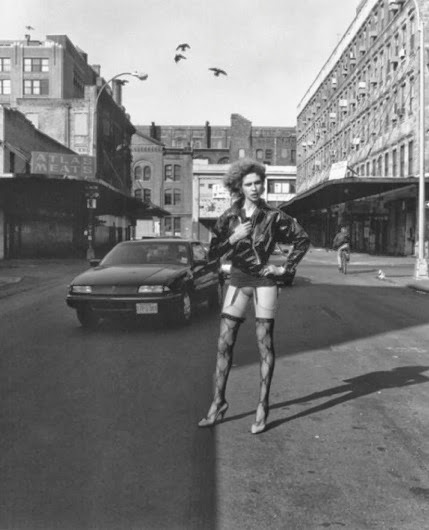
photo: Katsu Naito
Where did they go, all those working girls? Some no doubt were murdered, as marginalized transwomen too often are. Others found other strolls, in more dangerous neighborhoods. And some, I'm sure, quit the work. It's impossible to say. All we really know is that they're not a part of the High Line views.
Also see:
Meatpacking Before & After
Meatpacking 1985
Meatpacking 1980s
Life in the Triangle
Subscribe to:
Posts (Atom)