Tuesday, December 10, 2013

Bronx Gentrification

This past weekend, the Bronx Documentary Center organized and hosted the first annual Bronx Gentrification Conference. From past experiences at similar events, I expected a small crowd, but the place was packed to the rafters (turned away at the door, people stood outside in the cold to listen). From past experiences at similar events, I expected a docile group, but the people were angry, passionate, and desperate to be heard.


First, the panel made their opening remarks. It was, unfortunately, an all-white panel, made up mostly of people who worked in preservation and development. One man, an employee of HPD, talked about how his organization hasn't done much to bring in luxury development, but "we're pushing," because "we believe in economic diversity," and that the local community boards have been "demanding higher quality retail...national chains that best serve everyone in the community." The audience began to groan. But when he said, "If the definition of gentrification is about displacement, then, so far, gentrification hasn't happened in the South Bronx," one audience member shouted, "That's the stupidest statement I've ever heard!"

And we were off.

A mix of races and classes, the audience was a diverse group of concerned citizens from the Bronx and all over the city. People wanted to be included in the discussion, to organize, to get involved. One woman told the panel, "There's tons of us out here that you refuse to meet with because you don't like what we say and it makes you sweat." Young people asked what they can do to build community and provide political education to teens. A man from the East Village talked about the invasion of chains there, and asked why local community boards in the Bronx would want them. Audience members shouted answers: "Because they don't live here!" and "They don't know any better!"

Some people talked about wanting the benefits of gentrification without the displacement. One local woman who wanted to shop locally asked for ways to educate the mom-and-pops on how to do better business--for example, to sell fresh instead of rotten vegetables--and to "strengthen them so they can withstand a wave of gentrification." One working-class man bemoaned the loss of "a nice jazz cafe" that shuttered due to hiked rent and was replaced by, not an upscale business, but a pawn shop. "We want a nice cafe," he shouted. To which another man responded, "You put a nice cafe in my neighborhood, it's getting a brick through the window!"
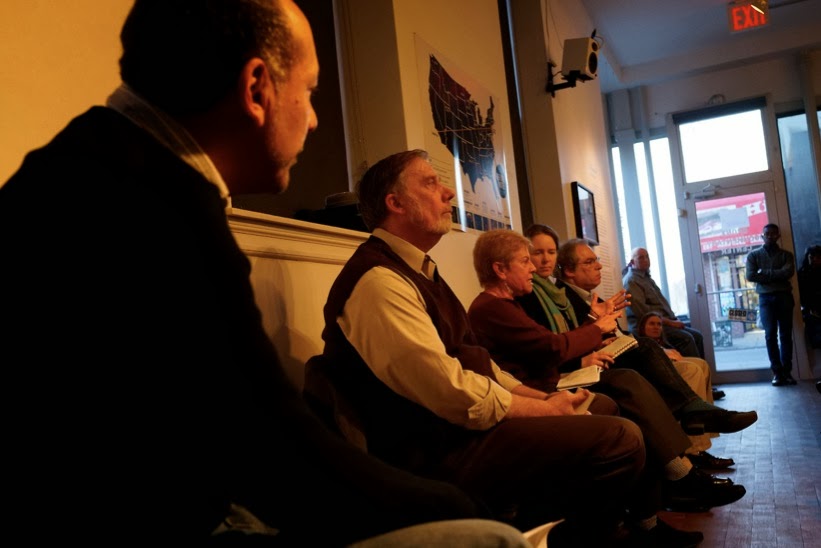

photo: Bronx Documentary Center

People told stories about their decades in the South Bronx, growing up in public housing, rescuing abandoned buildings, surviving, going to college, coming back. They talked about their fear of being priced out--and their fear of "SoBro" becoming the next new East Harlem.

The demographics of East Harlem and the South Bronx, explained the moderator, were the same until just four or five years ago. Now they're completely different. If you go there today, he said, "you'll think you're in Paris."

While some believe the Bronx will be the last to gentrify, it's never too soon to get organized. As Michael Kamber, founder of the Bronx Documentary Center, told the Daily News, “the Bronx is in a unique position because there has not been widespread gentrification. It hasn’t really happened on a large scale, and we want to be ahead of the conversation.


Monday, December 9, 2013

The War on Wieners

Yesterday, Cathryn Swan of the Washington Square Park Blog organized a rally in the park to save its hot dog vendors against the wrath of socialites. Thanks to reader Lois, a former vendor in the city's public parks, for sending in these photos from the event.


all color photos by Lois

As Swan first revealed on her blog (complete with secret documents!), a private group of "wealthy women" have incorporated themselves into a conservancy, a.k.a. "a little friends group," and are pushing to boot the “unsightly” hot dog vendors from the park, replacing them with more upscale food carts, along with a cart from celebrity restaurateur Mario Batali that will be allowed to remain. (Batali is on the board of the little friends group.)


The upper-crust cabal is run by John Leguizamo’s wife, Justine, and socialite Veronica Bulgari. John Leguizamo defended himself on Twitter, saying, “I wanna keep the hot-dog guy," and "We had nothing to do with it. The park did it on their own and we became the scapegoat.”

On the same day of the rally, the Post reported that the Parks Department was reconsidering its decision.


This isn't the first time that hot dog vendors have had to fight for their right to exist. Bloomberg got strict with them, his inspectors overcharging fines for various infractions. Also in the 2000s, the city tried to boot Vietnam veteran hot-dog vendors from in front of the Met. The vets won.

Rudy Giuliani tried the hardest to get rid of them in his 1990s Quality of Life campaign. As the Times wrote in 1998: "There is a difference between making the streets safer and cleaner and making war on the New Yorkness of New York City. In his zeal for order and obedience, he must not destroy the lively street scene that is part of the city's historic flavor. No one misses the squeegee men, but do we really want to outlaw the corner hot-dog stand?"

Ed Koch also cracked down, sweeping vendors from the busier streets for creating too much clutter. As the Times reported him saying in 1988, "This is not supposed to look like a souk."


Somehow, the hot dog carts and their vendors have come to symbolize disorder, disobedience, and the untamed spirit of the city. Maybe that's why many of us love them so much. They are among the last vestiges of the real New York, not controlled by big national chains and not branded "artisanal" with jacked-up prices.

The hot dog cart is utterly democratic. For over a century, it has been a low-threshold entryway to business for immigrants and others. There is nothing exclusive about the hot dog cart. It is not pretty and it resists control. That's exactly why it is problematic to the new urban elite, especially in today's luxury New York.


We've had enough of socialites dictating what the city is all about. Will Mayor de Blasio continue the war on wieners? Or will he give the humble and historic hot-dog cart (and its vendors) a break?


Hot dog vendor, 1910, via New York Times

Thursday, December 5, 2013

Doro's Annex

After 33 years in business, the upscale florist shop Doro's Annex has closed on 9th Avenue and 21st Street.


That part of town has been hyper-gentrifying fast. Does anyone know what happened here?

Wednesday, December 4, 2013

St. Mark's Books Auction

St. Mark's Bookshop is having a "Saved By the Book" auction to help benefit the store as it prepares to move to a new location. With signed rare and first editions from authors like Patti Smith, Paul Auster, Richard Hell, John Ashbery, and many more, the auction has begun online. It will also be happening live in the store, tomorrow night from 6:00 - 8:00 p.m. (There will be wine.)

Keep this great bookshop at home in the East Village. Click here for a full list of available items up for bidding.


I asked the bookshop's co-owner Terry McCoy a few questions about the auction and the future of the store:

Q: What do you think is the value of a signed, physical book in our digital age?

A: I think the value might be increasing, and will continue to increase, as people begin to feel the physical book is threatened. Look at the market in vinyl records. They are more obsolete than books are going to be for a long while, and they're trading for a lot of money among collectors. But I think books go beyond just "collectorism." Something special that's been signed by a writer you love can mean a lot.

Q: What can you tell us about the upcoming move? What are you hoping for?

A: "Hope" is the key word. We've looked at places we've liked for the last couple of years, but haven't closed the deal. We want to move by spring, we expect to be further east into the East Village, and we will have a smaller store.

Q: I understand you're putting together a community advisory board for the store. That's a great idea. What kind of input are you looking for from the community?

A: The advisory board idea is part of a general plan going forward to pursue a partially not-for-profit agenda which features community related projects. Everybody has been pretty much consumed with the here-and-now and being able to secure a future for the store, but that's going to be what we'll be aiming at if we succeed in relocating. So that's down the road a bit.

Q: Any added surprises at the in-store auction event? Guest appearances?

A: Some of the writers might drop by, but I can't make any promises. We are adding books every day, so, as of now, we have a few more to enter into the online site.

The auction site is up now. You can see some of the titles and what our "reserve" is. One of the values of the live, in-store auction is that people will be able to see the physical books that are part of the online auction. Our staff will be handling them, but they will show people anything they're interested in. Some books will be available to be bid on and won during the live auction. And there will be refreshments.


Read the story of St. Mark's fight to survive:
St. Mark's Success
Michael Moore at St. Mark's
Buy A Book Weekend at St. Mark's
Xmas in September
St. Mark's Vestibule

Tuesday, December 3, 2013

One 7-Eleven Down...

The 7-Eleven on St. Mark's Place has closed. EV Grieve was the first to report the thrilling news, noting that "Workers on the scene confirmed...that the store has closed."

I had to go look for myself. 


A peek inside the store reveals that the place is almost entirely emptied out. According to the Post's report on the closure, even the young people shunned it!

Immediately after opening, this 7-Eleven started threatening the future of Gem Spa across the street, a store that has been with us since at least the 1950s, and much beloved.


Meanwhile, the front window of this 7-Eleven was smashed--twice. Then the activist group "No 7-Eleven" formed, primarily fighting the 7-Eleven that opened further east on Avenue A. They held rallies, ran bodega tours, started petitions, and more--all to fight the invasion of this chain and others like it.

Years ago, Manhattanites defeated 7-Eleven. The chain tried to make it here, but no one shopped, so they failed, closing their last store in 1982. But then Manhattan changed. In the summer of 2005, the first 7-Eleven in 23 years returned, opening at 23rd and Park Avenue South. Many people were thrilled. They lined up to buy Slurpees. Since then, dozens (?) of 7-Elevens have followed.

Along the way, too many bodegas have fallen.


I don't know what the closing of this 7-Eleven means. I want to believe it's a watershed moment, a turning point, a sign that the people of this city are changing again--changing back to people who care more about local businesses than about "convenience."

But I would not (yet) dare to be so hopeful.


Monday, December 2, 2013

Colony for Christmas

As if getting Halloweenied wasn't humiliation enough, now the former site of Colony Music has been turned into a temporary Christmas store--with the treacly name "Christmas Treasures on Broadway."


From ADFeldman's Instagram, h/t Pippin Parker

I guess the landlord is having trouble finding a big-box national shopping mall chain store willing to pay the $5 million rent that put Colony out after 60 years in business.

See more unnerving photos on their Yelp page:


Wednesday, November 27, 2013

Jefferson Market to Luxury Sales

Awhile ago, there was some construction activity at the long-shuttered former site of Jefferson Market in the Village.


some months ago

Reader Lynne Lieberman checked in with the workers, who told her, "It will be a sales office and model apartment for the new St. Vincent's Hospital condominiums & that nothing else will go in there for at least 2 years." After that, it could become a Gap--though the worker who said that might've been yanking our chain.

Completed, the sales office has now opened for business.


There is no sign to mark its presence, just opaque white curtains covering the windows, the number 450 in elegant gold leaf on the doors, and a man in a suit and tie who opens the gates, one supposes, for those who look like they can afford a $29 million penthouse.

Very exclusive.


Jefferson Market, opened in 1929 and long beloved by Villagers, closed in 2008 for "restructuring." It reopened in 2009 as a Gristede's in mom-and-pop disguise. That closed in 2011 and Catsimatidis said he was considering reopening it again, this time as a full-on Gristede's, but that didn't happen. It was used briefly to house a temporary Halloween costume shop.

And now the shell of a once vital business is being used to sell uber-luxury homes built into the shell of a once vital hospital.

"Live exactly where you want," with "a staggering array of private amenities," say the big, splashy ads. (Check out the website if you want to have a conniption.) At the construction site this week, Yetta Kurland snapped this bit of graffiti--before it promptly disappeared: