Tuesday, June 11, 2013

Last of the Italians

With an essay in NY Press, artist and photographer Anne Kristoff began chronicling the last of the Italians in Manhattan's South Village, that one-time Italian enclave that's being swallowed up by Soho, as long-time small businesses like Rocco's, Pino's, and Joe's Dairy are taken over, threatened, or simply shuttered.

Anne has expanded the project to a wonderful website of photographs and audio that tells the oral history of the people and the place--click a photo and you'll hear a story.

Her work will also be on view during the Feast of Saint Anthony, June 13, at the Soho Gallery for Digital Art. I asked Anne a few questions about the project.


photos by Anne Kristoff

Q: What inspired you to chronicle the last of the Italians?

A: I started dropping in at St. Anthony's and began noticing that the senior women all arrived separately but then sat together. They all seemed to know one another. I began asking questions and it turned out that most of them had lived in the neighborhood for their entire lives. Many still lived in the apartments they grew up in. They attended St. Anthony's, went to St. Anthony's school, got married there, and raised their families in the neighborhood. Those that had married had all lost their husbands. Their kids had moved out to the suburbs. But they stayed and will not be leaving.

I wrote a story about them for NY Press/Our Town Downtown last summer and I had a lot of photos left over, so I applied for a Lower Manhattan Cultural Council Grant to produce an exhibit, and I found out in February that I got the grant! Since then, I've interviewed so many other people from the neighborhood that the exhibit went from being called "The Women of St. Anthony's" to "The Last of the Italians." The community that is left is strong but dwindling.

Q: How did St. Anthony's help to shape this community?

A: St. Anthony's is the "oldest existing parish founded for ministry to Italian immigrants in the United States." Anecdotally, I've been told that the parishioners at St. Anthony's were from one part of Italy, while nearby Our Lady of Pompeii was home to immigrants from another part of Italy. The two groups had a long running rivalry and didn't mix much. That has changed over the years as both communities have grown smaller in numbers.

Some of the women have told me stories of "Oh, you didn't go East of Broadway back then!" I guess for no other reason than because it was not their neighborhood.


Q: What was it like back then?

A: They tell me stories of whole families living in one building, no one locked their doors, everyone knew everyone and looked out for everyone. If you did something bad, by the time you made it home your family already knew about it. They would fly kites from the roofs, bring pots of sauce and pasta up to the roof for dinner. Swim in the water towers on the roof. Pushcarts lined Bleecker Street. You had everything you needed on your block--the butcher, the vegetable store, etc. Every day or so you'd walk the block to pick up whatever was needed for dinner that night. They all have tales of the 4th of July and how Vincent Gigante would put on a huge fireworks display every year on Houston St.

The fun thing about New York is that you can stand on that block and really imagine what it must have been like. The sad thing about New York is that it has changed irrevocably.


Q: With Joe's Dairy and Rocco's gone, what Italian businesses remain here?

I let the people from the neighborhood be my guide. They talk a lot about places that no longer exist. A lot of candy stores. Virginia's for sandwiches. A few places that they frequent have been around for a while but nothing from back when they were growing up. A lot of the women have been going to Villa Mosconi since the 80s. Frances Ciotta talked about Mosconi in her interview here (she died in December).

You still have Raffetto's and they have no plans of ever leaving. Romana (mother), son Andrew, and his daughter Sarah still run the business. Pino's is still on Sullivan. The women also frequent Arturo's a lot and are close with Lisa there.

I would say that the most authentic thing that still happens in the neighborhood would be the procession on St. Anthony day. They used to have a feast that rivaled San Gennaro and the procession was very long. Now it's shorter but it's really a good time. The church is packed to the gills, the balcony is opened. Everyone follows behind the statue of St. Anthony--up Sullivan, across Bleecker, down Thompson I think to Spring or Prince and then back up Sullivan. It's really neat to see.


Monday, June 10, 2013

Crest Art Show

Crest Hardware, on Metropolitan Avenue near Lorimer in Williamsburg, has been in business since 1962. They sold hardware for 30 years. Then, in 1993, they turned into an art gallery.

But this is not the same old story of the multi-generational mom and pop that gets run out of town by the slick gallerist. This story is much better.


In 1993, artist Gene Pool (you may remember him as the Can Man) asked Crest's owner, Manny Franquinha, if he could have some space in the front window to show his art. The neighborhood had just started changing, artists were moving in, and they bought their supplies from Crest. So Manny said yes.

The next year, as Manny tells it, Pool had the whole store, giving its shelves over to art each summer. The Crest Art Show was born.


The annual show went strong until 1999, when Pool left the city. It stopped for nearly a decade and was revived in 2008 by Manny's son, Joe, the new owner of Crest. With his friends, Joe has expanded the show to include a festival behind the store, complete with live music, beer, and burgers.

But it's the show itself you absolutely have to see.


All of it inspired by and related to hardware, more than 280 pieces of art are placed throughout the store, some in plain sight, some cleverly disguised. Roaming the aisles, you feel the thrill of an Easter egg hunt.

Sculptures and paintings hang side by side with store products--a painting of a padlock hides among actual padlocks, a painting of a hammer hangs among hammers, a sculpture involving Thomas Edison sits back among the light bulbs. Look carefully or you will miss them. Keep looking and you'll find more.


Look long enough and your perception shifts, a pleasant disorientation taking hold as the products on the shelves become undifferentiated from the art. That plastic piggie watering can? It could be a sculpture. That artfully arranged assortment of springs? Real or art?

The lines blur--between art and life, and between gallery-goer and everyday shopper. Throughout the exhibit, the store remains open to customers, so that people select plywood and duct tape and potted ficuses, leaving you to wonder if it's all part of the show. That man grinding a key, is he a performance artist? Everything becomes elevated in this atmosphere, touched by the unexpected, by the possible.


On opening day this past weekend, patriarch Manny Franquinha quietly watched over the happening, dressed in his red smock with cane in hand, greeting customers. I asked him about the show. He said, "It's like a neighborhood give-back. Lots of artists buy from us."


This is what can happen when the old and the new cooperate to co-exist. One feeds the other and is fed in turn. We don't need more banks and Starbucks and artisanal bakeries. We don't need a Potemkin Village of hardware stores and pharmacies and rock clubs that are "preserved" and turned into upscale other things. We need more collaborations like this one, between artists and mom-and-pops, if this city's life force is to be sustained.

The art is on display until August 18. Click here for more info. And watch Harvey Wang's short film below to see how Gene Pool (in his famous "grass suit") and hardware man Manny Franquinha got the show off the ground in the early 1990s.


Friday, June 7, 2013

*Everyday Chatter

"Facebook Inc. is moving its New York office south and nearly doubling its space, marking the latest technology company to set up shop in the city's Midtown South neighborhood." And by "Midtown South" they mean the East Village. [WSJ]

The New York City Marble Cemetery is open tomorrow. [NYCMC]

Check out "The Birdman," a film about the man behind Rainbow Music, a "hoarder's paradise" in the East Village. [vimeo]

Go to the 9th Street Bakery, buy something, and say goodbye. Sunday is the last day. [EVG]

Enjoy some rather vivid photos of Katz's pastrami-eating contest, by Tim Schreier. [Flickr]

"New York City has drastically changed, I don’t mean a block or two here and there but entire communities have been erased, as if they never did exist in the first place." An interview with Mick Dementiuk. [LM]

Visiting the ghost of Polo Grounds and Ebbets Field. [NSTAW]

Folsom East Tea Dance: “We got a lot of feedback from the community that were really disappointed about Folsom Street East being cancelled. There was a bunch of rumors about the community changing and pushing out events like Folsom Street East." [Next]

Goodbye to the Catene Deli. [OMFS]

Italian grandmothers review that place that took over Rocco's: "I'm not loving this. To me, it's like chopped liver in a pierogi. Sorry, darling." [Grub]

The closing of Paradise Garage. [DM]

The petition to save Pino's is growing--if you haven't signed or shared it, please do. [Petition]

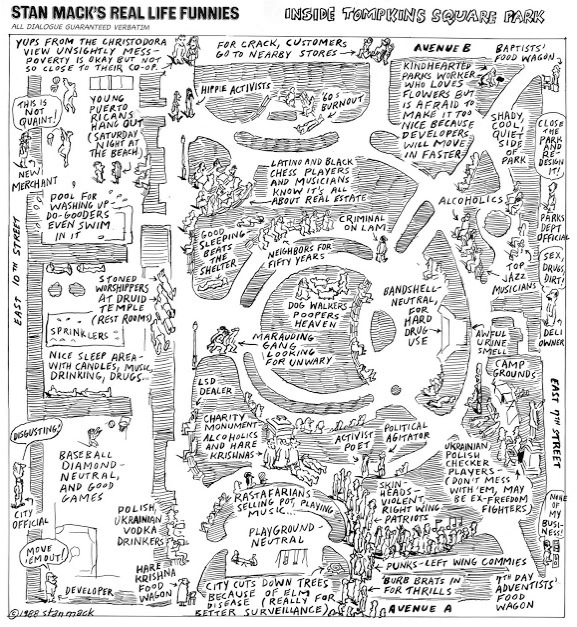
Stan Mack revisits the Mosaic Man and offers his wonderful 1988 map of Tompkins Square Park:

Thursday, June 6, 2013

Bell Bates

VANISHING

A couple of readers have written in to let us know that, after 128 years in business, Bell Bates natural food store in Tribeca is closing.


photo: Ron Greenberg

Tribeca Citizen first reported the story, saying, "it’s hard not to pin this as an inevitable consequence of Whole Foods coming to Tribeca." They hear the building has been sold to a school.

Located on Reade Street, Bell Bates has been family owned and operated in New York City since 1885.

“Oh no, oh no, oh no,” said one Tribeca resident to DNA when she heard the news. "Man, what a shame--this neighborhood is really changing. No more room for the mom and pop stores.”

Wednesday, June 5, 2013

Avalon has Landed

The Avalon West Chelsea has landed, and Jesus H. Christ is it big.


Avalon on W. 28th

According to the website, it consists of two buildings--one at a whopping 31 stories and the other at 13. One building is called Avalon West Chelsea and the other, capitalizing on the luxury park that spawned it, is called "AVA High Line."

We knew that 60,000 square feet, with 710 units and a parking garage for over 140 cars, was big, but until you see it live, you just cannot imagine. This one's a block buster--it takes up nearly the entire block between 28th and 29th Streets, and 10th and 11th Avenues. With no low setbacks, it's like a dark planet sucking light out of the sky.


From the Eagle's roof deck

We've been following developments on this block of West 28th for awhile. Someone must have pushed the light-speed button, because it's all happening. The little block has now been plunged into darkness. Walking on the block, which used to be open and bright, it feels like someone just bricked you inside a sarcophagus.

Right across the street, the gay leather Eagle Bar has its roof deck, soon to be invaded by neighbors too close for comfort. 

Because of all this construction, in part, Folsom Street East was canceled this year. 


Avalon from High Line

And it's not just the Avalon. Almost everything has been pushed out and demolished, thanks to the High Line and Bloomberg's luxury rezoning.

High Line Part 2 opened just two years ago, in June 2011, while Folsom went on below. Avalon West Chelsea broke ground across from the Eagle and the bar was raided by the NYPD, citing false noise complaints. In December 2011, one block over on 29th, Brownfeld Auto lost their business after a century here. It has been demolished.

In April 2012, demolition began on a former nightclub building on W. 28th, preparing for another massive tower to come. In June 2012, condo residents on the block began complaining about Folsom East, petitioning to have the fair removed. That year, for the first time and from the High Line, Christian right-wingers held protest signs telling the fairgoers they were sinners. Folsom East is unlikely to return to this block.

In January 2013, the Central Iron and Metal scrapyard, here since 1927, sold. It has now closed, part of the Great Die-Off of working class Chelsea, thanks again to the High Line. On my recent visit, I found two more blue-collar, auto-related businesses have gone.


Edge Auto Rental has shuttered, with a sign saying they've moved to Greenpoint.

And a mechanic's garage, in a prime spot right under the High Line, has closed up and moved to West 29th (how long will that last?)


This is all on one city block.

The area all around these former businesses has been demolished and cleared for new building. This is what hypergentrification looks like. Fed and nurtured by the city government, planned and strategized, it comes in fast and it comes in big. It wipes out everything in its path. Its appetite for destruction is boundless.

Where there was light and air, there will be darkness, brick, and glass. The High Line park is being suffocated, devoured by the beast it helped to create.


Behind Avalon, with Mr. Brownfeld's former site in rear

On their website, Avalon proudly calls itself "A Catalyst in Changing Neighborhoods," radically altering "neighborhoods that were 'up and coming,' but not yet 'arrived.'" Of Avalon West Chelsea, they say the building is contributing to "the revitalization of a neglected area." This area was not neglected. It was filled with thriving businesses and culture, just not the sort Bloomberg wants in his luxury city.

Well, here's a plus. A building of this magnitude is required to offer affordable housing, and 20% of Avalon's apartments fall under that rule. They're offering a percentage of those to "performing artists," and so they can claim that they're "ensuring the continued diversity of the Chelsea district." Here's a listing of those apartments.

Just think, if you lived here, you could have these people as your neighbors--instead of all the dirty queers, perverts, and working-class schlubs who long made this home.


See Also:
Disney World on the Hudson

Tuesday, June 4, 2013

NYC c. 1985

Clampart gallery in Chelsea is currently showing an exhibition of photographs entitled NYC, c. 1985 The group show includes work by Amy Arbus, Larry Clark, Nan Goldin, Mark Morrisroe, and many more, all featuring images of the city in the mid-1980s.

I talked with artist Linda Simpson about her photographs and she shared them with us here.


All photos by Les Simpson (a.k.a. Linda Simpson)

"My slideshow is all in color. It's a collection of very random snapshots that I took throughout the decade--all for fun and shot with basic point-and-shoot cameras. The photos are of friends of mine, after-dark events, celebrities that I shot at various encounters (including Liz Taylor!), ACT UP protests, Wigstock in Tompkins Square Park, etc.

My photo credit is 'Les Simpson,' since almost all the pictures were taken before Linda was born (in the late 1980s)."


"I was in NYC for practically the entire 1980s, and for me the decade was about finding myself. As the photos reflect, I didn't have a game plan. I was mostly just bouncing around, absorbing and observing the city. Near the end of the decade I began to find my niche, which was the East Village gay and drag scene.

My photos bring back a lot of great memories, and it's been an opportunity to reach out to some people I've lost contact with over the years. But I can't deny that there is some melancholy. It makes me realize even more that my youthful years are long gone. A lot of the people in the photos are dead. The slideshow is a tribute to them."


"I think what's important to remember about that time in the city's history is that it was extremely creative time. There were a lot of urban ills, but also it was time of much originality and imagination—in art, music, the nightlife, etc. New York had a very unique flavor back then.

When I moved into the East Village in 1987, the neighborhood was shabby and had an unsafe reputation. You rarely walked a straight route to get from Point A to Point B. Instead you zig-zagged to avoid blocks that were rough and only for drug dealers and addicts. Now the East Village is so much more tidy, and, of course, the rents are astronomical compared to when I moved in. My apartment on East 13th Street was originally under $400—and I never even had to put down a deposit! I moved out of the neighborhood in 2005. It was a great place to 'grow up' and I enjoy visiting. It's not the bohemian stronghold that I once knew, but it's still pretty lively."


"If I was young and moving to the city now, I'm sure my destination would be Brooklyn. There's an interesting drag scene in Bushwick that sounds right up my alley—avant-garde and DIY and pushing the boundaries of gender expression!"


Monday, June 3, 2013

Blarney Cove

VANISHING

Blogger C.O. Moed passes on the upsetting news that the Blarney Cove on East 14th will be closing this month. She writes:

"They changed one of the TVs to the Mets game, we got Rolling Rocks in big ass glasses because the Pabst only came in tall boys, the guy at the end of the bar played every version of every baseball song on the jukebox for us, including a song about being a Mets fan which really should be listed as a mental disorder in the diagnostic book and we watched the Mets play the Marlins. I asked the bartender when they'd be closing. 'End of June,' she said. 'It's sad.'"


Mars Bar, the Holiday Cocktail Lounge, and now Blarney Cove. A king among dive bars, it's been here for decades--maybe over 50 years--and still regularly tops "Best Dive Bar" lists for the city. Wendy Mitchell, author of New York City's Best Dive Bars, wrote: "In a city of homogenized bars, The Blarney Cove stands apart as a true one-of-a-kind."

And New York Magazine described it, "Blarney Cove isn't a faux dive bar, it's the real thing... one of the last places in the ever-gentrifying East Village where you can still hoist a Bud with characters who have earned their reputations over decades of serious drinking."

But the Cove's stretch of 14th Street has been changing dramatically--E.V. Grieve notes those changes in his coverage of the upcoming closure.
 

photo: Ken Micallef

I don't go often enough to the Cove, but when I do, it's always good, always a scene, always a story. Last time I wrote about it here, I noted:

At the Blarney Cove, old men hook their canes to the lip at the edge of the bar before taking their seats. One of those old guys says “ha-ha” and “ha-ha-ha,” not laughing, just saying "ha." And if you're lucky, you might overhear a mature lady explaining to another gray-haired fella all about her dear mother’s “nice pair of tits.”

The Cove has a rough-and-tumble reputation, but it's a friendly place. The second time I ever sat at the bar, Matty the bartender asked me if I wanted “the usual.” Since I’d only been there once before, I figured he had me confused with someone else, but he knew exactly what I wanted and how I wanted it. After my second drink, he bought me one on the house.


More dives on VNY:
Holiday Cocktail Lounge (vanished)
P&G (vanished)
Hickey's (vanished)
Mars Bar (vanished)
Dick's (vanished)
JJ's Navy Yard (vanished)
Ruby's (almost vanished)
Holland Bar (vanished, then revived)
Jimmy's Corner
Sophie's
Subway Inn

Also: Check out the documentary "New York Dive."