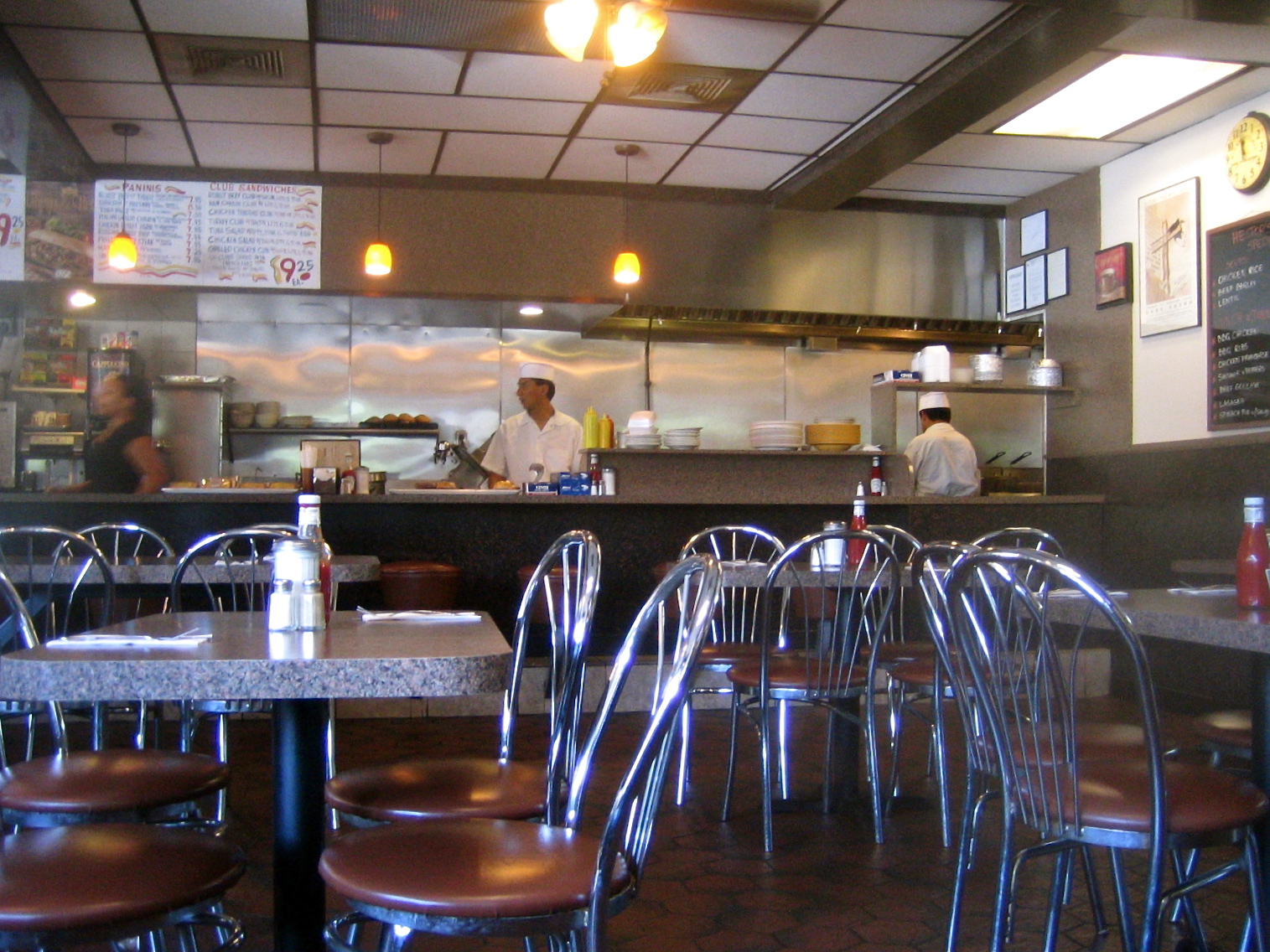
Sadie Stein lets us know that, after selling hand-made, vintage-style clothes in the East Village for 28 years, the D.L. Cerney boutique is leaving 7th Street.
I talked with co-owner Linda St. John about the closure. She said it's not about rent, it's just about time. She wants to get out of town for awhile and focus on her art and writing, as well as her farming upstate. She hopes to come back to the city, but not to the East Village.
"Back in the 1980s and into the 90s," she said, "this whole neighborhood was just filled with creative people. Now, nobody's left. The way Rudy cleaned up the neighborhood was awesome, but now it's too clean. When did those French bistros end up on Avenue D?"
She said that people don't spend money on hand-made clothes anymore, they want to buy "junk" from the chain boutiques. "It's psychological propaganda. People are told to shop there, so they do. I've seen people come in here wearing these low-waisted, pleated pedal pushers, and they look so dumpy, I mean, in these pleated, slob-making pants. But that's what's in style, so that's what they buy."
Clothes in the 1940s and 50s, she explained, were made to flatter the body. Anyone can look good in the right clothes. "Let me show you a constructed garment," she said, pulling out a lovely dress with a Chinese lantern plant pattern, orange on blue. She showed how the stitching in the sleeves was made to flex, "So you can dance and not worry about tearing a seam." It was the sort of dress you could imagine Kim Novak wearing in Picnic, all innocent Kansas girl, but steaming for Bill Holden underneath.
The shop will be open through November, and they'll be running a big sale until the end. Women's dresses and blouses are 50% off and menswear is 25% off.
If D.L. Cerney does come back one day, it might turn up in Chelsea, where Linda dreams of "2,000 square feet of space, with a white picket fence and bales of hay right up front."
It's been a week since my High Line op-ed came out in the Times and it's been interesting to read the response to it. The comments on this blog and its Facebook page were overwhelmingly supportive and positive, as were all the emails I received, including notes from several journalists. Many people commented that the op-ed gave them a sense of relief. "It needed to be said," said one, "but everyone else was afraid to say it."
A number of responses came out on other blogs. While Choire Sicha at The Awl and Kelly Chan at ArtInfo were largely in favor, author Matthew Gallaway and artist Paul Soulellis took offense. Treehugger wasn't crazy about it, either. And, of course, there were several unhappy commenters, here and on other blogs.
Rather than respond to each piece individually, I've summed up the main arguments against the op-ed and respond to them here.
The High Line is pretty and green, therefore it is made of perfect, total goodness.
1. You're right, the High Line is pretty and green.
2. Nothing is totally good. You might wish it to be that way, but in reality things are more complicated.
The High Line is innocent. It had nothing to do with gentrification in Chelsea. That process was already happening before the High Line got there. Saying the High Line is a gentrification machine is like "equating a cruise ship with a schooner" or "blaming the medicine for the cough" or something like that.
1. Yes, gentrification was already happening there, mostly around the Meatpacking District. But the High Line gave it a tremendous boost and helped to push it north. There is a direct link between the High Line and hyper-gentrification, especially of the area between Meatpacking and Bloomberg's Hudson Yards redevelopment. The Friends of the High Line co-founders talk about it quite openly in their book High Line, as when they explain how then Deputy Mayor Dan Doctoroff signed on to the park plan because they gave him a yes to the question, “Do you think that the community likes the High Line enough to make them supportive of the rezoning in West Chelsea?”
2. Several high-profile articles have been published that champion the High Line as a revitalizer of neighborhoods and an "economic dynamo." These articles put a positive spin on it, but the reality is the same--the High Line has helped to hyper-gentrify West Chelsea, and that means pushing some people out and bringing some people in. My argument is no different, it just comes from the critical side of the same reality.
3. What are you saying about schooners? I'm not following you.
You're a real complainer.
1. Yes, I am, and proud of it.
2. Complaining is one way of raising people's consciousness and maybe even getting things to change.
You're completely ignoring the fact that poor people live in New York City, too. In fact, your article doesn't say anything about people in other neighborhoods like in Brooklyn or the Bronx. Poor people want gentrification. I bet all the poor people who lived in the Bronx in the 1970s would love to have a High Line in their neighborhood today.
1. My article was about West Chelsea, not about other neighborhoods.
2. Many poor people (not all) do often welcome the first stages of gentrification--hoping for jobs and safety--until they get run out of their own neighborhoods by it. Then they're not so thrilled.
The High Line is right near a bunch of NYCHA housing projects, so having those poor people around balances out all the wealth moving in.
1. Correct, there is NYCHA housing nearby.
2. Balance? Have you taken a walk over there lately?
You're a gentrifier yourself--you're part of these big changes. You have no idea what it's like to be poor and want nice things (like artisanal popsicles).
1. I arrived in the East Village at least 30 years after gentrification had begun there. Did I benefit from that gentrification? Yes, I did.
2. My family was on welfare when I was a kid. I didn't live in abject poverty, but I have some idea what it's like to want and not have.
3. If you read it carefully, you'd know that my Op-Ed is not about the old-fashioned, gradual gentrification process. It's about government-engineered hyper-gentrification, which is a different animal. As CUNY professor Neil Smith explained here: In the 1980s "Gentrification became a systematic attempt to remake the central city, to take it back from the working class, from minorities, from homeless people, from immigrants who, in the minds of those who decamped to the suburbs, had stolen the city from its rightful white middle-class owners. What began as a seemingly quaint rediscovery of the drama and edginess of the new urban 'frontier' became in the 1990s broad-based market driven policy."
You want to go back to the 1970s. I guess you must love crime.
1. No, actually, I wasn't crazy about the 70s my first time around.
2. That tired, old "you like crime" argument is too stupid to address.
"It’s not wrong to want a coffee shop and a bakery... Believe it or not, people without millions of dollars also like to drink coffee and have fresh bread."
1. Are we still talking about the High Line?
2. I have nothing against coffee and bread, I swear.
In your piece, you don't even mention how pretty and well-designed the High Line is!
1. Yes, it is pretty.
2. About a million high-profile articles have talked about the High Line's physical attractiveness. I didn't think more praise was necessary--unless the High Line suffers from low self-esteem that must be continually propped up because it just feels so empty inside.
You're an elitist, snobbish Minuteman patrolling a border, trying to keep tourists out of New York City.
1. I don't have the power to keep anybody out of New York City. I wish I did. The city today would be very different.
2. Tourists from America and Europe are not the same as impoverished Mexican immigrants trying to find a better life--that's not a good analogy.
3. I don't hate tourists. Some of my best friends are tourists. But I do have a problem with Bloomberg turning New York into a city for tourists, instead of a city for its residents.
4. When did the right-wing Republican rhetoric of "elitist" become a weapon within Manhattan against the people who live here? Really, I want to know.
Autobody shops are closing! Who cares? They're dirty and cars are bad. You must be in love with autobody shops. Furthermore, people who drive cars are elitists.
1. Those autobody shops are (or were) run by small businesspeople and their families. Some of them for generations. That counts for something. At least, it used to. But maybe you'd prefer they get replaced by artisanal coffee shops and high-end bread bakeries--nothing elitist about that.
2. These mom-and-pop businesses will be replaced by corporate luxury chains or high-end condos. That's the antithesis of diversity.
3. I'm not in love with autobody shops. I don't own a car. The product is not the point. If those shops fixed umbrellas or made shoelaces, I'd point out their mass disappearance, too, and it would have nothing to do with any passion for umbrellas or shoelaces.
4. Again with elitist? What is that about? Fellow complainer Fran Lebowitz put it well when she said, "When Republicans, for instance, you know, disparage elites, they don't mean rich people. They love rich people. They mean smart people." So, if by "elitist" you mean I'm smart and want other people to be smart, too, then thank you.
But the High Line is so pretty! Why do you hate it so much?
1. Yes, once again, the High Line is pretty. It's pretty. It's very pretty!
2. Did I say I hated the High Line? I hate what it's doing to the neighborhood, true, but I also have complicated feelings about the thing itself, aside from its impact.
3. Do you believe that criticizing is the same as hating? Those aren't the same things. I criticize many things that I actually like and that only enhances my experience of it. We need to think more critically about more things more of the time. Our city would be better off if we did.
It's not getting its exact wish, but pretty close.
2009
A Department of Buildings permit has gone up in the window, along with the familiar brown paper that always comes with a move-in.
The renovation calls for "ten new yoghurt machines." And the march of the fro-yo chains continues.
But which fro-yo chain will it be? Pinkberry? Red Mango? 16 Handles? There are so many to choose from.
The architect on the permit is listed as MK Dream Design. They do plastic surgeon offices, beauty spas, and futuristic dance clubs. In the yogurt world, they designed The Yogurt Shop in Englewood, New Jersey, to look like an intergalactic cafe on a spaceship.
Is this what's coming to what was once a place for amputees to find new limbs? Where the upstairs was a haven for writers and artists? Change happens. But why, in the new New York, does it always have to go in the same mind-numbing direction?
Author and NYU professor Mark Crispin Miller is a member of the organization NYU Faculty Against the Sexton Plan (NYUFASP), a group that's fighting NYU's plan to bulldoze the Village for more development.
I asked Mark some questions about the plan, NYUFASP, and the fabulous book While We Were Sleeping: NYU and the Destruction of New York (which you can buy here or pick up at the McNally Jackson bookstore).
JVNY: Tell us a little bit about putting together the book While We Were Sleeping. It's got a fantastic roster of writers. How did you know who'd be able to write with anger and clarity about NYU expansion?
MCM: We didn't know, but it did work out beautifully. Peter Carey worked especially hard to help us fill that dazzling roster out. He also came up with the title, and got Tom Slaughter to provide us with the cover illustration. NYUFASP owes him a lot—and so will NYU, if it survives the Sexton Plan.
We're also indebted to Sarah McNally [of McNally-Jackson Books], as the book was her idea, and she's essentially the publisher, as her staff designed it, and the copies are all printed right there in her extraordinary bookstore.
Fran kicks ass--in conversation with Mark
JVNY: In your introduction to the book, you talk about the "death blow" NYU's plan will deal to the city. Can you quickly outline what that means, what you see happening if this plan continues?
MCM: Beyond its toxic impact on those two large residential blocks, right in the heart of Greenwich Village, the project sets a devastating precedent for every neighborhood in New York City, because of what the City Council gave away to NYU's administration. They didn't have to do it, but they did, because NYU demanded it.
First of all, the City Council changed the zoning, not in the best interests of the public or the city overall—on the contrary. The public, NYU's own faculty included, argued overwhelmingly, and cogently, against re-zoning the neighborhood for commercial purposes, but they—we—were all ignored. Thus the City Council, pressured heavily by Christine Quinn and Margaret Chin, shrugged off the objections of Quinn's and Chin's constituents, and favored NYU's administration and trustees, just because the latter asked for it
Second, the City Council nullified an urban renewal agreement that NYU signed decades ago, barring any new construction on the south "superblock" before 2021. There are many such agreements city-wide. That the City Council simply wiped out that agreement, just because NYU asked them to, does not bode well for other neighborhoods all over.
And, third, the City Council sold NYU precious strips of public land, while giving them broad easements over other public land—just because NYU demanded it. Thus they let NYU either build outright on what was public property, or ravage it to make way for construction.
That the City Council did all this at the mere whim of a giant developer—since that's what NYU has now become—bodes ill for every New York City neighborhood that could be overbuilt, and so destroyed.
The Sexton Plan
JVNY: What has NYU's response been to the book and to FASP?
MCM: No response. They seem intent on not acknowledging that we exist—i.e., that their own faculty are overwhelmingly opposed to this mad project.
To date, 37 departments and divisions have voted against the Sexton Plan, nearly all those votes unanimous or near-unanimous. Those dissenting bodies include the Stern Business School, which voted 52-3 against the Plan; and the Economics Department, which was unanimous against the Plan—meaning that its three Nobel Prize winners are against it, too. Aside from such prestigious, large departments as English, History, Mathematics, Anthropology and Sociology (all of those unanimous against the Plan), there are also the Gallatin School and the School of Social Work. And more bodies will be casting votes this fall.
Of the 30 departments in the School of Arts & Science, only six have not yet voted. One of those is actually against the Plan, but won't conduct a vote, having preferred to convey its qualms to Sexton privately; and two others will be holding votes this fall. So that leaves only three that seem resolved to back the Plan no matter what, though even they may change their minds, the more they learn.
And yet Sexton and his people say the Sexton Plan enjoys "amazing" faculty support, even though their list of pro-Plan faculty includes a grand total of 18 names.
They have to make such claims, and otherwise play down our broad and ever-growing opposition, because the truth is a PR disaster for them—i.e., that the Sexton Plan is really not an "NYU expansion plan," as they like to call it. How could it be, when we, the faculty, are NYU, and we don't want it? This plan, rather, is supported only by the president, a few of his associates, and certain powerful figures, primarily the real estate developers, on NYU's Board of Trustees. (That's why we call it "the Sexton Plan.")
Also, it would help them if they could laugh off the opposition as a cranky rabble of obstructive locals. That narrative—the noble University, beset by its weird, backward-looking "neighbors"—has always helped to undercut the opposition. Since we're allied with the community against the Plan, that narrative no longer works.
JVNY: How do you, and others, manage the tension of working for NYU, benefiting from NYU, teaching its students, and your own feelings about how NYU is behaving in the neighborhoods around it? It must be complicated.
MCM: I can speak only for myself, although I'm confident that many of my colleagues feel as I do. As one who lives, and has a family, in the neighborhood targeted for devastation, I have to say it's been less painful to combat the Plan than it would be to sit here waiting for the bulldozers to roar in and tear up the trees. And one great benefit of that horrific project is that it's brought us close together to each other and our neighbors all throughout the Village.
But it's been hard, living in the shadow of the wrecking ball—a little like having an armed drone always hovering high overhead. And it's also been hard bumping up against the indifference—maybe the word is "corruption"?— of the city agencies, and, especially, our elected representatives. Scott Stringer was downright abusive when some of us went in to see him, and the Council Members obviously tuned us out. That hasn't been fun.
And then there's the tension you bring up, of opposing your employer/landlord. All in all, it has been pretty hard. It's definitely had an impact on my health, and I am not the only one. But the alternative, which is to let the Plan go through, would be far worse for everyone; and so we have no choice but to continue doing all we can to stop it.
JVNY: The Sexton Plan has been approved by the City Council. What happens next?
MCM: No need to hang our heads, because we haven't been defeated, even though we lost the battle on that front—which we knew would happen. So we prepared to fight the Sexton Plan through other means; and with a little help from everyone who cares about the Village and the city overall, and everyone who cares about the university itself, we're going to win.
First of all, we have a powerful law firm, Gibson Dunn, working for us, and readying lawsuits on our behalf. The firm has a great record halting ill-conceived construction projects on behalf of the communities opposing them. Because the Sexton Plan is not unique, but just another case of runaway development in Bloomberg's New York City, we're joining forces with a lot of other groups that are fighting similar developments all over town—in SoHo, Chelsea, the East Village, Harlem, Brooklyn, Queens, you name it. In short, we're fighting not just to protect our own two blocks but—just like you, Jeremiah, and with you—for the very heart and soul of New York City.
Another consideration compels us to fight Sexton's plan—the unbearable debt burden carried by our students. NYU's tuition is among the highest in the country, and our undergraduates leave here more indebted than any other student cohort nationwide (among the graduates of private universities). Because NYU has a very small endowment, the Sexton Plan would be financed mainly by more student debt—an arrangement both precarious and wrong.
And so our fight to halt the Sexton Plan is actually a fight both for the city and the university—that is, all cities and all universities today, as both are under threat by the same interests. This is why our friends and peers at other schools throughout the city—Columbia, the New School, Hunter, CUNY Grad Center, Brooklyn College—are also joining forces with us, forming their own FASP chapters in solidarity with our attempt to save NYU, the university, from "NYU"—the corporation.
JVNY: What can people do to help?
MCM: We need funds to pay our lawyers, our PR team, and our small, highly dedicated staff (all former students). Donations are tax-deductible, and anyone who donates at least $18 will receive a copy of While We Were Sleeping.
Checks, made out to NYUFASP, may be mailed to:
NYUFASP
51 MacDougal St.
Suit 255
NY, NY
10012
For donating online, or by credit card, click here.
Each morning around 4:00, before opening his business, Dionisios Manesis goes next door to Weichsel Beef's outlet in the Gansevoort Market to buy fresh meat for making burgers at his Hector's Cafe and Diner under the High Line.
Weichsel's large, main plant is a few blocks away--it's the last free-standing meatpacking plant in the neighborhood and they've occupied it for the past 45 years. But now they're about to lose it, reports The Real Deal.
I wrote about the Weichsel plant back in November, looking at the luxury flood that was encroaching all around it. Weichsel is located on the extreme margin of MePa, out of sight and out of mind. But the High Line brought the Whitney Museum to Weichsel's doorstep, and there's no way Weichsel and its swinging sides of beef would be allowed to stay.
Weichsel will be shuffled out of its home and moved completely into the city-run Gansevoort Market Co-Op, where the endangered lease was extended to 2031 in exchange for giving a piece of itself to the Whitney. So all is not lost. Still, it is a loss of ground, and the end of an era. And what's moving in to Weichsel's space? "8,340 square feet of high-end retail."
Mr. Manesis will still be able to get his beef--and it makes for good burgers. I talked with him while writing my High Line Op-Ed for the Times.
When I asked Mr. Manesis "How was business before the High Line opened?" he told me, "It was much better. Now there are no people around. The High Line brings people, but only on some days. On Friday, Saturday, and Sunday there are people, but only during the day. At night they go to the clubs. It’s not like before. Nothing’s coming back."
Hector's
The rents in the area, he said, just keep getting higher. "Maybe 10, 15 years ago, the landlords were giving it away, rent was almost free. $300 or $400 a month. Now there’s nothing less than $25,000 a month."
He pointed out the window at the boutique across the street, "$55,000 a month." Then he pointed to another, "$75,000 a month." Finally, he pointed to a salon down the block, "$105,000 a month."
Hector's burger
The city owns Hector’s building, so he’s okay--for now. Still, it's not like the bustling days before the High Line, before MePa went glam. He used to have 22 employees, but has had to cut down to 14. He used to stay open 24 hours, now it's much less. But he'll keep buying burger meat from his neighbors, as long as the city honors that co-op lease.
Still, fewer people are opting for Hector's big, fresh burgers. As Mr. Manesis said, "Now, around here, people spend $30 on a little hamburger, frozen."
By now you've heard the news, first released yesterday here and since spread like wildfire, that Colony Records must close its long-standing Times Square home in the next month or so. Today, the Post followed up on the story and reported that the reason for the closure is not just because we all have iPods, it's because Colony's landlord is quintupling the rent to $5 million.
The Brill Building was sold in 2007 to Stonehenge Properties for $151 million. Here's the rendering they present of the future Brill at 1619 Broadway--and Colony's space--on their website today:
"Generation," a fantasy big-box flagship store features the usual glass and glitz, the horror of contemporary life in New York City. And here's how they're marketing it:
"Amazing opportunity for a brand to control a high-trafficked corner location"--can accommodate "big box"--in the spot where a family-run business thrived for 6 decades and contributed so much to America's cultural history.
THE BOOK:
"We should all buy Jeremiah Moss’s book, Vanishing New York." --Sarah Jessica Parker
“Essential reading for fans of Jane Jacobs, Joseph Mitchell, Patti Smith, Luc Sante, and cheap pierogi.” --Vanity Fair
"a vigorous, righteously indignant book that would do Jane Jacobs proud." --Kirkus Reviews
THE BLOG:
"the go-to hub for those who lament New York's loss of character." --Crain's
"No one takes stock of New York's changes with the same mixture of snark, sorrow, poeticism, and lyric wit as Jeremiah Moss." --Village Voice, Best of NY
“Jeremiah Moss…is the defender of all the undistinguished hunks of masonry that lend the streets their rhythm.” --Justin Davidson, New York Magazine
"One of the most thorough and pugnacious chroniclers of New York’s blandification." --The Atlantic, Citylab
"Hyperbolic and combative, tireless and passionate." --Salon