Thursday, September 11, 2008

*Everyday Chatter

Let's start the day with two miracles in the EV.

1. Unless some celebu-chef is pulling an Eldridge and disguising itself as an old EV staple, Kim's has landed in the former Kurowycky spot, saving us from yet another noisy, bustling upscale eatery, as reported here first:


2. When tailor/cleaner Michael Alter announced he'd be retiring, in part due to rising rents, we assumed that his spot and the vacated Fontana spot would be combined in one big something bad. Mr. Alter has retired, but another tailor/cleaner has taken his place, a friendly Asian woman who promises to "keep the same low prices." Miracles do happen:


If you missed the punk panel at Howl, now you can watch it here. [Stupefaction]

Keep waving bye-bye to the Bowery because here goes another chunk--and here comes another big shiny box. [Curbed]

Do some shopping at Sahadi's with BaHa. [SE]

How 9/11 Sells

September 11 changed us. Remember how, in the weeks following, as the smoke cleared, New York felt more cohesive? The whole city seemed to bind together in a warm, shared sorrow. The baker clapped your shoulder as he handed you a loaf of bread, waitresses gave you sad little smiles of recognition, strangers on the street moved tenderly around each other. It was an unexpected good feeling that could not last--and didn’t.

This feeling of connectedness soon crumbled. War began. Our streets rumbled with the noise of demolitions like aftershocks in the wake of the fallen towers. Glass high-rises began rising everywhere, as if to make up for the loss of those 220 floors. And the new buildings were stuffed with banks and stores.

The personality of this city changed as "Consume!" became New York's anxious war cry.


It has been well documented that Americans changed their consumer habits drastically after 9/11. Now, in the paper "The Sweet Escape," researchers Naomi Mandel and Dirk Smeesters take a fascinating look at why.

The authors discovered that when many people think about their own death they tend to eat, drink, and shop more. They become super-consumers. You might think people do this out of a desire for hedonistic pleasure, "I'm going to die, so I might as well live it up." But this is not what the research showed.


Instead, the study revealed the critical role of self-esteem. People with "high levels of self-esteem were less impacted by thoughts of death--and therefore less likely to increase their levels of consumption when dealing with those thoughts--than those with low self-esteem."

People with low self-esteem become ravenous consumers, instead of moderate, thrifty consumers. Such people, says Mandel, "are trying to put all of these [death] thoughts out of their minds. They want to escape from self-awareness. They don't want to confront the fact that they don't live up to cultural standards, and one way to do that is through overeating or over-consumption.”

Marketers know all about this dynamic and they use it to sell products. Just as our politicians have used 9/11 to sell themselves and their policies, stoking the fears of an insecure populace.


waiting for the iPhone

Narcissists are particularly known for their low self-esteem, though they may appear confident. This article in Harvard Magazine lays out the difference between narcissism and self-esteem, explaining clearly how self-loathing underlies the narcissist's apparent grandiosity.

After 9/11, a confluence of factors converged on New York City. Which came first, our dominant culture of narcissism or super-gentrification? Maybe it happened like this: Those already here with low self-esteem became hyper-consumers. The city fed that hunger with more stores, restaurants, condos, bars, and banks. New York must have begun looking like an all-you-can-eat smorgasbord to the insecure and fearful across America. And they flocked to come feed themselves, too.

It amazed me that after 9/11, more people came to New York than left, as if terror exerted a strange attraction.


cupcake feeding frenzy

The toll of 9/11 continues to reverberate in many different ways. People still suffer flashbacks and anxiety, along with grief for lost loved ones. Perhaps we must also include in that day's rolling tally of losses the vanishing of our city's mom-and-pops, priced-out artists, evicted poor and middle classes, and the tens of thousands of fallen buildings that once made up the fabric of our city.

Maybe the terrorists are "winning" after all.

Wednesday, September 10, 2008

*Everyday Chatter

Heated floors and shit flushers--the lives of the rich just keep getting richer. [Curbed]

The Mets' old homerun apple will be put out to pasture in favor of a polished new apple. Natch. [Gothamist]

I like Paul Auster and he's reading tonight from his new novel. [Gothamist]

Spittoons have been lost in 21's renovation. [CR]

How to tell the Hiltons from the Olsens and be a real New York man. [EVG]

Tuesday, September 9, 2008

*Everyday Chatter

The old EV flea by 12th and A may be getting flipped for luxe housing. [Curbed]

Take another trip to Doyers Street and the Nom Wah tea parlor, this time circa 1961. [HunterG]

The New Bowery claims another victim--in a move "likely to speed the transformation of the area surrounding the New Museum." [NYT] via [Curbed]

Check out "Counter Culture," a photo exhibit of Brooklyn's vanishing storefronts by James and Karla Murray. Opening Sept. 10 at the Brooklyn Historical Society. [Urban Image]

Fratboys were the first to claim the abandoned Christodora House for themselves. [EVG]

Are any of us "immune to housing-in-peril hysteria" these days? Not I. And not this resident of StuyTown either. [Villager]

One man, nineteen years, a lot of shoe leather, every street in Manhattan. [Coffeedrome]

City of Glass

EV Grieve points us to this week's extensive article in New York Magazine on the transformation of New York into a city of glass.

Chronicling the massive architectural shift, Pulitzer Prize-winning critic Justin Davidson gives readers a pretty incredible before-and-after collection of photos and such startling numbers as: "In the past fifteen fat years, more than 76,000 new buildings have gone up, more than 44,000 were razed, another 83,000 were radically renovated."


Davidson is critical but ultimately optimistic about the changes. He writes, rather eloquently, "I hear in the cacophonic symphony of construction the sound of a still vigorous and hungry city. I see in all that moving of dirt and hoisting of concrete panels the New York I’ve always known: unsentimental and steadfast in its refusal to stay the same, yet vigilantly proud of its past."

Part of me wishes I could see it this way. To have such hope would be less painful. Instead, I'll stick with urban nostalgist and poet James Merrill, a league I'm happy to let Davidson put me into when he writes:

"As pieces of the city evaporate, they take our memories with them. It gets hard to remember which block that old Chock Full o’Nuts was on or what was next to a lamented laundromat. This chronic amnesia is part of the New York condition. In his 1962 poem 'An Urban Convalescence,' James Merrill captured the feverish yet methodical sacking of the city and the way it toys with our sense of comfortable familiarity.

As usual in New York, everything is torn down
Before you have had time to care for it.
Head bowed, at the shrine of noise,
let me try to recall
What building stood here.
Was there a building at all?


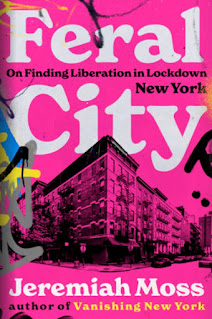
Among Merrill’s disciples is one Jeremiah Moss, who maintains the engagingly gloomy blog Jeremiah’s Vanishing New York, which he terms 'an ongoing obituary for my dying city.' His topic is the steady erosion of the city’s texture. He is the defender of all the undistinguished hunks of masonry that lend the streets their rhythm and give people a place to live and earn a living: bodegas, curio stores, a metalworking shop in Soho, diners, and dingy bars."

Monday, September 8, 2008

*Everyday Chatter

Full coverage of the Slacktivists' "Donut Social" this past weekend, complete with DEP sound meters, flying donuts, and tazerings. [NMNL]

Tonight: Enjoy the celebration of the Black Madonna at Phoenix Bar in the EV. [IADP]

The Post endorses McCain and The International Bar. Should we worry? [EVG]

Remembering the walls of Minetta's. [GVDP]

Brooklyn trendsters scared of jail reopening in their nabe. [Post]

Bankers, lawyers, Facebook partiers, Philippe Starck-dwellers all try to remain in denial as the tsunami of foreclosure descends upon Manhattan. [Times]

Enjoying burlesque in Tompkins Square Park. [Blah]

RIP for Astroland--is it really gone? [RH]

Astroland liquidated. Buy Dante's Inferno for $225,000. [GL]

Take a final ride through Dante's Inferno with this podcast. [BotB]

Can Coney still be saved? [AntiKris]

Old Newsstands

I wrote about the disappointing changeover from the old newsstands to the new Cemusa boxes here and here. Recently, Forgotten New York invited me to do a more extensive piece on the old newsstands, with lots of photos. It was a pleasure to write something more in depth and to contribute to Kevin Walsh's most excellent site.

Please click here to read the article at ForgottenNY.


credit: Rachel Barrett

In my on-the-street research for the story, I snapped a bunch of pictures, but they don't compare to the work of Rachel Barrett. Her NYC Newsstand Project was featured in a New York Times story and slideshow this summer, and I later spoke with her about her work.

In 2006, she began seriously capturing the old stands with her camera. In her artist statement, she writes, “I was driven by a sense of nostalgia, a need to hold on, a refusal to let go. Photographs allowed me to do that, not just document something but record the end of an era, the what was that will never be again.”

I asked her what she thought of the new kiosks and she told me, “The Cemusa stands have no character, each one is just like every other--cold and robotic. A huge aspect of making the work was to demonstrate the loss of the individual, how the old stands were so evocative and emblematic of the neighborhood or the proprietor or the customers, and these new ones are completely void of all of that."


credit: Rachel Barrett

She has so far photographed 236 stands and is still tracking down the more elusive ones. Most elusive, though, has been commentary from the vendors. Rachel told me, "very few were willing to really talk to me, the camera definitely puts people on the defensive. I remember one man down in the financial district said he was looking forward to the new stand because they told him it would be much bigger and much easier to operate his business out of. I'm not sure they told him that he would lose his business to the city."


credit: Rachel Barrett