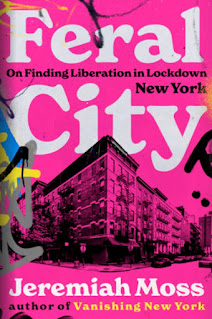
Wednesday, September 11, 2019
September 11: From "Vanishing New York"
Until September 11, 2001, New York was not quite America. From its Dutch beginnings, the city existed as a space apart. Exceptionally able to tolerate, and celebrate, a multiplicity of cultures and ways of living, it had been both the gateway to America for foreign immigrants and the escape from America for those who never fell in line with the American way of normal. New York was a liminal space between inside and outside, a threshold neither here nor there but ultimately itself. It was a city that permitted transgression, the crossing of old boundaries, whether that meant a Jewish immigrant from Russia casting off her wig, or a young man from Nebraska putting his on (with false eyelashes to match).
In The Island at the Center of the World, Russell Shorto writes, “It was no coincidence that on September 11, 2001, those who wished to make a symbolic attack on the center of American power chose the World Trade Center as their target. If what made America great was its ingenious openness to different cultures, then the small triangle of land at the southern tip of Manhattan Island is the New World birthplace of that idea, the spot where it first took shape.” Its multicultural receptivity arguably made New York the most truly American city, but not the Heartland version. It was something else. As Djuna Barnes said in 1916, it was “the only city where you can hardly find a typical American.”
When Al Smith, the Italian-Irish New York governor from the Lower East Side, campaigned for U.S. president in 1928, the Heartland rose against him as a Catholic, the son of immigrants, and a New Yorker. The Ku Klux Klan burned crosses on the tracks when his train came to their towns, and they warned constituents to be ready for Smith’s arrival, crying “America is for Americans!” In publications, they howled about the Roman Catholic “alien hordes” that had “invaded America,” determined to destroy democracy. “Already they have captured many large cities.” And no city had been more corrupted by alien hordes than New York. From his radio pulpit, Reverend John Roach Straton denounced Smith, accusing him of everything the Protestant American Heartland believed was wrong with New York: “card-playing, cocktail drinking, poodle dogs, divorce, novels, stuffy rooms, dancing, evolution, Clarence Darrow, overeating, nude art, prize-fighting, actors, greyhound racing, modernism.”
This view of the modern city was not fringe, but the extreme expression of a common American sentiment, one that would endure for decades. In 1977’s Annie Hall, Woody Allen might have had Straton’s speech in mind when he joked, “The rest of the country looks upon New York like we're left-wing Communist, Jewish, homosexual, pornographers.” In New York Calling, urbanist Marshall Berman recalled the anti-New York venom that streamed from 1970s America, when politicians asked their constituents, “Should New York live or die?” And their constituents chanted, “Die! Die! Die!” The city had reached its modern-day pinnacle of exceptionalism—and delinquency. For much of the nation, and for the conservative leaders in Washington, New York was a perversion, a dirty town full of dirty people, and now it would be punished and reprogrammed.
When President Gerald Ford essentially told the city to “drop dead,” denying a federal bailout to prevent bankruptcy, a presidential spokesman likened the city to “a wayward daughter hooked on heroin.” Like a rebellious teenager kicked out of the house, the city dis-identified further from the mother country, elevating itself in the process. If America was rejecting New York, then New York would reject America. Saul Steinberg’s 1976 New Yorker cover, "View of the World from 9th Avenue,” famously expressed the city’s sense of superiority with a map in which Manhattan is detailed, central, important, while the rest of the country, crammed between the Hudson River and Pacific Ocean, is just an insignificant sketch. In “My Lost City,” Luc Sante recalls, “in the 1970s, New York was not a part of the United States at all. It was an offshore interzone with no shopping malls, few major chains, very few born-again Christians who had not been sent there on a mission, no golf courses, no subdivisions. Downtown, we were proud of this, naturally.”
That vaunting pride did not endear New York to middle America. Talking to Ric Burns for his New York documentary, architecture critic Ada Louise Huxtable explained: "The combination of power and money and creative vitality has created a city that we New Yorkers are very chauvinistic about and rather disliked for all over the world; we're considered just not in touch with the rest of the world. Well, maybe we're not, and maybe that's a good thing, maybe the fact that we are doing all this creative work is something that is so unique, and so special, that it does make New York a city unlike any other."
As late as the 1990s, after more than a decade of City Hall working to make New York more likeable to the average American, the heart of the Heartland still wasn’t having it. New York magazine published a 1995 cover story that explained “Why America Hates New York.” In short, we were liberal, multicultural, and bereft of right-wing Christian family values. “New York is more than ever considered Sodom on the Hudson,” wrote the magazine. “More chillingly, [right-wing America’s] hatred for us is commingling with the conviction that New York is anachronistic, vestigial, and on its way to being expunged.” The Protestant American right, after disparaging the liberal city for a century, now saw a future in which New York would be overtaken by their values. “New York is a dinosaur,” Georgia politician Gordon Wysong told New York. “We’re the power now. These suburbs, built on white flight, are only going to become more conservative and more powerful. New York has been deposed.” Revenge was in the air.
The conservatives of America could see the changes coming, and they were gleeful. In the spring 1995 issue of City Journal, a publication of the neoliberal, neoconservative Manhattan Institute, David Brooks published a critique on “out-of-step New York,” scolding snobbish city folk for looking down on Middle America. “Over the longer term,” he wrote, “New Yorkers might—dare I say it?—change. New York liberalism will gradually dissolve; cultural attitudes will drift toward the mainstream.”
Looking back from a post-9/11 and post-Bloomberg position, these words offer an eerily prophetic message. But how could we ever have imagined the expunging of New York? Drift toward the mainstream? The city’s utter queerness—if we take “queer” to mean everything eccentric, suspicious, and strange—acted as a repellent that kept out the dull and unimaginative. Being hated by America was good for the city. And, ultimately, good for America. Every family needs a black sheep to keep it interesting.
And then.
On the morning after 9/11, in a cloud of dust and despair, the fractured, frightened city awoke to find itself cradled in the arms of the nation. In their murderous act of terrorism, the attackers managed to strip away New York’s grandiose exceptionalism and, humbling the city, made it accessible. Beneath the collective grief, America was enervated by the trauma, moved to a state of heightened arousal that pulled it magnetically toward Ground Zero, a smoldering hole that quickly became a tourist attraction, complete with grisly souvenirs. The attack was a colossal taking down a peg for wayward, arrogant New York. In the dark privacy of the human heart, who doesn’t feel a bit of Schadenfreude when a swaggering giant falls? Milton Glaser, creator of the “I Heart NY” logo, put it less cynically when he said of the post-9/11 city, “A powerful giant is one thing. A vulnerable giant is much more loveable.”
Into wounded, loveable, suddenly huggable New York rushed the Heartland with its homemade chicken soup for the soul. After that day, we heard the phrase “We are all New Yorkers” echoed across the country--and the globe. The statement appeared in the UK’s Guardian, France’s Le Monde, and in the program for a Carnegie Hall concert of the Berlin Philharmonic, echoing JFK’s famous “We are all Berliners” speech: ''At this terrible moment, we are the ones who say with you, 'We are all New Yorkers.’” America was attacked, but it was the city that fell to its knees. Capturing the touristic national sympathy, a cartoon in the regional newspaper Florida Today painted a suburban scene: Houses displaying American flags, one man watering his lawn in an “I Heart NY” t-shirt and Yankees cap, another pushing a lawnmower in a “Times Square” t-shirt, and a woman walking her dog with “NYC” spelled across her chest. For good measure, the dog wears one of those foam-rubber Lady Liberty crowns that tourists love. They’re waving to each other, as folks in Florida do, above the caption, “In light of recent events, we’re all New Yorkers.” It’s a supportive message that yet contains an ominous proprietary undertone. The city is ours. Here we come.
In 2004 the Republican National Convention came barging into liberal New York for the first time in history. Deep in enemy territory, with angry protestors howling at the gates, Bush supporters banged the drums of 9/11, waving the tragedy like a flag. Governor George Pataki told the delegates, “On that terrible day, a nation became a neighborhood. All Americans became New Yorkers.”
The Big Apple, the Rotten Apple, was done for. The vulnerable, diminished city became as acceptably American as apple pie. Soon after 9/11, the New York Observer announced, “The Heartland Loves New York,” claiming it had become “the most American of all cities.” A year later, The Economist called New York a “sweeter Apple” and “a nicer place” since the attacks. Sweet and nice? Those two words had never, I would wager, in the city’s long and turbulent history been seriously used to describe the unwieldy, throbbing thing that was New York. Something was changing in the civic atmosphere. While terrorism alone didn’t turn the tide of America’s sentiment toward New York, it surely accelerated a process already in place. In The City’s End, a history of America’s murderous fantasies towards New York, Max Page observed, “City leaders had made much of Manhattan safe and clean for tourists. A nation far more willing to be sympathetic to New York was fully on the city’s side after 9/11. Pity after the disaster bloomed into a surge of love for New York.”
Tuesday, September 10, 2019
Papaya Dog to Hair Masks
Twitter tipster Sara Harvey, a Brooklyn resident, let me know that something horrifying happened to Papaya Dog on 6th Avenue in the Village.

Gisou, Instagram
It was turned into a pop-up for hair care products. Expensive hair care products.
Dogs and fries were rapidly replaced by honey-infused hair masks and texturizing wave sprays.
Yelp has it marked down as "closed."

cititourofficial, Instagram
But fear not. The pop-up was only temporary. I gave them a call tonight. They answered "Papaya Dog" and told me "We're back again."
Let this be a warning to us all.
This Papaya Dog has been under threat of closure, so it may be a matter of time before something like this becomes a permanent installation. Read more here about the last remaining dog-and-papaya shops in town (minus some since then) and why they remain as important as ever to many New Yorkers.

Gisou, Instagram
It was turned into a pop-up for hair care products. Expensive hair care products.
Dogs and fries were rapidly replaced by honey-infused hair masks and texturizing wave sprays.
Yelp has it marked down as "closed."

cititourofficial, Instagram
But fear not. The pop-up was only temporary. I gave them a call tonight. They answered "Papaya Dog" and told me "We're back again."
Let this be a warning to us all.
This Papaya Dog has been under threat of closure, so it may be a matter of time before something like this becomes a permanent installation. Read more here about the last remaining dog-and-papaya shops in town (minus some since then) and why they remain as important as ever to many New Yorkers.
Monday, September 9, 2019
Gem Spa Makeover and Cash Mob
This Saturday, September 14, at 12:00 noon, come spend some money at Gem Spa--and Instagram the shit out of it.

At #SaveNYC, we are hosting a Cash Mob to help support this beloved and historic East Village business. Get some stuff--egg creams, pretzels, t-shirts, toothpaste!--and take your photo with a surprise work of guerrilla street art, as an acclaimed group of cultural activists and designers radically transform Gem into a dystopian vision for the new St. Mark’s Place.
The event will take place from noon to about 2:00, rain or shine, but you can visit and spend your money any time. Gem Spa is located on St. Mark's Place at the corner of Second Avenue in the East Village. (View the Facebook invite here.)

At #SaveNYC, we are hosting a Cash Mob to help support this beloved and historic East Village business. Get some stuff--egg creams, pretzels, t-shirts, toothpaste!--and take your photo with a surprise work of guerrilla street art, as an acclaimed group of cultural activists and designers radically transform Gem into a dystopian vision for the new St. Mark’s Place.
The event will take place from noon to about 2:00, rain or shine, but you can visit and spend your money any time. Gem Spa is located on St. Mark's Place at the corner of Second Avenue in the East Village. (View the Facebook invite here.)
Thursday, August 29, 2019
Paris and Beekman
VANISHED
The Paris Theater, along with the Beekman 1 & 2, has shuttered after a combined 111 years of life.

In June we heard the Paris might be closing. Then in July, I was told by employees and management that it was definitely not closing and the news was just rumor. I was not convinced and wrote, "As with all rumors and denials, take it as a warning. Go, enjoy the Paris, enjoy the movie. Because you really never know when it will be your last time."
Yesterday, tipster Dan Braun alerted me via Twitter that both theaters have gone missing from the City Cinemas website. The Paris Theater page goes to Page Not Found. Their telephone message about showtimes extends only until August 15. No one's answering the phone at the Beekman either.
After some further digging, Joe Wagner on Instagram has posted the goodbye note from the Paris:

Dan Braun says, "Both buildings which house the Paris and the Beekman 1 & 2 share the same landlord, Sheldon Solow. He might have decided he simply no longer wanted movie theatres as tenants. City Cinemas’s lease on the Paris is scheduled to end this month."
From a look at the comments at Cinema Treasures, it sounds like City Cinemas had 10-year leases for both sites--and those were not renewed. As I've noted on this blog many times, there are no protections for thriving businesses that want to stay put. No Small Business Jobs Survival Act. No commercial rent control. Nothing.
Meanwhile, Mr. Solow is doing alright. Forbes has him worth $5.2 billion. This is not the first time the Paris has shuttered due to a lease. Back in 1990, the theater closed. The Paris' managing director at the time told the Times, "It's obvious that we weren't wanted. We had a 20-year lease that expired on Aug. 31, and we offered Solow market rent--much more than we had been paying. But our offer was turned down flatly, and they gave us no explanation." In the end, the Paris changed management and went on showing art films for the next three decades.
Is there hope for another comeback? So far, Solow has not commented on the closure.

Opening in 1948, via Cinema Treasures
The Paris opened in 1948, "with Marlene Dietrich cutting the ribbon in the presence of the Ambassador to France," according to Cinema Treasures. It was the last of the great single-screen cinemas in Manhattan, it was loved by many, and it will be greatly missed.
As Joe Queenan wrote on the occasion of the Paris' 60th anniversary for the Times in 2008:
"The Paris is the kind of establishment where, when you show up, not one but two pipe smokers are congregating outside. They are throwbacks to an era when emaciated young men raved about Samuel Beckett, questioned the political ramifications of existentialism and lined up to see Brigitte Bardot in '... And God Created Woman' while meticulously cleaning their meerschaums. Some people may think this sort of thing is a bit passé and corny. The folks at the Paris do not agree. Neither do I."

Little Edie and the Maysles, via Cinema Treasures
As for the Beekman, the original opened in 1952 and closed in 2005. It was demolished, writes Cinema Treasures, and the "Beekman name was moved to Clearview’s New York One & Two across the street," which was originally the Loews One & Two, opened in 1979.
It was perhaps not as beloved, nor as special, as the Paris, but it is a loss.
Here's the Beekman's goodbye--same text as the Paris:

photo by Michael Lorin Hirsch
And so two more independent art-house cinemas have been ripped from our lives. And more culture gets flushed down the drain of this new New York City. But, hey, we'll always have Starbucks.
See Also:
Lincoln Plaza Cinemas
The Paris Theater, along with the Beekman 1 & 2, has shuttered after a combined 111 years of life.

In June we heard the Paris might be closing. Then in July, I was told by employees and management that it was definitely not closing and the news was just rumor. I was not convinced and wrote, "As with all rumors and denials, take it as a warning. Go, enjoy the Paris, enjoy the movie. Because you really never know when it will be your last time."
Yesterday, tipster Dan Braun alerted me via Twitter that both theaters have gone missing from the City Cinemas website. The Paris Theater page goes to Page Not Found. Their telephone message about showtimes extends only until August 15. No one's answering the phone at the Beekman either.
After some further digging, Joe Wagner on Instagram has posted the goodbye note from the Paris:

Dan Braun says, "Both buildings which house the Paris and the Beekman 1 & 2 share the same landlord, Sheldon Solow. He might have decided he simply no longer wanted movie theatres as tenants. City Cinemas’s lease on the Paris is scheduled to end this month."
From a look at the comments at Cinema Treasures, it sounds like City Cinemas had 10-year leases for both sites--and those were not renewed. As I've noted on this blog many times, there are no protections for thriving businesses that want to stay put. No Small Business Jobs Survival Act. No commercial rent control. Nothing.
Meanwhile, Mr. Solow is doing alright. Forbes has him worth $5.2 billion. This is not the first time the Paris has shuttered due to a lease. Back in 1990, the theater closed. The Paris' managing director at the time told the Times, "It's obvious that we weren't wanted. We had a 20-year lease that expired on Aug. 31, and we offered Solow market rent--much more than we had been paying. But our offer was turned down flatly, and they gave us no explanation." In the end, the Paris changed management and went on showing art films for the next three decades.
Is there hope for another comeback? So far, Solow has not commented on the closure.

Opening in 1948, via Cinema Treasures
The Paris opened in 1948, "with Marlene Dietrich cutting the ribbon in the presence of the Ambassador to France," according to Cinema Treasures. It was the last of the great single-screen cinemas in Manhattan, it was loved by many, and it will be greatly missed.
As Joe Queenan wrote on the occasion of the Paris' 60th anniversary for the Times in 2008:
"The Paris is the kind of establishment where, when you show up, not one but two pipe smokers are congregating outside. They are throwbacks to an era when emaciated young men raved about Samuel Beckett, questioned the political ramifications of existentialism and lined up to see Brigitte Bardot in '... And God Created Woman' while meticulously cleaning their meerschaums. Some people may think this sort of thing is a bit passé and corny. The folks at the Paris do not agree. Neither do I."

Little Edie and the Maysles, via Cinema Treasures
As for the Beekman, the original opened in 1952 and closed in 2005. It was demolished, writes Cinema Treasures, and the "Beekman name was moved to Clearview’s New York One & Two across the street," which was originally the Loews One & Two, opened in 1979.
It was perhaps not as beloved, nor as special, as the Paris, but it is a loss.
Here's the Beekman's goodbye--same text as the Paris:

photo by Michael Lorin Hirsch
And so two more independent art-house cinemas have been ripped from our lives. And more culture gets flushed down the drain of this new New York City. But, hey, we'll always have Starbucks.
See Also:
Lincoln Plaza Cinemas
Tuesday, August 27, 2019
Two Toms
The Gowanus building that houses the excellent Two Toms Restaurant is up for sale.

A tipster on Twitter alerted me to the Trulia listing. It offers the building for $3 million and exclaims, "LOCATION EQUALS OPPORTUNITY! Searching for the perfect investment property found in one of the hottest neighborhoods in Brooklyn?"
Also, as ominously noted, "Currently the space is occupied by Two Toms Restaurant, but this space may also be delivered vacant, if necessary."
Two Toms has been in business since 1948 when it was opened by Tom Giordano and another Tom. It's been family-run since and is one of the last authentic red-sauce joints in a city where red-sauce joints are vanishing.
Enjoy the wood paneling and definitely get the pork chop. Before some asshole comes along and fucks it up.


A tipster on Twitter alerted me to the Trulia listing. It offers the building for $3 million and exclaims, "LOCATION EQUALS OPPORTUNITY! Searching for the perfect investment property found in one of the hottest neighborhoods in Brooklyn?"
Also, as ominously noted, "Currently the space is occupied by Two Toms Restaurant, but this space may also be delivered vacant, if necessary."
Two Toms has been in business since 1948 when it was opened by Tom Giordano and another Tom. It's been family-run since and is one of the last authentic red-sauce joints in a city where red-sauce joints are vanishing.
Enjoy the wood paneling and definitely get the pork chop. Before some asshole comes along and fucks it up.

Friday, August 23, 2019
Bill's Flower Market
VANISHING
Bill's Flower Market opened in 1936. They are closing this month.

The sign in the window says the owners are retiring. It is another loss for the rapidly vanishing Flower District, which has been taken over and demolished by tourist hotels.
Reader Marjorie Ingall let me know about the closing. She writes, "Jim, Bill’s brother and co-owner, said he’s ready to retire and spend time with his grandkids in Nassau and Suffolk county, but high rent is a factor too. I bought a turkey made with real feathers that I will turn into a holiday centerpiece, two rolls of beautiful floral ribbon, and a tiny nest with two eggs and a sparrow. We both reminisced about when the Flower District went from 26th to 29th, Broadway to 7th Avenue. He said, 'It’s all fancy hotels now.'"

When I went by, Bill's was closed for the day, shutting down now at 3:00 in the afternoon, so I could not go in to see the artificial birds they are famous for. They used to have a sign that said something like "World's largest collection of artificial birds" and it was pleasant to go in and have a look at them.
Through the window I could see that most of the shop has been dismantled and emptied out. They're having a big sale on lucky bamboo and, while they still have a few birds for sale, the big displays are gone.
Here's what they looked like a few years ago:


Bill's Flower Market opened in 1936. They are closing this month.

The sign in the window says the owners are retiring. It is another loss for the rapidly vanishing Flower District, which has been taken over and demolished by tourist hotels.
Reader Marjorie Ingall let me know about the closing. She writes, "Jim, Bill’s brother and co-owner, said he’s ready to retire and spend time with his grandkids in Nassau and Suffolk county, but high rent is a factor too. I bought a turkey made with real feathers that I will turn into a holiday centerpiece, two rolls of beautiful floral ribbon, and a tiny nest with two eggs and a sparrow. We both reminisced about when the Flower District went from 26th to 29th, Broadway to 7th Avenue. He said, 'It’s all fancy hotels now.'"

When I went by, Bill's was closed for the day, shutting down now at 3:00 in the afternoon, so I could not go in to see the artificial birds they are famous for. They used to have a sign that said something like "World's largest collection of artificial birds" and it was pleasant to go in and have a look at them.
Through the window I could see that most of the shop has been dismantled and emptied out. They're having a big sale on lucky bamboo and, while they still have a few birds for sale, the big displays are gone.
Here's what they looked like a few years ago:


Wednesday, August 21, 2019
Seido Karate
VANISHING
Guest Post written by William Hennelly, an editor/writer and Seido Karate black belt
Down the block from the Flatiron Building in Manhattan sits another local landmark — the headquarters of the World Seido Karate Organization. Since 1976, the school founded by Kaicho (“Grandmaster”) Tadashi Nakamura has trained thousands of martial arts practitioners at 61 West 23rd Street, where it also has operated the Seido Juku Benefit Foundation, a charitable nonprofit.
Nakamura, 77, is a revered karateka worldwide, particularly in his native Japan, a status he earned in 1962 by knocking out a muay thai fighter in Bangkok in a much publicized international clash of fighting styles. But now Kaicho and his son, Nidaime (“Successor”) Akira Nakamura, 44, who is Seido’s chief instructor, are faced with a daunting opponent outside the arena — the New York City real estate market.

The owners of the 1886 Italian Renaissance-style building that houses the headquarters — or “Honbu” in Japanese — are repurposing the building, and all existing tenants must vacate by year-end. The family that owns the luxury men’s fashion company Ermenegildo Zegna, based in Milan, Italy, along with Taconic Investment Partners LLC, a Manhattan-based real estate developer, bought the building in June 2016 for $65 million, according to The Real Deal. The previous owners were the Drachman family of Long Island and their relatives, who had the seven-story building for more than 50 years.
The search for a new Honbu has been underway for some time, and Nidaime is currently looking at three rental properties near the current 23rd Street location. Seido recently launched a GoFundMe.com campaign to raise $250,000 toward escrow, a heating, ventilation and air conditioning system, a new dojo floor, office and locker rooms with ADA-compliant bathrooms. Live and online auctions also are planned.

In his office at Honbu, Kaicho recently recounted how he would traverse the neighborhood in the 1970s, scouting locations, when he came across the building that would become Honbu. “In the daytime, not many people walking around, then very, very quiet at night,” he recalled of a neighborhood that was not as prosperous and desirable as it is now. It’s that desirability that has made the neighborhood a costly place to operate what is essentially a family business.
The New York dojo is something of a karate museum. Its gleaming wooden floor has been polished by decades of vigorous martial arts activity seven days a week. “We have a veterans program, we run a disabled program, a program for blind students with Seido Juku Benefit support,” Kaicho said. “Not many organizations do that. We are all proud of that. I hope people keep this kind of spirit... Lots of wonderful, different kinds of memories, which is our treasure. It’s almost a miracle, same location for 43 years.”

The dojo’s walls are festooned with various proclamations by US presidents and New York City mayors. Over the years, Seido students from across the globe have come to visit and train at Honbu, as have some celebrities. Dolph Lundgren, who played the Russian heavyweight boxer Ivan Drago in Rocky IV, stopped by once in the hopes of meeting Kaicho. In 2018, two of the stars of the 1984 movie The Karate Kid — Ralph Macchio, who portrayed Daniel LaRusso, and William Zabka, who was Daniel’s rival Johnny Lawrence — traveled to New York for an interview with AdWeek magazine to discuss Cobra Kai, the YouTube Red sequel to their movie franchise.
Seido also has stood witness to other events in history. In 2001, the Seido community was stunned by the loss of Sensei Pat Brown, a New York City fire captain who gave his life in the 9/11 attacks on the World Trade Center. In 2012, undaunted Seido karatekas practiced with no heat and electricity in the aftermath of Superstorm Sandy. And while Seido is proud of its illustrious past, it is up for a new challenge.
“The members of the organization must now take the time to reflect on the rich history of the space and appreciate the time left to train and grow there, but also look now to the future, to bring the same energy and dedication to bear in finding, securing and building a new home for the World Seido Honbu,” Nidaime wrote in a letter to members in June.
Guest Post written by William Hennelly, an editor/writer and Seido Karate black belt
Down the block from the Flatiron Building in Manhattan sits another local landmark — the headquarters of the World Seido Karate Organization. Since 1976, the school founded by Kaicho (“Grandmaster”) Tadashi Nakamura has trained thousands of martial arts practitioners at 61 West 23rd Street, where it also has operated the Seido Juku Benefit Foundation, a charitable nonprofit.
Nakamura, 77, is a revered karateka worldwide, particularly in his native Japan, a status he earned in 1962 by knocking out a muay thai fighter in Bangkok in a much publicized international clash of fighting styles. But now Kaicho and his son, Nidaime (“Successor”) Akira Nakamura, 44, who is Seido’s chief instructor, are faced with a daunting opponent outside the arena — the New York City real estate market.

The owners of the 1886 Italian Renaissance-style building that houses the headquarters — or “Honbu” in Japanese — are repurposing the building, and all existing tenants must vacate by year-end. The family that owns the luxury men’s fashion company Ermenegildo Zegna, based in Milan, Italy, along with Taconic Investment Partners LLC, a Manhattan-based real estate developer, bought the building in June 2016 for $65 million, according to The Real Deal. The previous owners were the Drachman family of Long Island and their relatives, who had the seven-story building for more than 50 years.
The search for a new Honbu has been underway for some time, and Nidaime is currently looking at three rental properties near the current 23rd Street location. Seido recently launched a GoFundMe.com campaign to raise $250,000 toward escrow, a heating, ventilation and air conditioning system, a new dojo floor, office and locker rooms with ADA-compliant bathrooms. Live and online auctions also are planned.

In his office at Honbu, Kaicho recently recounted how he would traverse the neighborhood in the 1970s, scouting locations, when he came across the building that would become Honbu. “In the daytime, not many people walking around, then very, very quiet at night,” he recalled of a neighborhood that was not as prosperous and desirable as it is now. It’s that desirability that has made the neighborhood a costly place to operate what is essentially a family business.
The New York dojo is something of a karate museum. Its gleaming wooden floor has been polished by decades of vigorous martial arts activity seven days a week. “We have a veterans program, we run a disabled program, a program for blind students with Seido Juku Benefit support,” Kaicho said. “Not many organizations do that. We are all proud of that. I hope people keep this kind of spirit... Lots of wonderful, different kinds of memories, which is our treasure. It’s almost a miracle, same location for 43 years.”

The dojo’s walls are festooned with various proclamations by US presidents and New York City mayors. Over the years, Seido students from across the globe have come to visit and train at Honbu, as have some celebrities. Dolph Lundgren, who played the Russian heavyweight boxer Ivan Drago in Rocky IV, stopped by once in the hopes of meeting Kaicho. In 2018, two of the stars of the 1984 movie The Karate Kid — Ralph Macchio, who portrayed Daniel LaRusso, and William Zabka, who was Daniel’s rival Johnny Lawrence — traveled to New York for an interview with AdWeek magazine to discuss Cobra Kai, the YouTube Red sequel to their movie franchise.
Seido also has stood witness to other events in history. In 2001, the Seido community was stunned by the loss of Sensei Pat Brown, a New York City fire captain who gave his life in the 9/11 attacks on the World Trade Center. In 2012, undaunted Seido karatekas practiced with no heat and electricity in the aftermath of Superstorm Sandy. And while Seido is proud of its illustrious past, it is up for a new challenge.
“The members of the organization must now take the time to reflect on the rich history of the space and appreciate the time left to train and grow there, but also look now to the future, to bring the same energy and dedication to bear in finding, securing and building a new home for the World Seido Honbu,” Nidaime wrote in a letter to members in June.
Subscribe to:
Posts (Atom)