Thursday, August 13, 2015

B&H Reopening & Party

After being shuttered since the Second Avenue gas explosion, and struggling with bureaucratic red tape, the East Village's beloved B&H Dairy is finally set to reopen tomorrow morning for breakfast at 9:00 AM.

In addition, Andy Reynolds, the local neighbor and dedicated advocate who has been working tirelessly to help keep the place going, lets us know:

"We are planning a grand opening party on the following Friday, August 21. Details to follow, but from what I understand, they will clear out the tables and chairs, and just be serving cakes and coffee and challah."


Fawzy and Ola, today's mom and pop of the B&H, photo from GVSHP

#SaveNYC will be there. With many of you, we've supported B&H since their closure, pushing City Hall to take action to speed up permits and get this place running again. We hope you will join us and everyone who loves the B&H to celebrate the (miraculous, really) saving of this priceless mom and pop.

In addition, B&H is almost at their crowdfunding goal. But expenses keep piling up. Says Andy, "Last night they were told out of the blue they needed a new gas meter, $500!" Please donate at You Caring.

For the latest news on B&H, visit their Facebook page.


Previously:
History of B&H
Save the B&H
Second Ave Small Biz Crawl

Wednesday, August 12, 2015

Hollow New York

Hopefully by now we can all agree that the rent in New York is too damn high. For residents, yes, but also for small businesses. The city is becoming a hollow shell.

In a story last week about our dying bodegas, the New York Times reported: "According to a report from the Real Estate Board of New York, the average commercial rent in Manhattan rose 34 percent from 2004 to 2014."

And what's coming in to replace the bodegas (and everything else)? National and international chains. "In 2014, the city experienced the largest increase in chain stores in four years, and the sixth straight year of growth in chains."


In a story about our dying laundromats, which are vanishing from expensive and hyper-gentrified parts of town, the Wall Street Journal reported that rents are going up--by large percentages--and forcing out the laundromats. In addition, apps like Cleanly and Washio are taking business and killing the mom and pops.

The problem is happening in San Francisco, too, where techies have completely taken over. Writes Jack Smith at Tech.Mic, "As wealthy startup employees drive up rent and force out residents who depended on the convenience of nearby laundromats, those laundromats are now closing down... Services like Washio act like handmaids to wealthy young elites."

One Google employee's response to the problem was to dismiss it as "the cost of disruption," saying laundromats are no longer necessary. (Except, of course, for those of us who still need them.)

It's not just New York and San Francisco that are suffering from mass corporatization and murder by rent hike, it's the whole country (and the whole Western World). Grub Street just pointed to data that shows that, in another year or two, the majority of America's restaurants will be chains.


When landlords know they can get chains to pay high rents, they kick out small businesses--and leave the spaces empty for years. This creates what Tim Wu at The New Yorker called "high-rent blight." Entire neighborhoods are being wiped out and left as ghost towns. Think it's an exaggeration? Check out this piece over at Tribeca Citizen -- 100 vacant storefronts, all photographed, one after another, all pushed out by landlords demanding too-high rents.

Here's how Alan Ehrenhalt at Governing explains the issue: "Landlords sometimes jack up the rent not because they have a chain tenant in the wings, but because they hope to snare one. The landlords call them 'credit tenants.' In the meantime, there are tax deductions to be claimed. And if the building was a recent purchase, the landlord is paying off the acquisition at interest rates much lower than those that would have prevailed at any time in recent history.

In any event, the die-off is real. The question is whether the local government has the power and the political will to do anything about it."


Tribeca Citizen

Plenty can be done about this problem. And City Hall has the power. But no one is doing it.

This is a crisis of culture. It is a crisis of individuality and diversity. We can't save the world from this mind-numbing, soul-killing wave of monoculture, but we can #SaveNYC. And New York has been a driver of global culture from its beginnings.

I've said it before and I'll say it again: Let's put a stop to exorbitant rent hikes on mom and pops by passing the Small Business Jobs Survival Act. Let's stop the spread of chains by passing a city-wide ordinance to control them. Let's fine landlords who leave their spaces open for longer than six months.

Here's what you can do to help. It's really not that hard. This city is worth saving.


Tuesday, August 11, 2015

Block Drugs T

Block Drugs, the great old (since 1885) pharmacy in the East Village, with the great old neon sign, now has an official t-shirt.

It's black and it features that gorgeous neon. Perfect.


Why not show your neon-loving, local mom-and-pop pride and support this business by dropping 20 bucks on a shirt? Get it at 101 2nd Avenue.

Monday, August 10, 2015

Christopher's NYC

You know that odd little t-shirt shop on the corner of Christopher Street and Greenwich Avenue? The one with all the pre-faded Blondie and Bowie shirts in the window? It appears to be gone. Unless they're just renovating, but it doesn't look like it.


It was called Christopher's NYC and it had been there for some time. The reader who tipped me off says it was there for decades. Another said for 41 years.

It was praised a few years ago on Racked: "This obscure and random T-shirt shop gives you the feeling you're walking into a tourist trap but once inside, you realize you've stumbled into something special."


The inside of the shop today looks ransacked, the floor covered with papers, signs, junk. John Lennon wearing his New York City t-shirt. A suit jacket hangs from the ceiling.

This block of Greenwich Avenue is vanishing fast. Many of the storefronts are sitting empty, including recently shuttered Grano Trattoria and the Firestore. I don't know why Christopher's closed, but I bet it will sit empty for awhile, adding to the high-rent blight of the area.

You can still buy their t-shirts online.


Wednesday, August 5, 2015

Art Brut on Hudson

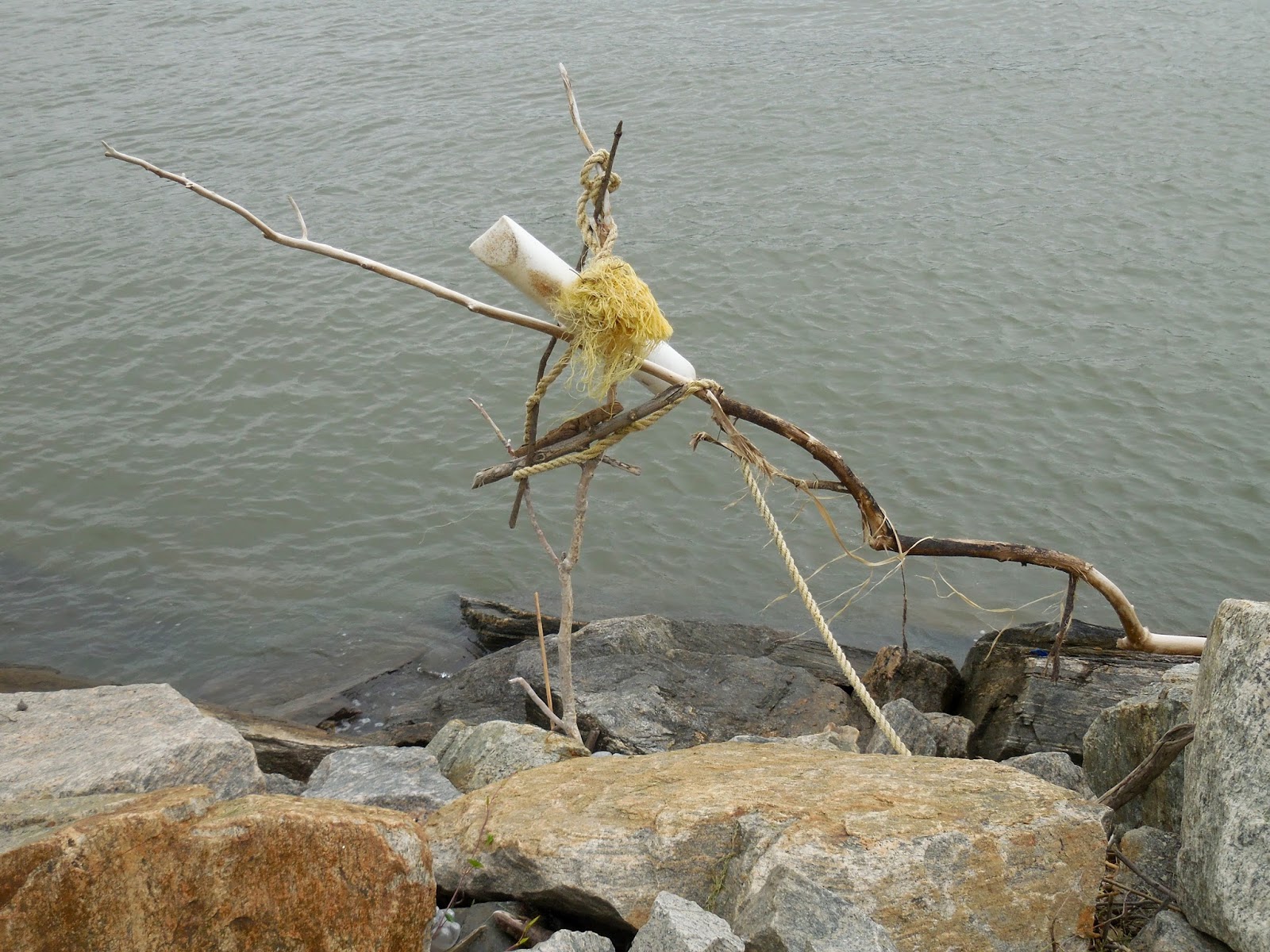
Up along the Hudson River Greenway, somewhere around Harlem, if you're going on foot or by bicycle and you're paying attention, you'll find some odd pieces of art.


Gathered from the detritus that washes up from the Hudson, they don't seem to be commissioned and have no sense of permanence.


They're built from driftwood, sticks, chunks of rope and floating bits, Styrofoam and lengths of corrugated tubing.


I wonder who made them and why. I wonder how long they'll last before they're washed and blown away, and if their creator will make something new in their place once they're gone.

A man named Tom Loback used to make them. He said there were other artists, too. From the Times:

"Mr. Loback said he does not have his open-air gallery to himself, noting that there are other artists who make something out of logs and tree branches gathered along the riverbank. He calls them El Ropo and Doodad because one’s signature element is rope binding the wood together, and the other’s distinctive touch is some little plastic object atop the sculpture. Mr. Loback said he does not know who El Ropo and Doodad are, though he suspects he has met them along the riverbank."

Here's Tom's work on video.


Tuesday, August 4, 2015

Found Dope 2

In the 1980s, artist Candy Jernigan collected detritus from the streets of the East Village. For her piece Found Dope 2, currently hanging in the new Whitney Museum, she collected 308 crack vials and their colorful caps, along with a map of the streets where she found them. She recorded the location and the time of collection.


"The first day I went out," she told New York Magazine in 1989, "I picked up 70 caps. If I was going anywhere, even to the store to buy milk, I'd pick them up."

Wrote New York, "Neighborhood kids whom dealers employed to recycle discarded vials were not happy with Jernigan." They sometimes chased her down the street.


Found Dope 2 is a meticulous archive of a despairing moment in East Village history.

I remember those colorful caps, on those same streets, sprinkled like confetti under the trees. I never fail to think of them when I walk on East 2nd Street.

I remember when they began to disappear, too. It was a sign of something new coming--and it wasn't sobriety and redemption.


When I think of that grim confetti and my attendant feelings, I think of this Adam Gopnik quote: "People who refuse to be sentimental about the normal things don't end up being sentimental about nothing; they end up being sentimental about anything, shedding tears over old muggings, and the perfect, glittering shards of the little crack vials, sparkling like diamonds in the gutter."

I'm not sure I agree--or disagree. Something here is not understood. (And what are the "normal things" about which one is supposed to be sentimental?) There is something still to get at. I can't quite put it into words.

Earlier in the essay ("Through the Children's Gate"), Gopnik paraphrases the querulous nostalgic: “What happened to all that ugliness, all that interesting despair, all that violence and seediness, the cabdrivers in their undershirts and the charming hookers in their heels? This is standard-issue human perversity. After they gentrify hell, the damned will complain that life was much more fun when everyone was running in circles: Say what you will about the devil, at least he wasn’t antiseptic. We didn’t come to hell for the croissants.”

Nostalgie de la boue gets a bad rap. But what if we look at it not as a longing for the lost thing itself--a crack vial, on its own, is not a loveable object--but as a response to the current moment? Maybe it's a psychic resistance to what is. A refusal to accept the anticepticism of the day. Perversity? Sure. Freud said the pervert both "rejects reality and refuses to accept any prohibition." The pervert attacks reality and fights for a different one, less boundaried and ruled. Not so normal.

New York needs more perverts.


Monday, August 3, 2015

Terra-Cotta Works

Tucked close to the Queensboro Bridge, on Long Island City's Vernon Boulevard, there's a little jewel of an abandoned building: the offices of the once-sprawling New York Architectural Terra-Cotta Works.


When the company closed in the 1930s, these offices continued to function in various capacities until 1965 or so. Citibank bought it, boarded it up, and forgot about it for decades. In old photos, the building sits forlorn and mysterious, its gorgeous ornamentation covered by plywood.

In 1987, Christopher Gray described it in the Times as "a burnt brown riot of pressed and shaped brick, chimneys with spiral designs, stepped gables and round-bottomed roof tiles... The entire building is a rich symphony of hard-burnt brown, cream and umber."


The building was landmarked in 1982 but nothing was done to protect it from the elements. The plywood on its doors and windows was left to rot and warp.

A couple of years ago, the building was wrapped in scaffolding and netting for "remedial repairs," noted Brownstoner. "Silvercup Studios planned to build a studio on the lot behind the building and restore the Vernon Boulevard landmark. Plans stalled after the economic downturn."


In old photos, the little building stands in front of a large factory and next to a yard for storing terra-cotta sculpture. (In the background, the cantilever Queensboro Bridge is half built.) In his 1891 book Terra-Cotta in Architecture, Walter Geer described the factory in detail. "The first story contains the engine, boilers, machinery for preparing clay, and the clay, coal and grit pits." This machinery included washer and slip tanks, crushers and mill stones, as well as some items known as pug mills. There were 12 kilns.

The clay came from New Jersey. It was mined, seasoned, and delivered to the factory, where it was crushed, ground, washed, and mixed with grit before being molded and sculpted. From there, the terra cotta got shipped off to adorn some of the most beautiful buildings in the city.


Today, the scaffolding and netting has been removed from the terra-cotta works office building. The windows are properly protected. The bricks, many of them made of textured terra-cotta, along with all the scrollwork, are looking clean and fresh.

What's next for this historic site?