Wednesday, February 11, 2015

Carmine & Bleecker

When I heard about the eviction of Avignone Chemist--on Bleecker since 1929 and in business even longer--I went by to talk to the owner.


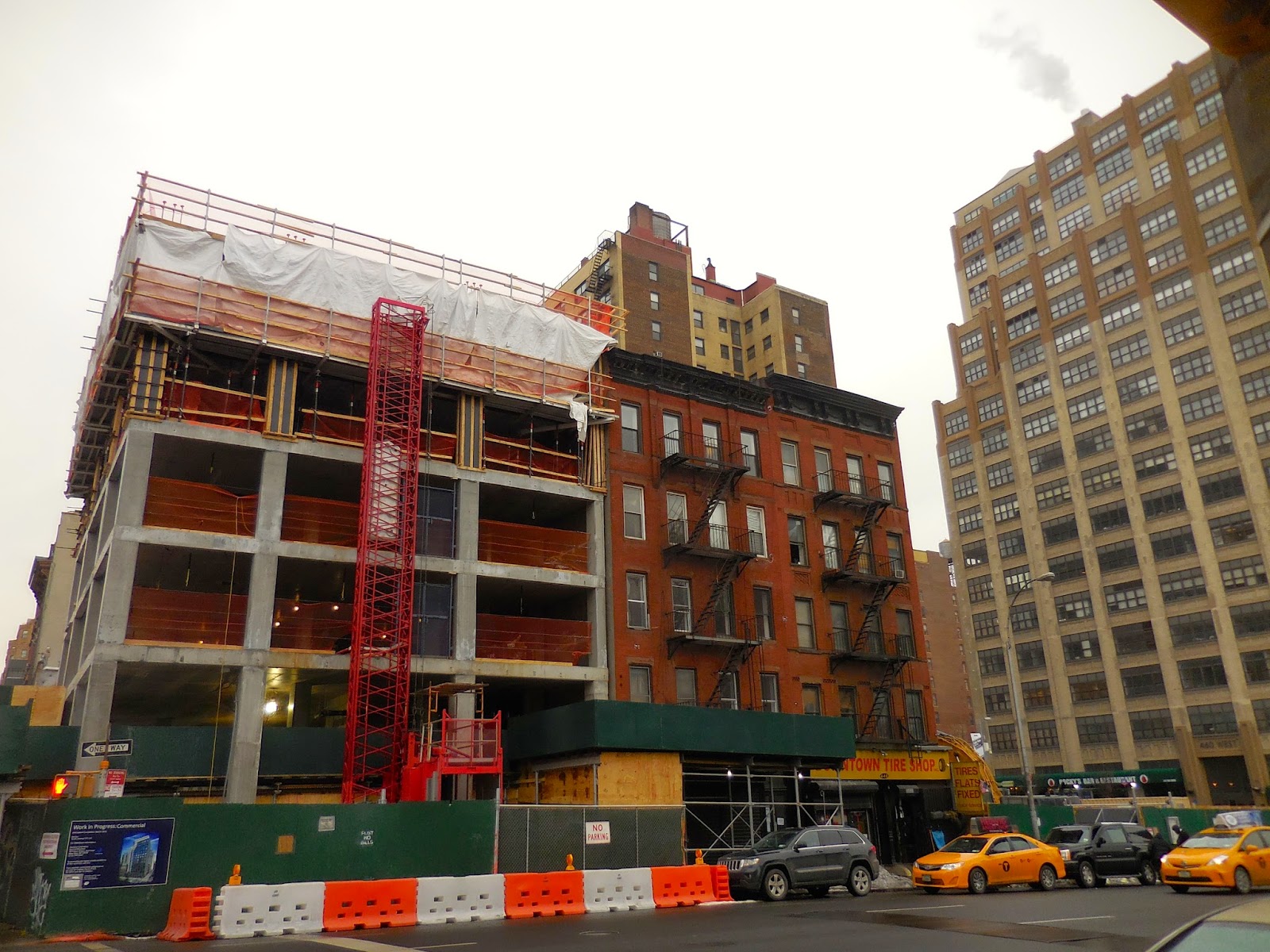
He told me that Force Capital Management, a hedge fund that manages $1.2 billion, not only bought his little building, they also bought the big building on the corner. Now they have the block.

Using the LLC 228 Bleecker Street Realty, Force Capital Management paid $18,700,000 for the corner building in 2012. Why? Don't tell me this old beauty can be torn down and replaced with a glass box.


And what about Trattoria Spaghetto on the ground floor? I asked--they told me they've got 15 more years on their lease.

By the way, Trattoria Spaghetto is a good place for lunch in the off hours, on a weekday. It's quiet. There's an old woman who sits by the door in a turban. She knows everyone and everyone knows her. She laughs and talks about the weather. Over the speakers, the music is Queen, nothing but Queen.


Trattoria Spaghetto opened sometime in the early 1990s or late 1980s. I'm not sure. Before that, it was the Bleecker Luncheonette, a beloved Italian soup counter that made a famous green minestrone. Some still don't forgive the Trattoria for "killing its old world charm."

So it goes.


via VintageOCD

Tuesday, February 10, 2015

Hudson Yards Effect

Like the High Line Effect that flattened west Chelsea, and the Marc Jacobs Effect that transformed western Bleecker Street, we're now seeing the Hudson Yards Effect decimate 10th Avenue in the 30s.

All along the Hudson Yards, buildings are coming down, or getting grabbed up by developers who aim to upscale. Into empty lots and parking lots are going new condos and hotels. Even the Brutalist 450 West 33rd is getting a facelift. In a city where everything must glitter, silvery cool, this brown beast just won't do.


It will be clad in pleated glass and incorporated into Brookfield's "Manhattan West" development, that massive hall of mirrors.


A couple blocks up, two little tenement buildings remain--440 and 442 Tenth Avenue. The buildings were bought by the Silverstone Property Group in 2012. Tenants reached out to Curbed to complain about the subsequent conditions--no gas, no hot water, holes in the ceilings.

Are there any rent-regulated tenants left? Apartments in the two buildings are now renovated and renting ($2500 for a studio) to anyone who won't mind the noise of construction on both sides.


On the north end of the block is rising a $20 million 17-story hotel--owned by a company calling itself Tenth Avenue YYY, LLC.


On the south side, a towering Marriott Hotel is coming. This one's costing $180 million and will have 385 rooms.

It's big and it's bland, just like they like it.


Across the avenue, another pair of tenements stand, surviving for now. But they look vulnerable out there. One houses a Penske truck rental place, the other is home to Taxi Parts, Inc.


This stretch of 10th Avenue, from the 20s through the 30s, used to belong to taxi drivers. It gave them gas stations, flat-fix shops, mechanics, medallion brokers, cheap food, and places like this shop, where you can find everything from tail lights to mud flaps.


Over the past decade, we've watched it all vanish. First by High Line development, and now by the Hudson Yards. Of course, we know the two are connected, one Bloombergian scheme rolled into the other. The whole west side, from below Gansevoort and into the 40s, is being paved in glass.

Soon, it will gobble up the carriage horsemen of the west 30s. (Read here for an in-depth look at what remains of that world.) Along with what remains of the old city a few blocks south, a parcel that Bloomberg's planning department targeted.

Take a walk up 10th and witness a neighborhood vanishing before your eyes.

Monday, February 9, 2015

Foley's

I don't like sports bars. I don't like nouveau Irish bars. So I'm not sure what made me stick my head into Foley's on West 33rd, but I'm glad I did.


Foley's is famous for its dizzying museum of baseball memorabilia (including more than 3,000 autographed balls). It's only been there about a decade, but the bar itself is a well-preserved antique.

The decorative tile floor alone is worth the trip. There's also a scenic stained-glass wall in the back (Tiffany, or so I was told), and a set of imposing men's room urinals that date to the late 1800s (I was told).


The staff is friendly and, if you're lucky, you'll find yourself in conversation with John Clancy, father of the owner, Shaun Clancy, and author of a memoir entitled "Never Say I Can't." It's easy to fall into chatting with Clancy. Just walk around admiring the place and he'll tell you all about it.

"See that clock up there? It comes from..."


"Papa John," as he is affectionately known, will also tell you about the days when he worked at Toots Shor's, serving Frank Sinatra and Jackie Gleason. And he'll point you to the pistol framed by the door, a gift to him from the mobster Frank Costello.

I wouldn't go to Foley's at night, or during a big game, but on a quiet Saturday afternoon, it's a perfect spot for an old New York feeling.


Wednesday, February 4, 2015

Subway Inn II

When the Subway Inn was forced out of its long-time home in December, after attempts to save the 77-year-old dive failed to sway the hearts of World-Wide Real Estate Group, the Salinas family vowed to reopen nearby.

It looks like the new place is progressing well.


the old Subway Inn today--sign removed

The beautiful neon sign was removed from the old spot and is being put back together in the new location at 1140 Second Avenue at 60th Street.


Subway Inn Facebook page

The bar is being rebuilt.


Subway Inn Facebook page

Michael Hirsch sends in this photo of the "coming soon" sign. The final product will include Atomic Wings at the back:


Check out this film by Zagat about Subway Inn's fight to stay alive:


Tuesday, February 3, 2015

Black Seed in De Robertis

Since the heartbreaking closure of De Robertis' Pasticceria, we've wondered what would take its celebrated space.


Today Florence Fabricant at the Times quietly notes:

"BLACK SEED BAGELS Noah Bernamoff and Matt Kliegman will open a full-service cafe and bakery with a wood-fired oven in the former De Robertis Pasticceria space in late spring. The new owners plan to increase their baking capacity and sell their bagels wholesale. Much of the venerable pastry shop’s tile work will be preserved: 176 First Avenue (11th Street)."


Here's a description of Black Seed from Grub Street:

"There are many things that Black Seed has that your neighborhood bagel shop most likely doesn’t: There’s the wood-fired oven, the last step in a process that begins with hand-rolling and poaching. There’s the design by hOmE, the Brooklyn firm that built Tørst and Paulie Gee’s, and here uses reclaimed sycamore, beveled walnut, and Carrara marble. There’s the Stumptown coffee. And then there’s the shop’s ambition..."

What is there to say? I just hope they don't fuck up DeRobertis' gorgeous century-old interior with all that design and ambition.

UPDATE: Good news, reports Gothamist: The owners of Black Seed are "working with the De Robertis family to honor and preserve original design elements of the bakery including the ornately tiled floor, handcut tile walls, and pressed tin ceiling."


Vintage NYC Films

The Prelinger Archives are something special. In addition to dozens of bizarre educational films from the mid-twentieth century, they've also got some great vintage films about New York City.


Go "Around the World" in the 1940s and never leave New York, aka "Baghdad on the subway"--from the Jewish Lower East Side to a Puerto Rican neighborhood to an Italian bocce court and kitchen, it's quite a trip.


Hop on the Third Avenue El in the 1950s:


Then fast forward to the 1960s and spend a Sunday in Greenwich Village:


See the whole list of films here.

Monday, February 2, 2015

Hustling 1975

The 1975 made-for-TV movie Hustling, starring Lee Remick and Jill Clayburgh, offers some fantastic classic scenes around 8th Avenue in Midtown.


Based on the book of the same name by journalist Gail Sheehy, Hustling takes us into the world of New York City prostitution. The opening sequence is a series of neighborhood shots, showing hookers and pimps on the stroll in Times Square.


Girls go running from the police, past the dearly departed McHale's, seen here from a squad car's window.


Jill Clayburgh as Wanda walks past Orange Julius and Howard Johnson's while a new pimp tries to enlist her for his stable. She doesn't go for it. She's trying to be independent.


We get a look at the famous Hubert's on 42nd Street. Opened in 1925, Hubert's closed in 1975, the year that Hustling came out. It was replaced with Peepland, later demolished.


You can watch the movie on Netflix, and read Sheehy's articles on prostitution in the archives of New York magazine--start with "Cleaning Up Hell's Bedroom." Her book is harder to find. To read about prostitution in an earlier era, 1950s New York City, track down Sisters of the Night.