Thursday, October 10, 2013

Joe Brainard on Film

Filmmaker Matt Wolf has made a sweet short documentary about the New York School artist and writer Joe Brainard. Up until yesterday, you could have watched the whole film for free at Vdrome, but I screwed up the dates (sorry), so now you can watch the trailer and buy the film at Matt's site.

The film features 1950s Americana footage, including scenes from sex education films about Syphilis, played while Brainard reads from the lovely "I Remember." In between, poet Ron Padgett reminisces about their close friendship, from their school days back in Tulsa to Joe's death from AIDS in New York.

I asked Matt a few questions about the film.


You said the vanishing of New York tapped into your desire to make a film like this--how so?

Sarah Schulman's book Gentrification of the Mind really shook me. It helped me understand the connection between AIDS and the transformation of New York. It also helped me better understand the kind of artist's life that is no longer possible in New York today. Joe is part of a generation of artists who died prematurely from AIDS, and I worry his and others' legacies might be lost if they're not celebrated. I made this film because I love Joe's work, but also because I don't want it to be forgotten.

Schulman's analysis of how AIDS contributed to gentrification is very important. Reminds me also of Fran Lebowitz in the documentary Public Speaking, when she says, "An audience with a high level of connoisseurship is as important to the culture as artists...and that audience died in five minutes."

I don't know. I'm always amazed when I go to a cultural event in New York that I perceive as marginal, and it's sold out. I imagine that the Joe Brainard fans of the world are highly concentrated in New York. While the life of artists is less and less sustainable here, I think the vitality of its many cultural institutions is enduring.

I've been a big fan of "I Remember" for years, but there seems to be an assault on nostalgia in the current climate. How do New Yorkers, especially, respond to "I Remember" these days?

I think the problem with nostalgia is romanticizing the past as better, or more authentic. But I think there's a lot to be celebrated in the present, in New York and beyond. There's so much value in digging into the past, uncovering hidden histories. Not just hidden cultural histories or biographies, but also the hidden histories within ourselves. That's what Joe is doing in "I Remember." I imagine that people will always find his poem to be refreshingly simple and emotionally direct.

Wednesday, October 9, 2013

Hua Mei Bird Garden

Recently, for the first time, I came upon the Hua Mei Bird Garden in Sara D. Roosevelt Park on the Lower East Side at Chinatown's edge. The garden has been around officially since 1995, but you'll miss it, too, unless you're up and walking in the early morning.


Hanging in trees, from poles, around the chain-link fence, and sitting on the leafy ground, are dozens of beautiful bamboo bird cages, some half shrouded in white cloths, most of them ornately carved, and all containing a songbird.

Many of the birds are small--colorful finches, a few black-capped chickadees--but some are the Hua Mei, a fighting thrush from China for whom the park was named.


Socializing around the cages are the elderly Chinese men who own them. Wrote the Times in 2007, "Most of the men who come to listen to them are retired; the oldest are in their late 80s. Yui Kang, who has been coming to the Hua Mei Bird Garden since the mid-1990s and has been collecting songbirds for more than 50 years, is known as the chief. 'We are old men,' he said the other day. 'We like bringing the birds and drinking the coffee. We feel better.'"


The park was born, informally, in the early 1980s, due to the location of a pet store across the street, reported the Times in 1994, "which sold hua mei and their favorite snack, live crickets." A trip to the park became the birds'--and the men's--daily constitutional.


Stumbling upon the scene is a bit surreal. It reminds you that surprises can still happen in New York City, where so much surprise is vanishing. The birds and their cages are beautiful. I stayed and watched them for awhile. It isn't easy to look at a caged bird. They are constantly in motion, hopping from perch to perch, as if frantically looking for a way back into the sky.

I felt both grateful and sad for their presence there, in those lovely cages, making that incredible music.

Listen here:


Tuesday, October 8, 2013

Donut Pub: Post-Cronut

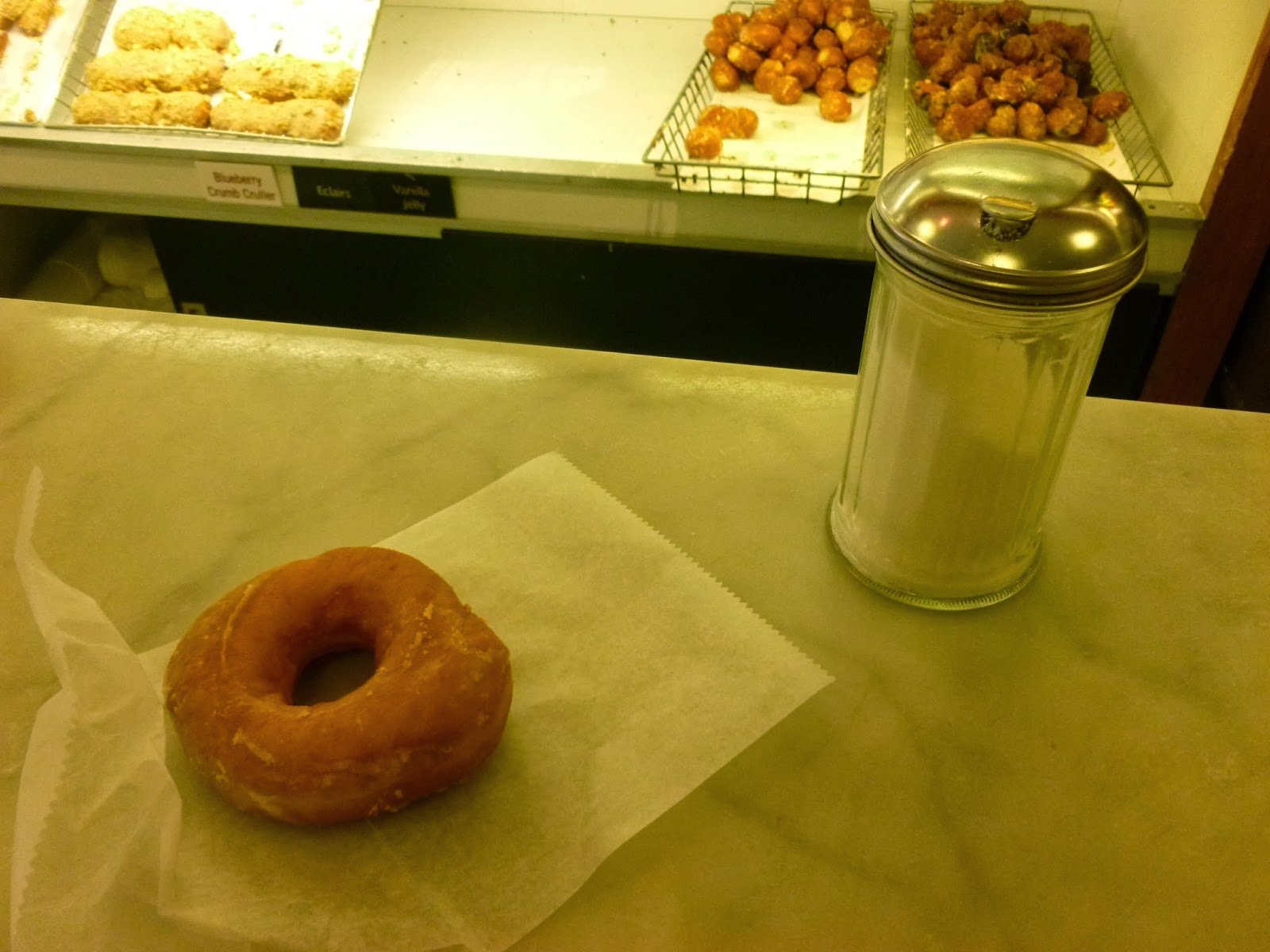
Next year, the Donut Pub on 14th Street turns 50. It shows no signs of closing and has outlived at least two Dunkin Donuts that have parked nearby in failed attempts to steal the Pub's customers. No dice. The customers here are loyal. The waiter knows their orders and gets them ready before they sit down--black coffee, jelly doughnut, coffee with half and half, decaf, sesame bagel with butter, glass of cold milk.

Now, like many places, they have created their own version of the hysteria-inducing cronut--the "Croissant Donut." But there is no hysteria here. No all-night lines, no sidewalk campers, no groupies. The Pub remains the Pub.


On an unseasonably warm afternoon, the Donut Pub is an oasis of cool and quiet. At the marble counter, a woman stirs her iced coffee, making the milk swirl. It feels like a long sigh.

"Get a load of this," says a man reading the paper. "That neighborhood north of Madison Square Park? Now they're calling it NoMad. Like Soho and Tribeca. Okay, but what the hell is fee-dee? Fee-dee? I can't figure that one out."

Someone complains about the temperature. Someone else says, "Hey, did you know, next year this place'll be 50 years old? Don't the doughnuts taste like they're 50 years old?"

It's a wisecrack. The doughnuts are delicious and fresh. Through the kitchen door, the baker pulls trays out of the oven to cool and gathers chocolate doughnuts into long baskets for display. He threads a dozen Honey Dips onto wooden spindles and douses them with a thick, gooey glaze before leaving them to drip.


The wisecracker is "Magic Mike," a retired member of the FDNY who wanders into the Donut Pub to perform card tricks and to sell decks of magic cards to customers. He demonstrates the Disappearing/Reappearing deck, the Svengali, and Chase the Ace. He says, "Hocus pocus, alakazam," and makes a handkerchief disappear into a fake rubber thumb hidden in his fist. He and the Pub's manager give each other the business.

"Hey Mike, who'd you have to blow to get into that Brotherhood of Magicians? I want to know, why'd they let you in?"

On the radio, The Eagles are taking it to the limit. A man who smells fresh from the barber, of Clubman talcum powder, walks in, sits down, and begins to obsessively arrange the nearby napkin and sugar dispensers, to make them neat, to make sure they're just right. Everything has its proper place. The waiter, without exchanging a word, places a cup of coffee and a toasted coconut doughnut in front of the man. All is right with the world.


Not everyone here is happy, however. Like the blonde who totters in on her stiletto heels to loudly ask, "You have coffee?"

"Regular?" says the waiter, grabbing a cup.

"Just regular? You don't have lattes, cappuccino, espresso?" She squints for several seconds at the coffee pots on their hot plates and then points a lacquer-tipped finger at them. "Is that the regular coffee?"

"That's coffee," the waiter says.

"What does 'regular' mean?"

"Milk and sugar."

"Oh," says the blonde, "no, no." She walks out empty-handed. She doesn't even look at the knock-off cronut. But nobody seems to mind.


Also:
Donut Pub Wins
The Donut Pub
Peter Pan Donut Shop
Donuts Coffee Shop
Disco Donut

Monday, October 7, 2013

The Fight for Willets Point

If you really want to see how the Bloomberg administration operates, look at what they're doing to the people of Willets Point in Queens. Blighting through neglect, land grabbing, baiting and switching. Lies and more lies. In the end, dozens of working class people, mostly Latinos, are about to lose their thriving businesses--and not for the affordable housing once promised. What is the City putting in? The biggest shopping mall in town.

Watch the whole story in this new short film:


The final vote on the Willets Point plan will be this week, on October 9. Please don't let these people be ignored. Call or email Council Member Julissa Ferreras at (718) 651-1917 and tell her to vote no on Bloomberg's inhumane project that hundreds of locals are protesting against.


I first visited the Iron Triangle, as the section of auto body shops is called, years ago, when a friend introduced me to it. We were seeing the Mets at Shea and wanted to get something to eat before the game. We went to the one of the little places that serve the auto workers and their customers, and filled up on big plates of chicken, rice, and beans.

I went back in 2007 to interview the Bonos, makers of sawdust for three generations. Since then, every now and then, I try to get up to Willets Point and went recently. When you arrive at the edge of the Iron Triangle, just across the street from the slick new Citibank baseball stadium, you feel like you're passing through a portal, from one world to another, starkly different.


It looks like a post-apocalyptic landscape, its roads ruined and filled with dirty water, ever since the City stopped providing maintenance services in a blatant act of blighting. The wind blows differently here. You feel how faraway you are from the city proper, like you're on the edge of the known continent.


You walk past tremendous pillars made of rubber tires, dozens of car doors stacked like upright files, walls hung with hundreds of shiny hubcaps. From the open garages come the sounds of salsa music and barking dogs. People from all over town bring their cars for new tires, new brake lights, new mufflers.

The Iron Triangle supports thousands of people, and not just the mechanics and their families. It sustains a sub-economy within it. People set up grills on the street, cooking meat to sell with beans and rice. One woman goes around hawking bootleg DVDs. A man pulls a rickety shopping cart, filling it with scrap donated by the mechanics. A Mr. Softee truck circles endlessly.


You might not like the Iron Triangle. It's dirty and cluttered, and it feels Third World. But it's a real place, where people own their own businesses and do what they need to support themselves and their families. Don't let Bloomberg just steal it away. Don't let him put up yet another glassy "neighborhood." Call or email Council Member Julissa Ferreras at (718) 651-1917 and tell her to vote no.


Previously:
The Iron Triangle
Bono Sawdust

Thursday, October 3, 2013

Ray Beauty Supply

Ray Beauty Supply has got to be one of the last old-school businesses left on 8th Avenue off Times Square. I've long admired their vintage sign, and their title, "King of Beauty," but I'd never gone inside until recently.


Ray has been here for over 50 years and their claim to fame is being "New York's Oldest Beauty Supply." Owned by the Mastrangelo family, who bought it from the Rays, it's a favorite of hairdressers, but they also sell to consumers. They've got everything--shampoos and cosmetics, wigs, hairdryers, clippers--everything.

At first glance, the staff looks a little intimidating, Bronx-style beauty supply guys posing in muscle shirts with baseball bats on their website, but I found them to be sweet as pie, helpful, and generous. Before making a sale, they'll give you free tips on how to deal with hair troubles and even print out recipes for DIY products you can make at home.

I suspect the angry reviews on Yelp might be due to the fact that this place, and its staff, probably does not suffer princesses gladly. Ray is King, after all, and this is not Sephora.

They've even got a "you break it, you bought it" sign--I haven't seen one of those in years. Hanging on chains from the ceiling it reads, "You open, you buy! You break, you buy!" Definitely not Sephora.


As a bonus, in the front window and in back, the store has a small collection of antique barber furnishings--a chair and a towel warmer, plus a handful of candy cane-striped poles, including one dating back to 1903. If you're in the market for an antique barber pole, inquire.

Otherwise, go in and buy some beauty supplies.

Wednesday, October 2, 2013

The Teddy Bear House

On a stately old block of West 11th Street there's an oddly modern townhouse that for years was known as the Teddy Bear house for the Paddington in the window and his many costume changes. The building is also famous for replacing the townhouse that was destroyed in a 1970 explosion by the Weather Underground when a pipe bomb prematurely detonated.

With one last costume change (a t-shirt from the Corcoran Real Estate Group), Paddington vanished soon after his owner, Norma Langworthy, passed away last year. The house was put on the market and sold for over $9 million. Now we hear the quirky landmark might be vanishing, too.


A reader sent in the following e-mail message circulated by a West Village block association member:

"The new owner of 18 West 11th Street has filed with the Department of Buildings to demolish the existing building and build anew. The plans were rejected by DOB as incomplete but it is safe to assume that the application will be corrected and re-filed. The new owner has retained the architectural firm where a principal, Hugh Hardy, who designed and argued successfully for the current design in front of the LPC several decades ago, is drawing up plans for the new townhouse. To date those plans have not be revealed to the public and no application has yet to be made to the Landmarks Preservation Commission. When such application if made and filed, the public process, including public hearings and opportunity for testimony, will begin.

Local and other preservation groups are considering what position they will take on this application to demolish an existing structurally sound townhouse which was twice found to be appropriate for the Landmark District and which has been part of the built environment for almost four decades. The underlying policy questions have significant implications for the landmarking process in general and the Greenwich Village Historic District in particular."


1970, after the explosion

What position to take, indeed.

Not everyone is crazy about the sharp-angled architecture of the current house. Said one local to the Observer in 2008, “Why did they do that? It doesn’t fit in the face of the neighborhood at all. That forceful geometric shape is too modern in a bad way.”


Thirty years ago, it wasn't an easy task to get this house approved for construction. The Langworthys bought the empty lot in 1976 and submitted their design to Landmarks. Reported the Times in 1981, "There followed a series of neighborhood and commission meetings of high dunder and dispute, as some neighbors insisted that the angles would disrupt the architectural coherence of the street. One older woman, crippled by a broken hip, rented an ambulance to deliver her in opposition to the plan."

Finally, the chairman of the commission asked Mrs. Langworthy, "what would you do if we told you you couldn't build that house?'' She said, ''I thought, 'Oh God, I don't know' -- and I started to cry."

Her house was approved, defying the dunder of West 11th Street. Now we'll see if those winds will blow in the opposite direction, to save what was once considered an eyesore--and came to be beloved because of a bear.


Paddington's last hurrah: Barbara Corcoran's corporate tee


Previously:
The Paddington Lady
Weathermen Easter


Tuesday, October 1, 2013

El Sombrero

VANISHING

As Bowery Boogie reported last week, El Sombrero, aka The Hat, will be closing for good very soon. But not as soon as we thought.


Regina Bartkoff, a long-time waitress at the restaurant, says they probably won't be closing until early December. "Everybody jumped because of the community board announcement," she told me. "I walked into the restaurant and was shocked to see people there! All telling me they thought we were closing Oct 7 and all telling me they haven't been there for 15 years or so."

Back in February, I reported that the Ludlow Street classic (since 1984) was on its last legs. Said Regina at the time, "We have been losing our regular customers steadily, due to them not being able to pay the rents on the LES and being forced out." In April, we tried a cash mob--with free margaritas--and no one showed up.

A Facebook page is coming to keep people up to date. And Regina notes, "Happy Hour is all the time, if you buy a large frozen Margarita, you get a small for free and all beers are $4."

So get to The Hat before it's gone.

Previously:
The Hat
Cash Mob