Showing posts sorted by date for query 125th. Sort by relevance Show all posts

Monday, September 11, 2017

Greater Than Ever?

In their last issue, New York magazine published an eye-opening interview with Dan Doctoroff, former Mayor Bloomberg's deputy mayor of economic development and reconstruction.

The occasion for the interview was Doctoroff's new book, Greater Than Ever: New York's Big Comeback, about his years working to rezone nearly half the city after 9/11, a Robert Moses-level act that made the city glitter as it helped to boost vast inequality and unprecedented levels of hyper-gentrification.


Doctoroff at Hudson Yards. Photo: Kyle Dorosz

In the interview, Doctoroff acknowledges this. A bit. "The city grew faster than we expected," he says. But he holds to the belief that "You have to treat citizens and businesses like customers." It's a basic tenet of what urbanist Julian Brash has called The Bloomberg Way, "a notion of governance in which the city is run like a corporation. The mayor is the CEO, the businesses are clients, citizens are consumers, and the city itself is a product that’s branded and marketed. And New York is a luxury product."

To create that luxury product, the Bloomberg administration relied on two types of zonings: up and down. They are not equal.

Upzoning opens territories for higher rents and bigger development, while downzoning preserves neighborhood character by limiting growth. As Sarah Laskow pointed out in Politico New York: “Upzoned lots tended to be in areas that were less white and less wealthy, with fewer homeowners. Downzoned lots tended to be areas that were more white and had both higher incomes and higher rates of homeownership.” That meant “more privileged people were more likely to have the city change the zoning of their neighborhoods to preserve them exactly as they were.” Less privileged people got upzoned out.


In his book, Doctoroff argues that this massive rezoning “changed the physical nature of the city in ways that will undergird prosperity for decades,” while attracting new “dreamers and strivers."

Interviewer Carl Swanson calls these people "the new New Yorkers who, while they might claim they long for some filth Camelot of the busted 1970s, happily throng this implacably gentrifying customer-service metropolis."

For Doctoroff, says Swanson, nostalgia is "practically an epithet." Of course. Nostalgia as epithet is a strategy used by pro-development people to discredit and dismiss those who want to preserve the city as a diverse and affordable place. "You're just nostalgic" has become a cliche of the pro-growth mindset.


But it was this bit of the interview that really grabbed me:

"Doctoroff also writes in the book about how he never really liked New York City, much less wanted to live here, which is an odd thing for someone who served for six years as its deputy mayor to admit. When he first visited with his family, in 1968 — he was 10 and a resident of Birmingham, a well-off suburb of Detroit — it was 'hate at first sight.' He moved here in 1983 after his wife got a job at HBO — Doctoroff had been only three times and it never grew on him. The self-described 'creature of the suburbs' helped remake this city, in some ways, for his own maximum personal comfort."

Isn't that what many of us suspected?

It brings to mind something that urbanist William Whyte wrote on the urban renewal of the 1950s and ’60s. While more people were moving into cities and rebuilding them, he said, it was “not the same thing as liking cities.” The people doing the rebuilding “don’t like cities. They do not merely dislike the noise and the dirt and the congestion. They dislike the city’s variety and concentration, its tension, its hustle and bustle.”

And what about the new "dreamers and strivers"? Do they love New York? Or do they love the suburbanized town remade for the personal comfort of a certain class of people?


Doctoroff calls himself a "creature of the suburbs." Throughout the 2000s, we've witnessed the suburbanization of New York City. This shift is not expressed only in the proliferation of big-box chain stores, it also comes in the hearts and minds of many (not all) newcomers.

As Rem Koolhaas has said, "The city has twice been humiliated by the suburbs: once upon the loss of its constituency to the suburbs and again upon that constituency’s return. These prodigal citizens brought back with them their mutated suburban values of predictability and control."


125th St. after a Bloomberg rezoning

Under Bloomberg, the city’s poverty rate rose to its highest levels in a decade. More people became homeless. The income gap in Manhattan rivaled sub-Saharan Africa. By 2016, New Yorkers were spending 65.2 percent of their total income on rent. Small businesses are in crisis. Neighborhoods are hyper-gentrifying -- and re-segregating along race and class lines.

As Michael Greenberg recently wrote in his important New York Review article on the city's affordable housing crisis: "We speak nowadays with contrition of redlining, the mid-twentieth-century practice by banks of starving black neighborhoods of mortgages, home improvement loans, and investment of almost any sort. We may soon look with equal shame on what might come to be known as bluelining: the transfiguration of those same neighborhoods with a deluge of investment aimed at a wealthier class."

Is this really "greater than ever"? As always, we must ask: Greater for whom?


Monday, May 8, 2017

Lenox Lounge Demolished

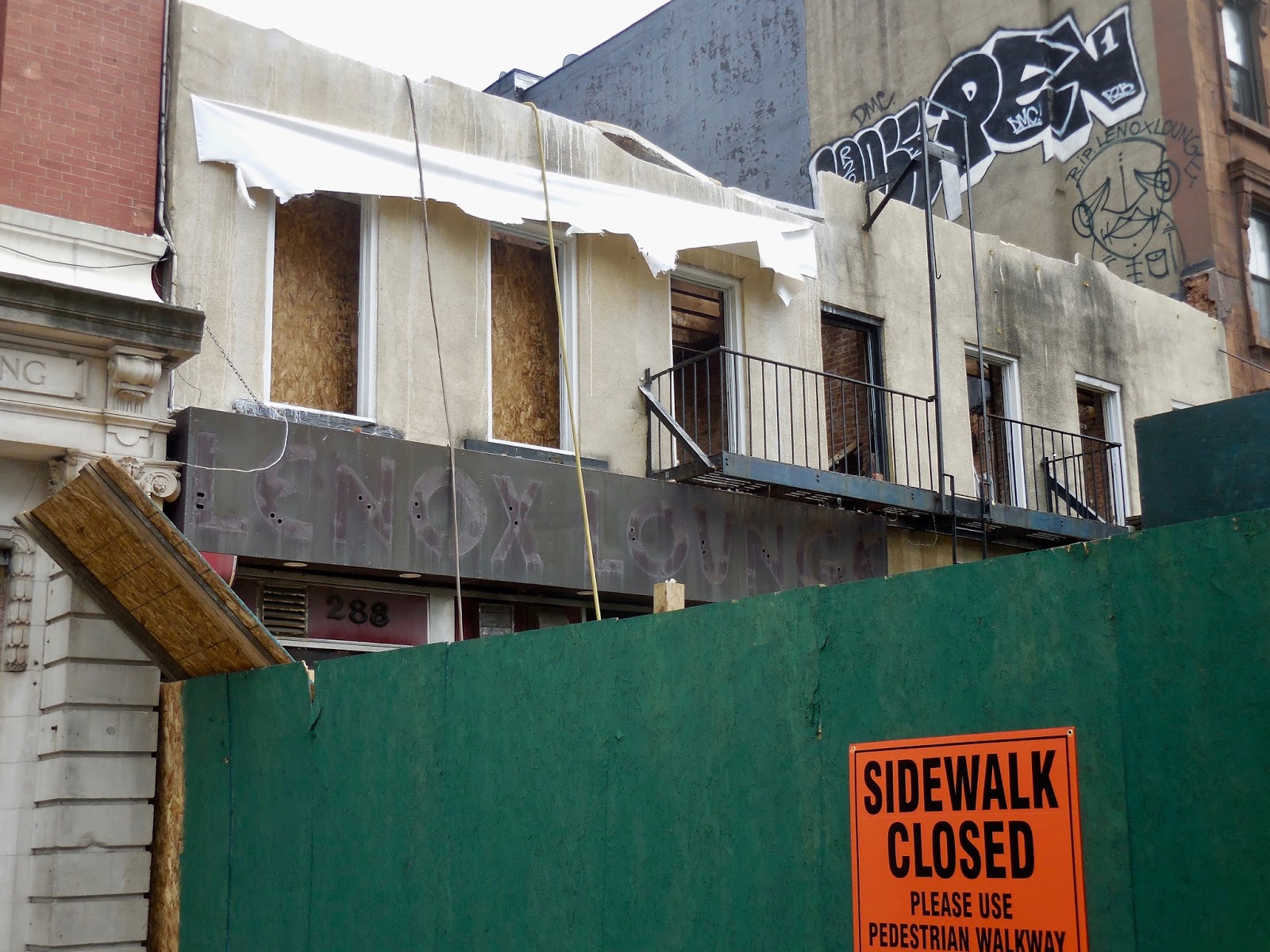
After 73 years of legendary life in Harlem, and after 4 years of sitting empty and wasted, the once great Lenox Lounge is currently being demolished. It is a terrible shame that could have been avoided.


today

If the city had commercial rent control, as it did for many years, it would have been avoided. If the City Council had passed the Small Business Jobs Survival Act, it might have been avoided. But City Hall refuses to protect small business people against landlord greed, claiming that it's a free-market society--which it is not.

Corporate chains in the city are regularly chosen by Business Improvement Districts and given millions of dollars in tax breaks and incentives. That's not laissez-faire. That's corporate welfare.

Thanks to City Hall's catering to big business, we have lost the Lenox Lounge, along with countless other precious local landmarks. For the soul of the city, the price of that loss is high.


Owner Alvin Reed, Daily News photo, 2012

In 2012, the landlord of the Lenox Lounge doubled the rent, from $10,000 to $20,000 per month. This was more than small business owner Alvin Reed could manage. The lease was given to Richie Notar of the Nobu luxury restaurant chain.

At the same time, Whole Foods announced a move to 125th Street--later we would learn that it would land in the empty lot directly across from the Lenox Lounge. In the Whole Foods Effect, rents near the store increase. That's exactly what happened in Harlem. And that Whole Foods would not have been there without the Bloomberg Administration's rezoning of 125th Street, a controversial process that has strangled the historic street in chains.

After being forced to close on New Year's Eve 2013, Alvin Reed stripped the Lenox Lounge of its antique facade, announcing that he would resurrect it all in another location. That did not come to pass.

The landlord sued Reed for stripping the place. Cultural history isn't worth much without those antique details. Notar backed out of the deal, telling the Daily News, "the scope of the project (mostly the overall condition of the building) became bigger than anticipated."

The Lenox Lounge was left to rot. Someone spray-painted "1939 - 2012: 80 YEARS FOR THIS” across the plywood that covered the door.


2016

As the big, shimmery building that will house Whole Foods rose across the street, the rent on the Lenox Lounge space doubled again--to $40,000 per month.

Then we learned that it would be completely demolished and replaced with a dull glass box containing a Sephora. Two glass boxes, two hollow mirrors, will soon reflect each other across Malcolm X Boulevard. What effect will that have on the people there?


Whole Foods coming

In 2011, cognitive neuroscientist Colin Ellard studied what happens to people on the sidewalk when they stand in front of a bland glass façade. He placed human subjects in front of the Whole Foods on the Lower East Side, strapped skin-conducting bracelets to their wrists, and asked them to take notes on their emotional states. He reported, “When planted in front of Whole Foods, my participants stood awkwardly, casting around for something of interest to latch on to and talk about. They assessed their emotional state as being on the wrong side of ‘happy’ and their state of arousal was close to bottoming out.” The instruments on their wrists agreed. “These people were bored and unhappy. When asked to describe the site, words such as bland, monotonous and passionless rose to the top of the charts.” Ellard then moved the group to another site nearby, “a small but lively sea of restaurants and stores with lots of open doors and windows.” Here, these same people felt “lively and engaged.” Their nervous systems perked up.

In his book Happy City, Charles Montgomery calls this “an emerging disaster in street psychology.” The loss of old buildings and small businesses, the homogenization from suburban chains and condo boxes, is more than an aesthetic loss. It is damaging us psychologically and physically. Montgomery writes, “The big-boxing of a city block harms the physical health of people living nearby, especially the elderly. Seniors who live among long stretches of dead frontage have actually been found to age more quickly than those who live on blocks with plenty of doors, windows, porch stoops, and destinations.”

The big shiny boxes are literally killing us.


Small old buildings and businesses, like the Lenox Lounge, have a positive effect on our mental health. Just walking past and looking at them can be an emotional and physical boost.

Today, as the Lenox Lounge is demolished, there is no boost, only despair. The inside has been gutted to the beams and bricks. Sunlight streams in through the busted roof and shines in the place where the walls were once flocked in zebra stripes and Billie Holiday sang of "Strange Fruit." On the sidewalk, black Harlemites walk past shaking their heads. They stop to take a final photo, a memory of what's been lost.

Last week we also learned that New York City has lost 30% of its black-owned businesses--in just the five years between 2007 - 2012. The Lenox Lounge was one of them. Its loss was not inevitable. It wasn't normal or natural or part of that tired cliche of "New York is always changing." It was part of a systemic process rooted in the racism and classism of redlining and urban renewal, what James Baldwin called "Negro removal." Today, he could use the same words for hyper-gentrification.

The Lenox Lounge is yet another casualty in the long battle for the soul of New York.


For additional reading, see Michael Henry Adams' "Last Call: Who's to Blame for the Destruction of the Lenox Lounge?"


Monday, November 21, 2016

Lenox Lounge Demolition

Is it possible that the former Lenox Lounge will be completely demolished? *UPDATE: Yes--and here's what's coming.

New York Yimby notes: "An anonymous Midtown East-based LLC has filed applications for a four-story, 18,987-square-foot commercial building at 286 Lenox Avenue."

So, either two stories will be added to the existing building, or the whole thing will be torn down and replaced.


The Lenox Lounge closed on New Year's Eve 2013 after 73 years in Harlem. The landlord had doubled the rent from $10,000 to $20,000 and handed the lease to Richie Notar, the jet-setting entrepreneur behind the Nobu luxury restaurant chain. "I don’t want to change a thing about how it looks," Notar told the Daily News, adding that his renamed Notar Jazz Club would be "not too much different than what it is now."

But lounge owner Alvin Reed stripped the vintage facade before he left, rather than have its history co-opted. Someone spray-painted "1939 - 2012: 80 YEARS FOR THIS” across the plywood that covered the door.

The landlord sued Reed for stripping the place. Notar backed out of the deal, telling the Daily News, "the scope of the project (mostly the overall condition of the building) became bigger than anticipated."

The Lenox Lounge was left to rot.


"R.I.P. Lenox Lounge"

Meanwhile, across the street, a giant glass box has risen, infesting 125th Street with more chains, including one infamous for its power to give hyper-gentrification a shot in the arm: Whole Foods.

The Whole Foods Effect is powerful. The creators of real estate site Zillow revealed how Whole Foods moves in to neighborhoods where home values are rising more slowly than the rest of the city. “But as soon as the Whole Foods opened its doors,” they wrote, “these nearby homes’ values took off,” increasing at twice the speed of other properties. In the Post in 2016, one real estate broker reported that Harlem landlords were planning to raise rents as soon as the supermarket opened.

Already, the Lenox Lounge landlord has doubled the rent--again--to $40,000 per month. And now, it's possible that every last trace of the grand old Lenox will be vanished.


Across from Lenox Lounge


Wednesday, July 20, 2016

Price on Harlem Gentrification

Author Richard Price spoke at the New York Times' "Cities for Tomorrow" conference earlier this week. He talked a bit about gentrification in Harlem and "that eternal argument: Is this good for Harlem or bad for Harlem?"


NY Times photo

He said: "The big picture is: Everything that's happening now in Harlem, everything that's being built in Harlem is with someone like me in mind, preferably 30 years younger than me. The born-heres? They're looking around and seeing new restaurants, and high rises going up, and new trees planted, and they know it's not for them. It's like: You're in the way..."

"It's like white people discovered Harlem like Europeans discovered America, and the Indians are going, 'Really? What are we standing on, cream cheese?' ... So whatever's exciting and new is a little bit of a death knell."

He talked about the recent closure of Pathmark and the opening of Whole Foods on 125th Street: "The minute that Whole Foods went up--game over."

And he had some sound advice on how to be a decent neighbor in a gentrifying part of town, including "learn manners" and "patronize businesses that were there a hell of a lot longer than you were." Also: "Be a good guy. Have a heart."

Watch here at minute mark 16:15.

Monday, April 18, 2016

Showman's Jazz Club

Showman's jazz club has been in Harlem since 1942. They've hosted many of the greats, including Sara Vaughan, Eartha Kitt, and Duke Ellington. With 74 years under their belt, they are Harlem's longest running jazz club -- after the wasteful and tragic destruction of the elder Lenox Lounge.

Last week, Showman's posted the following "farewell" announcement on their Facebook page:


Reader Carrie Butterworth sent in the tip and followed up with some questions for the owners. She reports: "Mona Lopez and Al Howard are selling the business so they can retire."

Lopez and Howard have been running the club for the past 38 years. (Howard was one of the NYPD detectives who took the call when Martin Luther King was stabbed by a woman with a letter opener. He was also a supervisor on the hunt for Son of Sam.)

Showman's has moved three times since 1942. Their original building, next to the Apollo, was destroyed by fire. "After playing at the Apollo," writes Butterworth, "the musicians used to go next door and play their own music, hence the name Showman's."

They were pushed out of their second location by the Harlem USA mega-development. And they've been in their current spot on 125th since 1998.


Washington Post photo

Butterworth says, "What I and so many other people enjoy about this bar is the sense of community and family. It's full of regulars--Harlem old-timers and people who are friends with the musicians--who show up every time to support their friends. If it's your birthday, they'll have a cake and some chicken and rice.

A lot of the new jazz clubs charge you a cover, then you have to buy dinner or drinks, and then they throw you out after the set, unless you want to buy another table charge. At Showman's, there's only a 2 drink minimum per set. You can stay all night. The barmaids, or as they call them 'star-maids,' know what you drink, and have it ready."

She does not know who is buying the building. However, she adds, "they claim they'll keep it as a jazz club."

Let's hope they do. Rezoned by the Bloomberg administration, 125th Street is being destroyed by chain stores and other developments. Let's hope the new owners keep Showman's accessible, affordable, and welcoming to all, just as it has always been.


Monday, February 1, 2016

Trowel and Square

The Trowel & Square Ballroom on Harlem's 125th Street had a great old sign. The typeface. The word "ballroom." And "social functions." Good stuff.


Anyway, it's gone.

The letters have been ripped down and the sign has been covered with a Ripco real estate banner. The Salvation Army thrift store on the first floor has also vanished. The entire building is available. It sold in 2014.


Located in the Croft Brothers Building, the Trowel & Square used to be the Tusken Ballroom, "used at least once as a meeting place by Malcolm X and his recently-formed Muslim Mosque, on June 22, 1964," according to Daytonian in Manhattan.

And next for this space? Probably another chain, as the whole of 125th Street is being wrapped in chains.


Monday, November 23, 2015

125th Street in Chains

The Pathmark supermarket on East Harlem's 125th Street closed this weekend amid controversy, more controversy, and the despair of 30,000 customers who have few places left to buy groceries.


After the Pathmark opened in 1999, a number of small grocers shut down, leaving residents dependent on the big supermarket.

The Times reported that the grocery store's intended role would be to increase development: "the Pathmark's popularity is having a big impact on the neighborhood. Not only has it altered the fortunes of the unsightly intersection where it is located, it is also helping to spur development across 125th Street."

At the time, Karen A. Phillips, chief executive of the Abyssinian Development Corporation, who put in the store, said the supermarket had "done what it was supposed to do -- inspire new commercial development" through the heart of Harlem.


Then, last year, Abyssinian sold the Pathmark site to mega-developer Extell for nearly $39 million. Extell, as you may know, is creating a giant luxury city at Hudson Yards, with hundreds of millions of dollars in tax breaks and other subsidies from Bloomberg.

Said Council Speaker Melissa Mark-Viverito of the Abyssinian and Extell deal for Pathmark, “I believe they threw this community under the bus.”

A look inside the supermarket on Saturday evening revealed shelves already stripped bare, the registers closed, and the employees--200 of whom will now be out of work--gathering to say goodbye.


Also around 1999, the Abyssinian Development Corporation, with mega-developer Forest City Ratner (known for getting eminent domain land and subsidies from Bloomberg to develop Atlantic Yards), developed the Harlem Center to the west, a suburban-style shopping center with an Old Navy store, among other chains.

As promised, more development has come to 125th Street, especially after the major boost of Bloomberg's massive "river-to-river" rezoning in 2008, a brainchild of Amanda Burden, then director of the Department of City Planning.

The eureka moment came after a Roberta Flack concert at the Apollo, when Burden discovered there was simply nowhere to eat in Harlem--nowhere, not even at Sylvia’s or Manna’s or any of the other soul-food restaurants nearby. She realized that the neighborhood would have to change. “There should be a million different eateries around there,” she told the Times, “and this is a once-in-a-lifetime opportunity to frame and control growth on 125th Street.”

Well, now Amanda Burden can eat at Red Lobster. There's one right next to the Apollo, just after the Banana Republic.


Since the rezoning, several mom-and-pops have been evicted and several chains have gone in.

How many?

I took a walk along 125th Street, from the Hudson River to the onramp of the Triborough Bridge. Along the way, I counted 77 national chains and 15 commercial banks -- even though Burden said that the rezoning would limit “bank exposure on the street level, positioning the banking floors on the second floor to encourage more vitality,” because "Banks can deaden an environment.”

The majority of those 92 chains and banks are located in the core of central 125th Street, which is maybe 7 blocks wide. That’s about 10 chains per block. And more keep coming. A new development under construction flies a banner that announces the future arrival of a Burlington Coat Factory.


As if the story can't get any worse for 125th Street, back on the easternmost end, just one block east of the Pathmark development, a group of businesses is under siege from the city government.
In 2009, the Bloomberg Administration blighted a whole block on 125th Street and 3rd Avenue, using eminent domain to claim it for a massive $700 million development project, the 1.7 million-square-foot East Harlem Media, Entertainment and Cultural Center, aka "MEC."

This, in addition to the eminent domain deal gifted to Columbia University at the westernmost end of 125th, means the street has been bookended in Bloomberg's land grabs.

Today this eastern, edge-of-the-earth block contains a dry cleaners, a hair braiding salon, a gas station, a flat-fix shop, an auto-body shop, a Baptist church, and other businesses. The city has already seized property, including a building from Demolition Depot. The owners are still fighting in court. Reported the Real Deal: "the de Blasio administration has not announced plans for the site, and is instead moving forward with the land seizure without defining a clear purpose for it."


blighted block

Call me crazy, but I don't think it's any coincidence that this block sits right over the Third Avenue Bridge from the waterfront of the South Bronx, where another Bloomberg rezoning helped to usher in major development.

Here, from Lugo's Flat Fix stand looking north, you can see clear to the so-called "Piano District," where luxury towers will soon be rising.

It would be naive to deny that it's all connected.


Thursday, February 26, 2015

What Is Authentically Harlem?

Last week, the Columbia Spectator published an op-ed entitled "Is Columbia really destroying Harlem’s authenticity?" Written by first-year student Cristian Zaharia, it supports the school's expansion into Harlem, which was made possible via eminent domain. Zaharia argues that Harlem's authentic culture is not African-American, but one of ever-changing cultures dating back to the Dutch, and that the expansion "will be the start of a new, fresh era for the neighborhood."

On his Facebook page, Harlem historian and activist Michael Henry Adams wrote a reasoned and impassioned response. It is reproduced here in full, with his permission:


Adams arrested while protesting the demolition of Harlem's Renaissance Ballroom and Casino, photo by Antwan Minter

Harlem has numerous lovely old buildings reflecting varied cultures, even former synagogues. But throughout history, nothing about Harlem has made it renown, world-wide, apart from black people. One may talk all one likes about other earlier Harlems populated by people who were not black. By contrast, these white Harlems were insignificant. African Americans alone--our culture, drive, and creativity--have accorded Harlem a status as fabled and fabulous as that held by Paris or Rome. Everything, anything else is superfluous, even meaningless, in terms of Harlem's well-deserved fame.

Entertaining any illusions about the possibility of preserving an authentic Harlem, absent African Americans, it's instructive to look downtown. What survives in Greenwich Village or Hell's Kitchen, to suggest an earlier historic black identity today? And so, yes, Columbia and by extension unknowing or unwitting students--through displacement and gentrification--are rapidly helping to destroy Harlem's irreplaceable heritage and rich legacy.

You are not alone. Many blacks, beguiled by white dollars, are just as eager to replace the houses, churches, schools, stores, theatres and other buildings where Langston Hughes, Georgette Harvey, A'Lelia Walker and other Harlem luminaries, lived, worked, played and prayed, with more luxury condominiums.

Indeed, whatever one has to suggest, even if it's making a black congregation's church into a private school for your kids, or a mansion just for you, they are cool with it. A fig leaf of 20% "affordable" housing, and an historic name, derived from some black hero, for the new condo building or the street or park nearby are nice, but hardly essential. Landmarking and preservation that enhance neighborhoods downtown are antithetical to them. "How much longer will blacks exert political sway over Harlem?" they reason, "while whites are buying, we had better sell up."

A few brave voices contest Columbia University’s contention that their Harlem expansion plans will be universally beneficial. "It's nothing but rubbish," says distinguished and scholarly architectural historian Robin Middleton, who formerly taught at Cambridge before joining the faculty at Columbia. "Columbia's plans are simply monstrous, like an Orwellian, Stalinist, or dystopian campus of factories. No one touting how much they cherish 'design excellence,' could possibly approve of what they are doing, unless of course if it were their job to do so. And, it is, isn't it?"

It was around the connected issues of Harlem being up-zoned, and observing Planning Commission Chair Amanda Burden much more closely, that I began to see who she really is and how it shapes what's at stake. Did it help the homeless to provide for evermore $900,000 condos, in a community where the yearly wage for half the residents is less than $36,000? Is it beneficial to small local merchants, allowing for 25-story towers where 19th-century buildings with just 6 floors once prevailed? What's the point of confiscating thriving businesses that want to be a part of a new revitalized Harlem? Why were they "compensated" at a rate pegged to the value of property prior to the zoning change allowing greater density? Why clear 17 acres, solely for Columbia's use, and leave only 2 of dozens of historic structures? Ought not the sole Planning Commission vote against this ill-conceived venture, cast by Karen Philips, a black woman who lives in Harlem, to have influenced the chair, who said, "The community is not going to buy in, unless it reflects their culture?"

For a long while, it seemed as if the teeming numbers of poor people here would mean Harlem's and Manhattanville's salvation. Reliable voters, housing project residents seemed sure to elect legislators who would act in their interests. Given the great numbers of low-income people here and the enmity that many affluent have to living among such people, it seemed as if gentrification might just be held at bay.

Now the marketplace seems poised to pressure the elimination of such oasis of affordable civility. More and more affordable housing and other matters affecting the poor are deemed issues only possible to address by warmly embracing the concerns and requirements of the rich. In a city of more than eight million, an utterly unwinnable solution to the massive problem of housing that's unaffordable to most is underway.

Seemingly commendable, government in partnership with developers, is making inclusion of "affordable" housing a condition for building. Ironically though, on average, 80% of all new housing is targeted for those who already have the greatest amount of choice, people who make up fewer than 20% of the population. Conversely, the "affordable" component, typically 20% of units in a new structure, will never meet an ever-growing demand among the city's working poor.

What will remain when it's all finished? No one can say for certain. Some romantically hope for the best. That, miraculously, the African American Cultural Capital at Harlem will somehow survive. Very likely, however, what's in store for Harlem instead is yet another Manhattan community like every other: one boasting the same stores, restaurants, banks, condos, and rich people. As one writer observed, "the same three stores, for the same two people."

About:
Michael Henry Adams is an accomplished writer, lecturer, historian, tour guide, and activist. Born in Akron, Ohio, he lives in Harlem. Michael trained at Columbia University's graduate historic preservation program. His books include "Harlem, Lost and Found: An Architectural and Social History, 1765-1915," and "Style and Grace: African Americans at Home." Currently, he's at work on the forthcoming "Homo Harlem: A Chronicle of Lesbian and Gay Life in the African American Cultural Capital, 1915-1995." He is a passionate supporter of historic preservation, for the Casino Renaissance the fire watch tower restoration and Villa Lewaro, Madam Walker's house at Irvington. Dismayed by Harlem's piecemeal destruction, he is seeking to establish a preservation advocacy organization to Save Harlem Heritage. For additional info, call 212-862-2556.

You can also follow him on Twitter: @harlemhellion


Previously:
Capturing Manhattanville
Rebranding Harlem
The eviction of 125th
On revanchist hyper-gentrification
Columbia wins right to seize private property in Harlem

Thursday, January 8, 2015

Food Warriors

Talking to filmmaker Casimir Nozkowski about his new web series, The Food Warriors.


What's the series all about?

The Food Warriors is a web series by the Internets Celebrities (Dallas Penn, Rafi Kam, Casimir Nozkowski) where we travel an entire subway line--in this incarnation, the A--get off at key stops and seek the hungry traveler’s holy grail: where the people who live or work near that stop, eat.

The series in general is really an excuse for us to examine neighborhoods and talk to people on the street about their habits and tastes and see just how many things change over the course of one subway line. We've made a lot of movies about New York institutions (the bodega, the check-cashing place, the pizza spot, street vendors, Yankee stadium, the Coney Island polar bear swim, to name just a few of our past subjects) and it felt natural to track the city through the subway.

Why the A-train?

We chose the A train because of its historic importance and because it winds through three boroughs in what felt like dramatic fashion. The longest one-seat NYC train ride, at over 31 miles, the A starts at 207th street, slices down the west side of Manhattan, under the river into Brooklyn and out to Queens, and we're going to ride and eat all the way to JFK and the Rockaways.

We're all native New Yorkers who have ridden the subway all our lives (Dallas grew up on the 7, Rafi the L and I took the 6 to high school) so it's exciting to capture the city from this vantage point. Above and below ground. The 7 was our runner up and it feels like if we finish the A train, that'd be the next one we'd choose.

Is the New vs. Old debate going to be a theme throughout?

In many of the videos we've put out so far, there is a theme that keeps coming up: Old New York vs. New New York. Especially in the Harlem vids (145th Street and 125th Street). In those episodes, we found that some people we talked to were drawn to the classic restaurants (Famous Fish Market at 145th and Manna's at 125th) and some people celebrated the newer establishments that were now staking their claim to the neighborhood (Harlem Public at 145th and Dinosaur BBQ at 125th). Ultimately we leave it up to the people to tell us where to go and no spoilers, but Old New York does okay.

I would say the themes vary by neighborhood though. We really try to take what the people give us and in places like midtown on the A train, the old vs. new new york falls by the wayside because we run into way more tourists and people who just work in the neighborhood.

What's coming up next?

In the spring we are heading out to the Rockaways with stops at Broadway Junction, Ozone Park/Lefferts Blvd, Howard Beach JFK on the way. Like I mention above, the Midtown ones dwell more on just how hard it is to find a great place to eat there--even though it FEELS like you're surrounded by places.

Another recurring theme in the whole series is how much New Yorkers prize convenience over just about anything else sometimes in New York City--even pleasure.


See all the Food Warriors videos here

Check out more videos from Internets Celebrities:

Bodega: a celebration, indictment, and tour of a typical Bronx bodega
A Fare Slice: an examination of the correlation between subway fare and pizza slice prices
Stadium Status: about old stadiums being knocked down and new ones built up at the expense of the taxpayer
The Vend Diagram: about the struggle of the everyday NYC street vendor

Thursday, August 28, 2014

Rebranding Harlem

Hyper-gentrification--the jet-fueled process in which city government and corporations collude to displace the existing culture and population of New York and replace it with something shinier, wealthier, and homogenized for your safety--is often used by real estate agents to rebrand and sell "newly discovered" neighborhoods.

Sometimes, the sell can be unabashed in its revanchist rhetoric. A reader sent in a newsletter from one real estate agent working to sell Harlem. I'll let the text speak for itself.


- "New Yorkers are always debating which hood is the hottest. Is Bushwick the next Williamsburg? NoHo the next Tribeca? It’s Harlem: buy now and you will thank me."

- "Harlem is getting a tech-led makeover, thanks to a new series of economic development initiatives aimed at combating the neighborhood's infamous high unemployment rates and widespread poverty."

- "Blue-collar retirees are watching their neighborhood, once crime-infested and poverty-stricken, being reborn and rechristened as money-hungry real estate investors mine for gold in the pocket between W. 125th St. and W. 150th St."


- "Harlem is facing another wave of gentrification, which will push prices up further than the current median."

- "Call it the Whole Foods Factor. The organic grocery has the power to remake neighborhoods
, and it’s planning a new location at Lenox Ave. and 125th St."

- "That will add to a bevy of bars and restaurants that have opened up in the last few years, like Marcus Samuelsson’s Red Rooster and the 11 commercial banks on 125th Street from Lenox Ave to Morningside Ave. Some of the other retail giants following Whole Foods is H&M and Forever 21."


11 banks! And, ooh look! There's an Olive Garden, too!

Tuesday, May 21, 2013

Celebrate Katz's 125th

Katz's Delicatessen is 125 years old--and still going strong and now there will be a party, thanks to 5th-generation owner Jake Dell. And you could win $3,750 for eating a lot of pastrami really fast. Here's the scoop on all the upcoming festivities from Katz's.


Friday, May 31st
James Beard Award winner Danny Bowien of Mission Chinese Food, Bill Telepan of Telepan, Joey Campanaro of The Little Owl, Market Table, and Quality Clam, along with Pastry chef Sarabeth Levine will be the chefs interpreting Katz’s Delicatessen staples for a Shabbat dinner with all proceeds benefiting Henry Street Settlement! For Tickets, click here.

Saturday, June 1st
125th Anniversary Community Celebration continues, stop by and see live music from our stage inside Katz's, with festivities that will run all day.

Sunday, June 2nd
We will be participating in the DayLife Festival on Orchard Street between East Houston and Stanton Street for another fun filled day of events. Come watch or enter the first ever Katz's Delicatessen World Pastrami Eating Championship! There are 3 amateur spots to fill, if you think you can do it, sign up now!

If you want to eat A LOT of pastrami enter our eating championship.

Tuesday, May 14, 2013

Katz's at 125

Katz's deli is crowded in the middle of a weekday afternoon, packed with tourists. All the tables are taken. Seats are being saved. I drift into the back with my hot dog and chocolate egg cream, and find an empty table. An older lady approaches, bearing a tray of fries, pastrami sandwich, and a Doc Brown's cream soda. I motion for her to sit.


Her name is Norma, she lives in Chinatown, and she's been coming to Katz's since she was a girl in the 1940s. "There were four of us kids," she says, "and my father would cut this pastrami sandwich into four pieces, one piece for each of us. That was plenty." Katz's pastrami sandwich is big. Norma only intends to eat half of it, saving the other half to eat in the morning with fried eggs.

"Please," she says, "help me with these French fries." So I do.

A young man asks if he can join us. He's wearing a Katz's t-shirt and carrying a brisket sandwich on a plate. He's friendly, chatting with Norma and me. I figure maybe he's a busboy or a ticket giver. He tells us he's the fifth-generation owner (or third-generation, if you're being picky). He says, "See that sign on the wall that says 'Jake's Bar Mitzvah'? I'm Jake."

Son of Alan, grandson of Martin (a close friend of the original owners), Jake Dell is a mensch. He talks with a boyish passion and excitement about Katz's, the way another guy his age might gush about working for the Yankees--or running an empire of artisanal gastropubs. I ask him how he got involved in the family business. "Since the womb," he says, laughing. "I was handing out tickets when I was six years old." But owning Katz's was never the plan.

Jake was pre-med, with plans to go on to medical school, when he took a year off after college to help out his dad at the deli. "I fell in love with the place, and everything about it made me realize that this is who I was meant to be." He never went on to become a doctor. "When I told my parents I wanted to do this, my mother said, 'Are you sure? Let's think about it,' but my father was grinning from ear to ear."


Before Jake came on board, the future of Katz's was uncertain. His father and uncle were getting older, ready to retire. It was 2009. The neighborhood was filling up with more and more condo towers and luxury hotels. While the family owns the building, rumors circulated that Katz's was not long for this world. Jake says, "I just couldn't imagine it becoming a condo, or having someone else running it. I could not handle that. So it was an easy decision. If I wasn't here, this place would disappear."

Jake loves his job. He loves talking to people and seeing them happy. He loves the food and its traditions. Katz's makes all their pickles in the basement, and behind the dining room wall there's a refrigerated room where 40,000 pounds of meat are pickling. Jake eats three meals a day at the deli. When asked about his heart health, he says, "I go to the doctor a lot to make sure I'm okay." He has no interest in updating the menu. His favorite dish is pastrami on rye, with a little mustard, washed down with a Doc Brown's black cherry soda. (Egg creams are for lighter fare, like hot dogs.)

He has zero interest in changing anything about Katz's. "If we keep things the same," he says, "that's what people love. It's nostalgia."

But he did come up with the idea to deliver--and to celebrate Katz's 125th anniversary with a street party on June 2. "We're shutting down Orchard Street. There's going to be klezmer music, maybe some old vaudeville acts, and a pastrami eating contest. Joey Chestnut, the hot dog eating champ, is going to be here. He told me to set aside six pounds of pastrami for him. He's going to eat it in ten minutes. Six pounds of pastrami! That's a lot of pastrami."


After Jake goes back to work, Norma and I talk and keep working on her pile of French fries. She tells me how she used to go to school with a hot Katz's knish in one pocket, to keep her hands warm on winter mornings, and a pickle in the other. But no matter how many layers of paper she used to wrap the pickle in, her teacher could always smell its strong fragrance, and she'd be forced to throw it out.

"So many memories here," she says. "It sounds silly, but every time I come to this place, I feel spiritually connected to my father."

I tell her there's nothing silly about that. Then we talk more about Katz's and about Jake, how lucky we are to have him, to keep Katz's going. I marvel at how a young man would give up a career in medicine to run the family deli. "That's very rare," I say.

Norma throws up her hands and says, "Oh, we have enough doctors. We don't need any more doctors. We need places like this. It's good for your soul."


Wednesday, January 2, 2013

Lenox Lounge Stripped

The Lenox Lounge closed on New Year's Eve after 73 years in Harlem. The landlord doubled the rent on its current owner Alvin Reed, from $10,000 to $20,000 per month, essentially forcing him out of business after 24 years of stewardship.

On New Year's Day, these heartbreaking photos appeared on Twitter and Instagram. Already the gorgeous chrome neon letters are gone and the door has been plywooded and padlocked. The historically detailed facade has been ripped off, leaving only the underbelly of weathered wood. It is painful to look at.

Photo: Nobodies of Note 1/1/13

The interior gutting has begun. The long wooden bar has been ripped out.

Photo: Hosea Johnson

Was this done by Alvin Reed or the new owners? Black Enterprise reported last month, "When Reed leaves he’ll be taking the iconic Lenox Lounge neon sign with him." Said Reed, “If they want to use Lenox Lounge, they will have to negotiate with me. I brought it back and I want to see it stay there. I want to keep the legacy alive. I am Lenox Lounge, and I will be Lenox Lounge for quite some time. And if they want Lenox Lounge, they want me.”

I guess the new owners decided not to negotiate.

Photo: CMTapper

The lounge is being taken over by Richie Notar, who runs the luxury restaurant chain Nobu. Robert DeNiro may also be involved. According to the Daily News, Notar will rename the place after himself, putting up a new sign to read NOTAR JAZZ CLUB. He will close it until March to renovate and add a bakery. "I don’t want to change a thing about how it looks," he said, adding it will be "not too much different than what it is now."

We know what that means. We've seen it all before (again and again and again). The Lenox Lounge will never be the same.


Before it closed, I went up for a final drink (or two), to be in that rare atmosphere one last time.

The bar was quiet on late afternoons, as the sun goes low and golden over Lenox Avenue, streaming across the wide-open space of the vacant lot across the way, a grassy field that will surely one day be crammed with condos and chain stores.

Black men drank at the bar and watched the football game. A few couples, mostly mixed-race couples, sat in the ragged, duct-taped booths sipping neon-vibrant cocktails and eating fried catfish, lazily reading the newspaper. The bar felt easy like this. A neighborhood joint decked out in faded glamor.


A walking tour went by the window with people snapping photos. Inside, the bartender explained to a couple of white tourists exactly what made the Lenox Lounge so special, "All kinds of people come in here. All ages and ethnicities. On any night you can find a doctor, a lawyer, sitting next to some guy with no teeth."


Originally owned by Ralph Greco (whom Jet magazine referred to as "ofay" in the 1950s) and built for white customers seeking black jazz, the Lenox Lounge was bought and revitalized by Harlem local Alvin Reed in 1988. He brought jazz back in the late 1990s and the white people came back with it. As Reed told the Times in 2000, ''I thought I was bringing jazz back to Harlem for black folks. I thought I would bring out a lot of locals."

But the black folks mostly stayed in the bar, while the zebra-skinned back room was frequented by whites and tourists. Said Reed in the Times, "A lot of whites are very disappointed because they are coming for our culture. They want to see how we pop our fingers and get with it, and they get in here, look around and it's nothing but white folks." By 2001, reported Ebony magazine, 90% of the customers were white.

As Reed told Ebony, "I didn't envision Whites walking in my door. But they made it work. I have to be totally honest. Without them, jazz would not be in here right now."


That was 2001, a tipping point for Harlem and the city at large. Bloomberg was taking over where Giuliani left off and everything was about to change at an unimaginable pace and intensity. You could see the shift, you could feel it, but you could also stay in denial. In our own neighborhoods, we all thought: It can't happen here.

In the same Ebony article, Charles Rangel said about gentrification: "I walk the streets of Harlem and I don't see it. Sure, I see Whites, but I don't see them moving in and attempting to take over Harlem."

What a difference a decade makes. From river to river, Harlem has since been colonized. East Harlem got rezoned and loaded with condos. Manhattanville was nabbed via eminent domain and handed over to Columbia University for bulldozing. And many in Harlem have fought the big rezoning of 125th Street to no avail. Said planning commissioner Amanda Burden in the Times, "this is a once-in-a-lifetime opportunity to frame and control growth on 125th Street." Since then, the chains have moved in and many local businesses, like Alvin Reed's Lenox Lounge, have been pushed out.
Said a shaken and heartbroken Reed in the Daily News recently, “It’s like I don’t exist.”


Previously:
Lenox Lounge Vanishing
Lenox Lounge at 70

Tuesday, December 4, 2012

Lenox Lounge

VANISHING?

This past spring, the Daily News reported that Harlem's legendary Lenox Lounge was losing its lease. Now we hear from Black Enterprise that the club will be closing its doors December 31. The rent has increased from $10,000 per month to $20,000.

Owner Alvin Reed, Daily News

Writes Black Enterprise, "Richard Notar, Managing Partner in Nobu Restaurants, will be taking over the space the bar currently sits at and plans to open a new spot named 'Notar Jazz Club.' Notar has already applied with the local community board for a liquor license." (Notar Jazz Club, LLC, was formed back in August, under Notar's company Raptor Capital Management. Raptor.)

Gawker describes Notar as "a 16-year-old from Jamaica, Queens when he landed a job as a busboy at Studio 54. He spent the next few years partying with the best of them, gobbling down Quaaludes by the fistful, he says, and getting high with the likes of Jean-Michel Basquiat." He is now a luxury restaurant chain mogul. Nobu is a favorite with the Sex and the City set.

Notar and DeNiro

Notar is also a business partner of Robert DeNiro. A tipster tells us that DeNiro has "stepped in to save" the Lenox Lounge: "A very prominent jazz musician friend just played there Sunday night and told me straight from the owner's mouth." Which might mean that the name and the neon sign will stay--something the current owner would not allow without a renegotiation. Reported Black Enterprise, "When Reed leaves he’ll be taking the iconic Lenox Lounge neon sign with him... He trademarked the club’s name and even though he’s giving up the space, he’s not giving up the name."

So it's unclear if, after December 31, the Lenox Lounge will still be the Lenox Lounge in name, and what's in store after the Nobu team takes over. We can say that the Lenox Lounge won't be owned by an African-American and it won't be owned by a long-time Harlem resident. History comes back around? When it officially opened in 1942, under owner Dominick Greco, the Lenox Lounge was built expressly for white customers heading uptown to see black performers.


So can we really say it's being saved? Or is this yet another example of "fauxstalgia," where trendy restaurateurs cash in on New York's history? (See: Fedora, Minetta Tavern, Bill's Gay 90s, Rocco's, Waverly Inn, Lion, and Monkey Bar...) Some would say it's all the same, that newcomers are saving these historic places. But many places wouldn't need saving if their landlords didn't have bigger offers. It's all part of the hypergentrification machine. And we have to wonder who will be sitting at the bar, nursing their beers, this time next year.

Harlem has been changing dramatically, and the loss of the Lenox Lounge as it's been is part of that change. Said a real estate agent to DNA one year ago when news of the club's rent hike first hit and restaurateurs were battling for its lease, "They already have a built-in brand, a history before opening the door. These famous places change hands and they have instant popularity. People are always looking for the hot place...Finally the hype has met up with Harlem."

That hype is also bringing a Whole Foods to 125th.

Wednesday, January 12, 2011

Bobby Robinson

A reader sent in the sad news that Harlem legend Bobby Robinson passed away last Friday. "He was 93," reported the Daily News, "and had been ill for several years--though he regularly went to work at his shop until it was forced to close in January 2008."


Daily News

That shop was Bobby's Happy House. It closed, ironically, on Martin Luther King's birthday in 2008. It was quickly stripped and boarded up, readied to be razed, along with its neighbors, to create a new shopping mall.


The Happy House had been going strong for more than 60 years before it was felled. As the Times reported in Mr. Robinson's obituary, the shop "became a treasured Harlem institution for a half century. The store spawned a remarkable recording business that helped launch artists from rhythm and blues giants like Gladys Knight and the Pips to the rap stars Grandmaster Flash and the Furious Five."

It was also "one of the last old-time stores to battle the neighborhood’s relentless gentrification, albeit unsuccessfully."

When I visited the store soon before its closure, after the neighborhood rallies and petitions could not save it, I found a place with a window full of memories--trophies, awards, autographed photos--with a television playing a 1980s video of Michael Jackson to a group of men who had gathered out front to dance, mirroring Michael's moves on the sidewalk, moonwalking and leaping to their toes. The place was alive.


I don't know what's there now. If the shop is still standing, boarded up, waiting for the economy to change, or if it's been demolished and replaced already with a big, glass box. Either way, the aliveness of the place is gone.

Places matter in people's lives. I think of elderly couples--how, oftentimes, when one dies the other soon follows, as if they cannot bear to be in the world without that person. And I wonder if this happens with people and the places where they have spent much of their lives, if the loss of these places accelerates sickness, hastens death.

Of course, Mr. Robinson's life goes on in the music and musicians he discovered, produced, and promoted. The shopping mall people can't take that away.


To pay your respects, Stupefaction gives us the details: "A memorial service for the legendary Harlem music entrepreneur Bobby Robinson will take place this Thursday, January 13, at the United House of Prayer for All People, 2320 Frederick Douglass Boulevard (Eighth Avenue) @ 125th Street. The viewing is from 3:00 - 6:00 pm, with the service to follow."