Wednesday, June 30, 2010

*Everyday Chatter

I love this Best Housekeeping sign on Avenue A. Selling appliances since 1924. But how long can it really last? ...before some genius entrepreneur turns it into an appliance-themed bar.


"Brooklyn has become as much a brand these days as a location. Slap the word 'Brooklyn' on a piece of clothing and it’s instantly edgy, and quite likely to sell." [Inc]

The Amato Opera House has lost its commemorative plaque honoring the decades of work from Tony and Sally Amato. They just can't have that on the bar/lounge to come. Is nothing sacred? [EVG]

Richard Price on the LES: "there were lines going around the block to buy heroin in an apartment that today probably sells for about $2 million." [BB]

People have kicked the shit out of the Fairey mural on the Houston Wall and it looks like the repairer elves have given up. [P&W]

Frank Gehry's IAC Building looks like "a plastic iceberg, proud to be likely the last iceberg on earth." [Restless]

I can't believe I missed the Drag March this year. [SG]

Man in the White Dress

The Man in the White Dress is running around the East Village, "spreading the joy," as he says to passersby, and promoting his film, Love Comes Out of the Butt, which will be screening at Anthology on July 7.


He is Matthew Silver of Bedford Avenue microfame, a.k.a. the "Cosmological Jester or the Village Idiot." He has been spotted screaming, "I am the master of all reindeer," outside the Village Voice offices. He's been threatened with mace and doused with water.


But on a summer evening, he's simply marching up and down Avenues A and B, entertaining the pedestrians in his weird Shirley Temple get-up, complete with fanny pack. Girls stand around and giggle uncomfortably in his presence. Old ladies throw their arms around him.


In the pre-hipster-vitriol days, such a man would be appreciated as part of the East Village fabric. Like the guy who wore a suit made of aluminum cans. Or any one of the people who come out of the woodwork for Wigstock (when it happens). He's got a 1960s vibe, a Radical Faeries energy. Hipster or not, I like it.


As he finishes his schtick and hops on his giant, heart-shaped lollipop, riding off into the sunset like a spastic boy-girl on a stick pony, making fart noises with his lips, I think: What a relief. What a relief from the dull barrage of cell-phone shouters and text-walkers, from the NYU "woo-hoo" brigade, from the frat-boys and bachelorettes, from the slack-jawed super models and the pink-shirted princes of the Doucheoisie.

Love does, indeed, come out of the butt. (And Slum Goddess got a snapshot of that process in action.)

Tuesday, June 29, 2010

*Everyday Chatter

Boy, an apartment in Stuyvesant Town sure was big back in the day. And ruffly. This vintage ad comes from Samuel Zipp, author of Manhattan Projects:


"N.Y.U. students, for example, are often held up by neighborhood activists as prime culprits of the 'whoo-hoo,' vomit-on-the-doorstep monoculture they see springing up around them, where once drag bars and indie rock lounges and late-night vegetarian restaurants were the norm." [Capital] via EVG

Check out the queer HOT Festival at Dixon Place.

A call to rally around Stonewall veteran Storme Delarverie. [LWL]

City's oldest Papaya King is closed for a re-do. [Grub]

Roy of Mars Bar has passed away. [EVG]

Hoteliers work fast on the LES. In May 2009, fire destroyed two tenements. Today, plans for a hotel on the site have emerged. [BB]

Lafayette and E. 4th--in 1912 and today. [FP]

A list of places where people, for reasons I will never understand, like to stand in line. [Eater]

Digital Gould

Back in October, I wrote about how the portrait of Joe Gould has gone missing from the Minetta Tavern, ever since Keith McNally took over the place. I noted how a commenter to Greenwich Village Daily Photo discovered that the painting is now "collecting dust in the owner's 'private collection.'"


my flickr

That commenter, video-game designer Dave Gilbert, recently wrote me an email about how the Minetta, Gould, and Joseph Mitchell have become players in a series of video games that he created. I asked Dave a few questions.


digital Gould

What roles do Gould and Mitchell play in your videogame?

They play roles in two of my games. There are three games in the Blackwell series--Blackwell Legacy, Blackwell Unbound, and Blackwell Convergence. Mitchell plays a part in the second game (Unbound), which takes place in the early 70s. The main characters are investigating two unusual deaths, and it turns out the victims are people Mitchell had written about. You can go to Mitchell’s office at the New Yorker and speak to him about them. The conspiracy behind these deaths (and the curse that caused them) is further explained in the third game (Convergence), which takes place in the present day. It ties into the strange mystery surrounding Mitchell and why he stopped writing for thirty years.


digital Minetta Tavern

What attracted you to the old Minetta Tavern and the portrait of Joe Gould?

For some reason, I found it fascinating. The image of this emaciated man, wandering the streets and scribbling away in composition notebooks, chatting away with intellectuals and writers, so on the pulse of everything but still very much an outsider. I learned about his relationship with Joseph Mitchell and the fascination increased tenfold. I actually made an appointment with the NYU library to read portions of the oral history (and yes, it’s just as boring and banal as the reports claim).

I still can’t explain why it resonates with me so much. Maybe it’s because Gould and Mitchell were so “old” New York. A type of New York that you don’t get anymore. A type of New York that I was born too late to see and never will. That’s part of what attracted me to the Minetta Tavern. A way to feel connected to that time. I’d go in there and look up at that portrait and get mega inspired.

What do you think of the new Minetta?

I’m the type of guy who likes to drink in quiet, relaxed places. They are hard to find, but the Minetta used to be one of them. Despite being on MacDougal, you didn’t get a lot of the NYU crowd there during the week and so it became my default place to go when I wanted to meet friends for drinks. It was quiet and relaxed, but you could find people to talk to if you wished. A far cry from “On the Wagon” next door, which is always loud and rowdy and not my kind of place. Ironically, I suppose what made it so great was also why it had to be sold. That neighborhood is ridiculously expensive and they just couldn’t pack the people in.

As for the new Minetta, I don’t feel comfortable there. When it reopened, I walked in wearing my t-shirt and jeans and I felt really, really out of place. The missing Joe Gould portrait was only a small part of it. The bouncers, the Gucci and Prada clientele, the loud inane chatter. It just wasn’t my Minetta anymore. And that’s fine, I suppose. For the Minetta, it was either change or die, and at least I can LOOK at the place, even if I don’t want to enter it.


the ghosts of Mitchell and Gould at a diner

There's a lot of discussion these days about digital media vs. print media. And here you are, paying homage to two men of print--Gould and Mitchell--in a digital format. Do you think the two can co-exist, or are they naturally at odds?

The way media is consumed and created is changing rapidly. Joe Gould’s oral history is almost like a personal blog. I always say that if Joe Gould were alive today he would have probably jumped on the Facebook and Twitter bandwagon like a shot.

Monday, June 28, 2010

*Everyday Chatter

More on the art of heroin. [Stupefaction]

Thanks for Jack Szwergold for scanning these flea market photos of NYC from the 1960s and 1980s.

More and more theme-park bars for the East Village. [EVG]

Woody Allen doesn't think Manhattan is one of his best? [P&W]

Who knew anyone cared about the V Train? [BB]

A history of and requiem for St. Vincent's. [youtube]

Running into punk stalwarts at the K-Mart. [FP]

Seen at the Brooklyn Flea, Brooklyn's ghostly scaffold signs on t-shirts by Live Poultry:

Soccer Kids

Since the beginning of this inexplicable World Cup madness, I keep thinking: Where did all the soccer fans come from?

There never were such enormous, rowdy crowds of soccer fans in the East Village. Now, every bar is overflowing with them. Nevada Smith's is compared to Studio 54. They're dressed in national-flag colors. They're lining up around the block to get into bars. They're parading and screaming and sitting in the middle of the streets.


EV Grieve

I know that plenty of people enjoy soccer, but it's never been like this before. It was in a few sports bars. It was on the crappy TV at an Italian-owned pizza place. All I can think is: It's a generational thing. Soccer wasn't really on the radar when I was a kid. We didn't play it and we didn't care about it.

In the East Village today, it's become a sudden, fanatical religion. Which must be why I feel like it's sacrilege, maybe even dangerous, to say anything less than celebratory about it. How did this happen?


EV Grieve

Recall the advent of the Soccer Mom. She burst into the national vocabulary in 1996. Wikipedia paints a detailed portrait of her: She is a key consumer, a middle-class mom who "lives in the suburbs...is busy, harried, stressed out, or overburdened...drives a minivan, (usually Volvo) station wagon, or sports-utility vehicle...is married and is white."

Trouble later came for the celebrated Soccer Mom when her name eventually turned very ugly. Writes Wikipedia, "Soccer moms are sometimes accused of forcing their children to go to too many after-school activities; overparenting them in concerted cultivation rather than letting them enjoy their childhood." And we know what that can lead to.

It stands to reason that many of the people who are screaming and vomiting in the streets of the East Village today are likely to be the soccer-loving children of Soccer Moms.


my flickr

It makes sense, right? These are kids who would have been just old enough to play soccer in 1996. So they were born around 1989, which means many of them turned 21 this year--the prime age for pub crawling, and for passing out drunk at the curb outside the Pour House. During the last (much quieter) World Cup in 2006, they were either too young to drink--or they weren't here yet.

I'm not sure what it all means, other than good news for the U.S. soccer market. But it's interesting to think about cultural trends converging--the ascendancy of the SUV, the suburban child-sport wars, hyper-gentrification, the Soccer Mom haircut, the suburbanization of the city, Bloomberg, Sarah Palin--and what emerges when you mix them all up, add alcohol and advertising, then pour them onto the streets of the East Village.

Friday, June 25, 2010

10th St. Graffiti

The plywooded corner of 10th St. and 4th Ave. continues to become more interesting since the plans to build a boutique hotel here evaporated.

Some time ago, someone wrote a series of messages that are anti-Bloomberg...


...anti-Marxist (and not anti-Muslim)...


...and anti-psychiatry. The messages seem to be spreading.

Other people have responded in their own notes. Some simply call the writer an "Asshole," others offer their own opinions. It's the old-school analog form of the blog-style comment thread.

There are even grammar and spelling police--my favorite kind. One corrects the spelling of Frances Farmer's name and the myth that she was lobotomized, a fantasy perpetuated by the 1982 movie Frances, starring Jessica Lange.


Most recently, into the monochromatic montage walked this interloper, a wheat-pasted nude with black ski mask and erection spouting floral ejaculate.

Thursday, June 24, 2010

*Everyday Chatter

After the departure of Treasures & Trifles, western Bleecker loses another antiques shop. Leo Design's sign--printed in the same font, on the same paper, as T&T's--says goodbye and "We're being turned out." They will, however, be relocating:


Levinstein photos at the Met: "Though it’s hard to imagine now, there was a point when New York was truly the creative engine of the international art scene... That all began to change about a generation ago, as gentrification smothered the city in upscale conformity." [TONY]

The Tenement Museum puts its photo archives online. [TM]

Manhattanville set to be bulldozed by Columbia. Take a look back in photos. [Curbed]

All over Manhattan, junkies are lining up for their drug of choice. [Gothamist]

The art of heroin, the "ultimate ephemera." [Stupefaction]

Farewell to a tugboat bard. [CR]

There are lots and lots of bars on Ave. A. [EVG]

This Is Not NYC

We long ago watched the vanishing of the wonderful Gordon Novelty shop. Opened in 1934 and closed for years, its building was purchased by Thor and put on the market, its classic facade stripped of all its details.


It was soon covered by a tarp showing faux boutiques and offered for lease--"Lease me now, love me forever..." It got no takers. In April, In & Out Burger hoaxers pretended to be moving in.


Now a Massey Knakal FOR SALE sign has been bolted on top of Thor's faux-tique tarp, as well as another, curious banner. It says Volume Black, with the words, inspired by Magritte's famous line about a pipe, "This is not NYC."


Designed by artist Seth Mathurin, the banner advertises the presence in the old novelty shop of the gallery Volume Black.

Michel Foucault wrote a whole book about Magritte's pipe, but for this banner we only have a press release, which calls it "a surrealist tribute to New York City" that pays homage "to the motif of artist Rene Magritte while celebrating the brave heroes of NYC."

Amid the 9/11 imagery, there are women with amputated limbs. One has her leg stumps spread around a wine goblet.


First we had the real New York in the facade of the novelty shop. Then a faux New York, the real-estate developer's dream on a vinyl tarp. For a brief moment, in this location, there was a hoax New York. And now, layered on top of those layers, some sort of surreal New York.

So if this is not New York, but a visual representation of New York, then what is New York in this moment of time--real, faux, hoax, surreal?

Wednesday, June 23, 2010

*Everyday Chatter

Florent documentary premieres. [Gothamist]

Hotel Pennsylvania is back on the chopping block for demolition. Visit soon and say hello to bellhop Barrington Lovers who doesn't like wheeled suitcases. [LM]

CB3 denies Frank's 165-seat restaurant for Ave A. [EVG]

A former stripper and quinquagenarian horns in on the Naked Cowboy's territory. [HP]

Scenes from Punk Island. [FIB]

Some lovely old store signs. [ENY]

Planet One Cafe

VANISHED

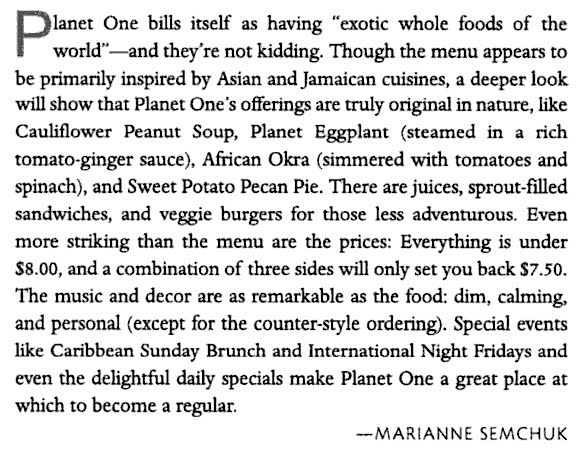
Planet One Cafe is gone. On 7th Street for decades, the little vegetarian restaurant has been shuttered. Inside, the window is stacked with cardboard boxes marked FRAMUS--inventory from the new guitar shop next door.

I guess custom-made guitars are expanding and vegetarian food is not.


I don't know much about Planet One, except that it seems to have been there forever and have a very neighborly vibe. And now, without a goodbye sign, they are just gone. Does anyone know what happened here?

Here's what Vegetarian New York City had to say about Planet One:

Tuesday, June 22, 2010

*Everyday Chatter

Urban Outfitters is creating a fake, "old New York" Upper West Side. Writes one blogger, "Coming next--a theme park where you can meet actual 'mom and pop' actors portraying independent store owners. Bring your kids! Watch actual small business owners cry as their dreams are dashed by sky-high rents!" [WSI]

Raised on the Upper West Side in the 70s, a blogger defends her childhood home from "bad old days" attacks from Commentary and City Journal. [CGW]

A letter of opposition to crowded outdoor cafe on Ave A. [EVG]

"Forget the clopping of hoofs, it was the clipping of hair that beckoned Saturday at Belmont Park." Anyone up for a haircut at the race track? [via Fat Al]

The condos coming to replace Frank O'Hara's last home have been revealed. [Curbed]

Are we about to lose the signage of Katz and Sons? [BB]

Gino's Zebras

When Gino closed, many of us wondered what would become of their signature zebra wallpaper. Sprinkles, the Beverly Hills cupcake chain that is moving in to the location, wanted to keep it on the walls, but as Obit reported, Gino co-owner Michael Miele said, "We take our zebra with us."

And they have.

JVNY reader Karen McBurnie sends in a gut-wrenching photo of a gutted, de-zebra'd Gino:


Karen & Jon's flickr

Without the old wooden bar, without the tables filled with patrons, without the zebras leaping across their tomato-red walls, the place has no character.

It amazes me how all that feeling can simply vanish, leaving a shell that looks just like any other vacant storefront, a dull rectangular box, soon to be churning out cupcakes.

Monday, June 21, 2010

*Everyday Chatter

What happened to the Empire Diner's Empire State Building?! It used to stand at the corner like a glittering hood ornament. I hope those Coffee Shop people are just polishing it up to be put back:


"In the late 1970s, the historian Christopher Lasch famously described America as a culture of narcissism. Today we might well be called a nation of dysregulation. The signs that something is amiss in our inner mechanisms of control and restraint are everywhere." [NYT]

Walking the Seaport. [FNY]

If there are mermaids, then it must be summer. [Blah]

Who's designing NYU's big tower? Grimshaw, the creators of the Cemusa news boxes. It's all a matched set. [WSJ]

Looking at the watery ruins of the Hudson. [SNY]

Fairey mural just can't win. [EVG]

Tomorrow night, author David Freeland speaks at the Skyscraper Museum.

In the Bronx: "Today’s bland urban landscape of concrete towers and big box stores rests atop what was once Freedomland, which shrank the United States down to theme-park size." [CR]

Times Square? Enough already. [FP]

Folsom Street East went on this weekend in the shadow of shiny new condo towers:

Klein's Fat Men's Shop

Ever since I first discovered its existence some years back, while researching the city's past, I've had a mild obsession with Sig Klein's Fat Men's Shop. From the late 1800s until who-knows-when, it stood at 52 3rd Avenue, near the corner of 10th Street. For close to a century, it served the needs of fat men all over.

Let's take a look back at Klein's timeline...


from under the 3rd Avenue El

Klein's was the subject of a New Yorker "Talk of the Town" piece in 1931, a year before Mr. Klein died in 1932.

Ben Shahn photographed the shop around 1935. The painter Paul Feeley painted it in 1936. Klein's can also be seen in the background of Berenice Abbott's 1937 photo of the Stuyvesant Curiosity Shop.


Ben Shahn

Kiplinger's Personal Finance wrote in 1949, "The store is well-known in New York for its huge weather-beaten sign featuring an enormous fat man wearing a form-fitting union suit," above the famous slogan: "If everyone was fat there would be no war." (Apparently attributable to one Dr. Frank Crane, a Presbyterian minister fond of making up aphorisms.)

For a peek inside the shop, check out LIFE for their shot of a rather rotund man being fitted for a suit. And Getty Images has two excellent exterior close-up shots, one from the north, and another from the south--both taken in 1947.

Throughout the 1940s, Klein's advertised in popular magazines, proclaiming their prodigious sizes.


Advertisement in Popular Science, 1943

In 1955, Meyer Berger wrote about the place, noting that the "two low gray buildings that house the gargantuan sizes date from 1804," and that Klein "launched the specialty shop back in the Eighties, when most of his customers were German neighbors too fond of their beer. 'The more they drank, the bigger they got.'"

East Side News columnist George Freedman got a similar story in 1954 for his "Did You Know That??" column, crediting the beer-loving Germans for the birth of Klein's:


click to enlarge

In the '60s, things started going downhill for Klein's. In 1963, the Times reported, "Garments Stolen (Sizes 62 and Up) at Fat Men's Store."

The Klein's sign then shows up in Bill Binzen's wonderful book of photos, Tenth Street, published in 1968. In the same time frame, possibly the most recent trace of it appears in this undated shot of that era by Tony Marciante. The photo is from inside the Brata Gallery at 56 Third Avenue, from the time when art galleries took over on 10th Street and 3rd.


Bill Binzen

I can't find any mention of Klein's from the 1970s. No, I take that back--it is briefly mentioned in a 1978 New York Times article about a store called London Majesty, for "royally proportioned men." The writer states, at the end of the article, "shops for king-sized men have come a long way since they had names like Sig Klein's Fat Men's Shop."

Since they had names like Sig Klein's--past tense.


c. 1950s, Klein's sign at 4th Ave. and 10th St.

So was Klein's gone by 1978--or just forgotten? Did it live to see its 100th birthday in the 1980s? What happened to it?

A walk over to its former address shows that the two gray 1804 buildings that once housed Klein's are gone today. A squat, khaki-colored building stands there now, housing a surgical supply pharmacy and a nail salon.

There is no sign of Klein's.

Friday, June 18, 2010

*Everyday Chatter

Italians in Williamsburg maintain their traditions while coping with hipsters and yuppies who drop their pants during church processionals. "They don’t respect us, all these young kids--artistes, whatever you call them." Warning: This article will make you angry. [NYT]

Take a look inside an old theater on Ave B. [EVG]

Dispatch from the Noise Wars of the 1980s: "Hey, look man, New York is party city, that's why we moved here...if you don't like it, you can move to the country, old man." Sound familiar? [FP]

In the Village, an urban etiquette sign shows the new nervousness of bar and restaurant owners--please be quiet so the neighbors don't stop us from having our liquor license renewed:


TGI Friday's really is coming to further humiliate Union Square. [Eater]

Bloomberg backs down "somewhat" from banishing art vendors in the parks. [NYT]

Taxi Driver is playing at the Sunshine. [BB]

Looking back and forward at Lafayette Street. [NYT]

In Chelsea, lovely house numbers. [ENY]

Thursday, June 17, 2010

O'Toole's Trash

*6/18 UPDATE: A call to St. Vincent's from a major media outlet, who emailed me, reveals the hospital is auctioning off these items and they are not being destroyed.


As the goodbye notes on boarded-up St. Vincent's hospital continue to accumulate, across the avenue at the hospital's doomed O'Toole building, an outdoor courtyard has filled up with discarded medical equipment.


It's a tangled graveyard of exam tables, scales, IV stands, walkers, chairs, and much more.


I don't know what's to become of this equipment. Left out in the elements, it looks a lot like trash. And visible red stickers announce the single-word instruction: DESTROY.


While some of it may be trash, much of it looks viable. Why is this equipment not being donated to community medical clinics in poor neighborhoods in the city, or across the country? Couldn't an organization that helps set up clinics in places like Haiti take this on?

Wednesday, June 16, 2010

*Everyday Chatter

Also on the hunt for Hopper's diner--check out the conclusions from Nighthawks Forever. [ShadeOne]

Newest NIMBY war: Wine bar vs. Street fair. [Eater]

Tie up your dog, watch your ass. [EVG]

Remembering the General Slocum. [GL]

Bobby Steele at Niagara. [SG]

"Fauxcade" all wrong for the non-Nighthawks triangle. [Villager]

Beware: "the digital hive mind has no superego." [CR]

Pizza for Zito's

In 2004, Zito's Bakery closed after 80 years in business. At the time, along with rent increases and the rising price of coal, Mr. Zito cited the war on carbohydrates. Since then, the beloved bakery has remained empty and unrented.


The facade has become a miserable canvas for junk graffiti and stickers. One of the tinted glass panels above the window has popped out, leaving behind a dark cavity. But this month a building permit has gone onto the door for a $160,000 renovation--for a "BUILD OUT OF A PIZZERIA."

So much for the war on carbohydrates.


A quick search online reveals an article from Crain's, who reports that "Pizza Roma is taking over the former home of the famous Zito’s Bakery... The new eatery, which has outposts in Rome and Barcelona, is expected to open its first Manhattan location within four months and hopes to follow up with more New York eateries in coming months."

So, Zito's is getting a chain--at least it's Italian.

Will Pizza Roma keep any of the interior? Here's a shot I took in 2008. While the shelves and tiling are intact, it looks like there's not much there to save.

Tuesday, June 15, 2010

*Everyday Chatter

The Standard moves those picnic tables that were taking up the whole sidewalk:


Allen Ginsberg's apartment is being gutted--and the neighbors wait for the move-in of a "long-past-teenage idiot amping-up to Baba O'Reilly." [Blah]

Landmarks tries to save Bowery buildings. [Curbed]

All these people moved to New York in 2008. [Gothamist]

The debate over banks vs. crowded restaurants. [EVG]

Pre-demolition at Coney landmarks. [ATZ]

There is still nothing happening at Chumley's, though the plywood piles have been moved around:

West 4th Copper

When Left Bank Books and Lee's Laundry were kicked out of their side-by-side locations on West 4th Street, it was soon evident that the landlord was combining their spaces to rent out as one large space.


before

But it's not becoming another Marc Jacobs, as some of us might have conjectured.


What it is becoming is a swank restaurant (or cafe, or bar) with lots of copper detailing. You can tell it's swank because the interior has been painted in swank-coded colors, pistachio and aubergine. It also has a giant copper breadbox-looking thing on the brushed-steel countertop--or maybe that's part of an over-performing coffeemaker. I can't identify the object conclusively.

And is that a super-trendy and inefficient exposed-filament bulb in that hanging lamp?