Tuesday, May 15, 2018

2 Chinatown Newsstands

(From an old post I never posted.)

C&L Sunrise Grocery was a little newsstand on Hester Street at Bowery. Its facade is remarkable thanks to the old, hand-painted sign that hangs above its awning, announcing: "Chung's Candy & Soda Stand," with 7-Up and Coca-Cola logos, also painted by hand.


The place sold candy and newspapers, lottery tickets and umbrellas. The usual stuff. Awhile ago, I went by to find a "Space for Lease" sign on its rolled-down shutter. (Maybe by now it's reopened as a new newsstand?)

Meanwhile, at another corner of Chinatown, where Lower East Side-style gentrification is seeping in, another newsstand vanished.


before

At Rutgers and East Broadway, against community objections last year, Jajaja Plantas Mexicana moved in to what had been the Golden Carriage Bakery and a little newsstand with a metal awning.

The popular restaurant serves vegan Mexican food. They left the newsstand signage, but it looks kind of sad, hanging out there without its old soul.


after

Monday, May 14, 2018

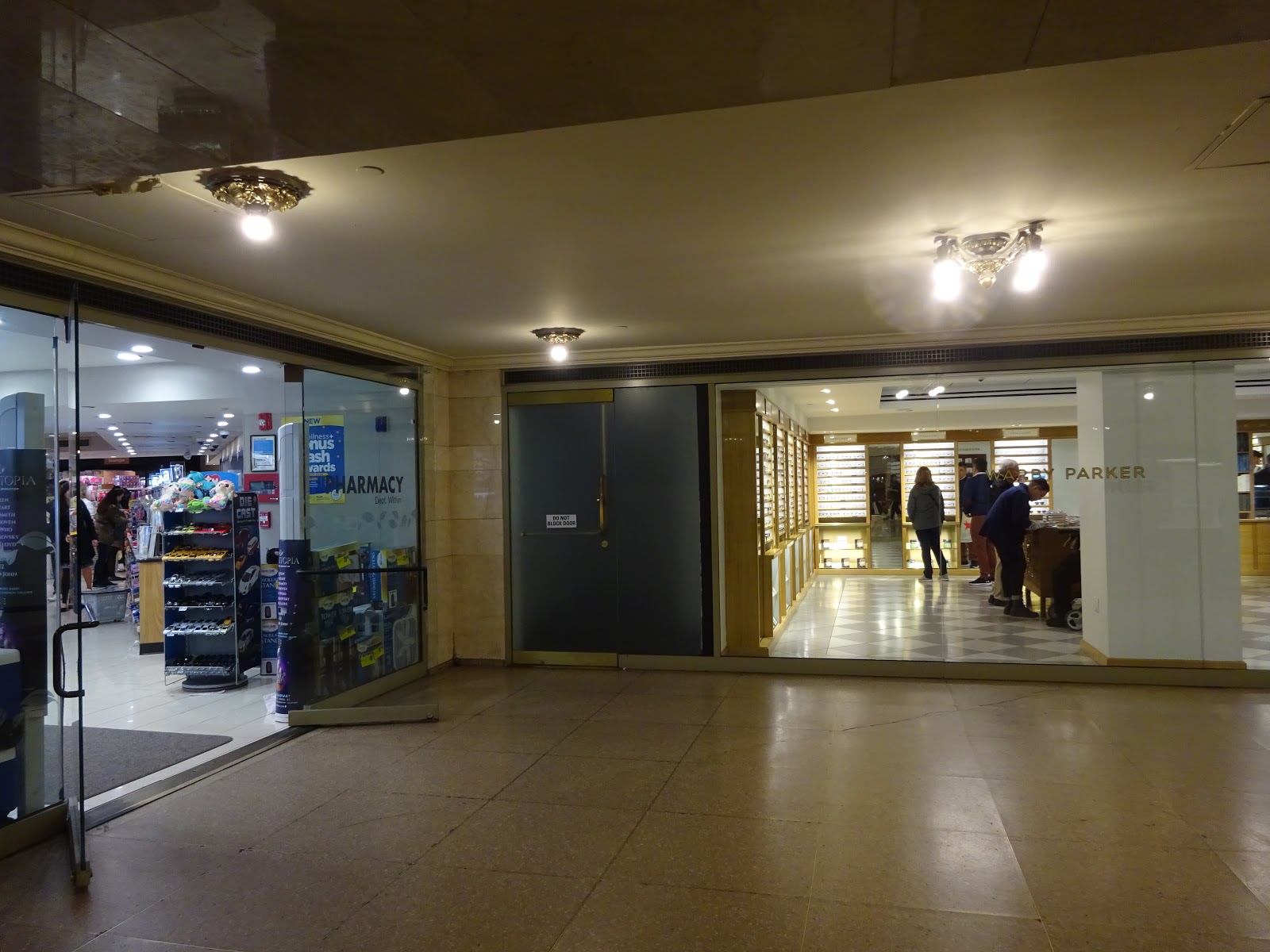
Posman's to Warby Parker

When Posman Books was evicted from Grand Central in 2014, New Yorkers were heartbroken.

At the time of the closure, it was understood that Posman's spot would be left vacant for "short-term storage area during the construction of the new eateries planned for Vanderbilt Hall." The neighboring Rite-Aid was allowed to stay in business.

But then (two years ago now), a new tenant moved in.


Warby Parker, the eyeglass chain, moved into Posman's space.

So what's that about? Why did we have to lose another bookstore?


today: Rite-Aid and Warby Parker

From these before and after shots, it looks like only a small portion of the space is being used by Grand Central.


before: Rite-Aid and Posman's

Thursday, May 3, 2018

Tax Commercial Vacancies

Back in 2015, Benny's Burritos shuttered on Avenue A after 27 years in business. The space is still empty, creating more high-rent blight, a plague that is swallowing hyper-gentrified neighborhoods across the city.

Someone has a suggestion.


A vacancy tax has been on my wish list for a few years now. Recently, Mayor de Blasio mentioned it on WNYC. He said:

“I am very interested in fighting for a vacancy fee or a vacancy tax that would penalize landlords who leave their storefronts vacant for long periods of time in neighborhoods because they are looking for some top-dollar rent but they blight neighborhoods by doing it."

Now the street is speaking.

Wednesday, May 2, 2018

Eisenberg's Sandwich Shop

The great Eisenberg's has been sold.

We've been hearing whispers about this for the past two years. Today the sale was announced on Eisenberg's Facebook page. They say they've "passed the torch" and hope "things will continue as they were."


When I called for information and asked for long-time owner Josh Konecky, I was told by Jodie the manager that he is "no longer connected with Eisenberg's."

The employees just got the news on Monday night. "It's so fresh for us," Jodie said, "I know nothing except they told me that Eisenberg's will be running just as is."

The new owner is named Warren, but that's all the information available right now. Let's keep our fingers crossed and pray that Warren is a true fan of Eisenberg's and will in fact keep the tradition going, just as it is, like Josh did when he first bought the place, saving it from certain destruction and running it for the past several years with heart and soul.


When I spoke to Josh for this blog in 2007, I asked him, “Most people nowadays when they buy a place, they change it. Why did you keep this place the same?”

He looked at me like I had just asked the most ridiculous question in the world, then he shrugged and said, “Why change it? When I bought the place, people kept saying, you’re not gonna change it, are you? I told them, I’m just gonna clean it up a bit. And they’d say, Don’t clean it up too much!”

Eisenberg's opened in 1929. It's beautiful. It's perfect. There is nothing else like it. Warren, whoever you are, don't fuck it up.


Previously:

Eisenberg's Not Vanishing
Eisenberg's U-Bet


Monday, April 30, 2018

Gargoyle Hunting

On a warm spring afternoon I meet John Freeman Gill on the Lower East Side for a little gargoyle hunting. Gill is the author of The Gargoyle Hunters, a novel set in 1970s New York City about a boy and his father who rescue ornamental stonework from tenements and other old buildings under demolition. For the father, it's a way to preserve a vanishing city.

"The book is completely about the evolving streetscape of New York," says Gill. "The city is constantly destroying itself. Regenerating. It's always been a city in a hurry."
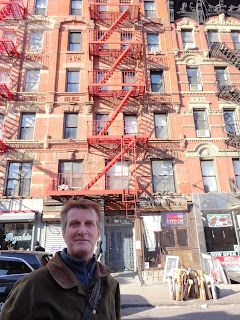


Gill's inspiration for the book was a man named Ivan Karp, a self-taught gargoyle hunter who put together a team in the 1950s and led "clandestine raids on demolition sites." It was the time of Urban Renewal when countless tenements were destroyed, taking their decorations with them. Karp saved some 1,500 sculptures and eventually got the Brooklyn Museum to take them in.

Since the days of Urban Renewal, housing for low-income people doesn't come with much in the way of beauty or aliveness.

Gill and I are standing on Madison Street and Rutgers. On one side are tenements, covered in ornamentation--demon faces, cherubs, sea monsters, nudes. Their first floors are full of businesses like bodegas and Chinese restaurants. The sidewalk is busy. Across the street are the public housing towers that came out of the 1950s. They are dull and drab. Little life occurs at their feet.


Decorating tenements wasn't an act of landlord generosity--it was a marketing tool, says Gill. "The goal was not to create beauty, it was just to dress up shabby housing for the poor. It makes it look fancier than it is." Still, the decorations made for a livelier streetscape, one much less homogeneous than what we have today.

"You can feel the imprint of the individual in the object," says Gill. Then he points across the street at the housing projects. "These monstrosities are just boxes for housing low-income humans."


On the tenements, the ornaments generally come in two types: terracotta and stone. The terracotta pieces, Gill explains, were produced in a factory. The stone pieces were carved. How to tell the difference? Terracotta works tend to be sharper, while stone pieces are more likely worn away by time.

Many men among the nineteenth-century immigrants who came to New York were stone carvers. "They carved the monuments, the statues and gravestones, of Europe," says Gill, and then they carved the monuments on the faces of the tenements built for them to live in. "These gifted carvers are decorating their own housing. "

The architects didn't specify on the blueprints what decorations they wanted. "They'd just write 'carving,' and then the foreman might say 'Give me a Mary' or 'Give me a Moses,'" generic terms for a type of male and female face. "So the carver would do what he wanted. They'd carve each other's faces. Or the cop, the barkeep, or a girlfriend. So when you look up at these buildings, you're seeing the New Yorkers of the late nineteenth century looking back at you."


This stuff is in Gill's DNA. His mother, Jill Gill, was a gargoyle hunter. A self-taught artist, she painted street scenes as they were vanishing, and when she came across a forsaken ornament from a demolished tenement, she'd load it into her baby's stroller and cart it home. "My mother was obsessed about this," says Gill, but he didn't pay much attention to it in his youth.

It wasn't until he started writing for the New York Times' City Section that he "Gravitated toward historic preservation." Now, he says, "The ephemeral nature of New York's cityscape is my eternal fascination."


He wants to make it a fascination for his readers, too. "New Yorkers never look up," says Gill. And there is so much they're missing. The carvers of the past "incised their imagination onto our streetscape. They turned the streets of New York into marvelous public art galleries."

After you read The Gargoyle Hunters, you might find yourself looking up more often.


Read more about The Gargoyle Hunters and find out where John will be next


Tuesday, April 24, 2018

NY Cake Move

In February, I reported that NY Cake was closing, hoping to move to a new location.

They have announced that they are staying in the neighborhood, moving to 118 West 22nd Street in the fall of 2018.


In their press release, they write:

"The larger space is located just a block away from the current storefront which will remain open throughout the summer to ensure customers’ baking needs continue to be met. The new location will enable NYCAKE to enhance the store’s offerings including the introduction of new lines of baking products, expanding the school’s schedule to include additional baking classes with co-owner Lisa Mansour, and launching their first-ever cafĂ© offering freshly-baked confections from NYCAKE."

Monday, April 23, 2018

Rally for the SBJSA

Tired of just complaining about small businesses closing? Then show up and make some noise for something that can actually help. On Wednesday morning at 10:00, join the rally for the SBJSA on the steps of City Hall.


The Small Business Jobs Survival Act (SBJSA) is the best way we currently have to slow down the loss of our small businesses and the scourge of high-rent blight that is killing our streetscapes.

Recently, City Councilmember Ydanis Rodriquez reintroduced the SBJSA. Corey Johnson, the new speaker of the City Council, has pledged to give the bill a public hearing, and we hope it will go up for a vote and pass in full force.

It sounds good. But supporters of the SBJSA are worried that the City Council will kill the SBJSA once again--or rip out its teeth and pass a watered-down version to end the discussion. But the discussion will not end.

Show up and let them know you want a strong SBJSA, not a "REBNY Trojan horse" version of the bill.


Here's what you can do:

- Show up at City Hall. Be there and make some noise.

- Write to the mayor and ask him to support the SBJSA. Here's a quick form you can fill out in just a few easy steps.

- Write to Council Speaker Corey Johnson and ask him to support a strong SBJSA and bring it to a vote. Here's a quick and easy form for that, too.

- Here's more you can do.

- And talk about it. Talk to your friends, family, and co-workers. Tell them that mom and pops aren't vanishing "because of the market," they're vanishing because the city and state support landlord greed -- but this can change. There are solutions. The first step is raising consciousness. We have to imagine a different city.