Wednesday, December 19, 2012

NYU: No Confidence

Last week, the faculty of NYU authorized a no-confidence vote, a move that could lead to President Sexton's termination. They write, "The NYU 2031 Sexton Plan, the administration’s ill advised multi-billion dollar plan to expand the university within Greenwich Village, was the proverbial straw that broke the camel’s back." And now, some key quotes from the must-read book While We Were Sleeping: NYU and the Destruction of New York.


"It's not just NYU. There are days when I feel like I'm stranded in some upscale mall in Pasadena. Don't even get me started on the insidious transformation of Bleecker Street!" --Jessica Hagedorn

"Those little garden plots on the corner of Bleecker and LaGuardia may not be on our way to anywhere. And yet we need them, we seek them out, to smell the wet earth, to remember the feel of soil drying on our hands, the smell of a fresh tomato, the wonder of a dogwood blooming. I'm sure NYU has computed the dimensions of this garden, but they are using the wrong units of measurements." --Peter Carey

"The tall buildings started to pop up all over the place. In the east village that used to groan when the fall came ('NYU' we'd hiss) and it meant that the east village was always our neighborhood but come fall all these kiddies would suddenly be streaming into the streets with their avidity and suburban fashion. But there were more of us than them so the problem was fortunately contained. They were actually still part of what there was. And there were many things here including students. Then by the 21st c. they were living in our buildings. Not like us, but like them. Their parents bought them apartments or else were paying the rent which was five times higher than ours. They were wandering (or running) through the halls of our building at night with their beers or also in their bathrobes between apartments with their cups of tea. They were incredibly loud. The way they were talking. Like no one was living here. Like they were living in a dorm. They were." --Eileen Myles

After NYU's expansion, "There will no NYU, no Village. Just another herd of de-zoned skyscrapers ready for another wrecking ball, another rage of 'development,' another detraction from New York City, that which makes it different from the featureless, dangerous inhuman depopulated streets of Downtowns USA across the country." --Kenneth Lonergan

"In the past, heartland whites with some kind of dream or desire left their towns for cities to become citified. They wanted to get away from religion, from their families, they wanted to come out, make art, have sex, have experiences. But this new crew was something we had never seen before. They were the first generation of suburban Americans. They came, not to be citified, but rather to change cities into places they could recognize and dominate." --Sarah Schulman

Tuesday, December 18, 2012

Carmine's IHOP

As we heard this past summer, IHOP signed a 49-year lease for the corner of Carmine and Varick, paying $300,000 per year and setting off a panic about its potential impact on a street that has remained authentically New York. As the Observer put it in a headline, this move is "Effectively Stabbing Village in Heart."

Now that heart-stabbing IHOP shows itself with blue awnings, signage, and the warning "Coming Soon."

Photo thanks to Richie Cohen

What does this mean for the neighboring mom-and-pops? Carmine Street is a place of survivors--though much has been lost--but for how long? Already, Unoppressive, Non-Imperialist Bargain Books is struggling. All of them are in the crosshairs of Big Development.

The real estate agent who brokered IHOP's deal told the Wall Street Journal that Carmine, "was a dumpy street. Now it's top-notch." IHOP is "a big brand, and it'll help me convince other big brands to follow. People don't even know where Carmine Street is--yet. We'll fix that."

These suburban chains don't come here by accident. They are lured here as part of Big Development's overarching plan for the city, and Bloomberg opens the door wide. The Center for an Urban Future just released their exhaustive report "State of the Chains 2012," finding that "the number of chain stores in New York City increased for the fifth straight year." And that runaway train shows no sign of stopping in 2013--an Applebee's is coming to Coney Island's Surf Avenue.

Previously:
Carmine Survivors
Lost on Carmine
Chain Stores in the City

Monday, December 17, 2012

Meatpacking 1985

A couple of months ago we got to see some wonderful photos of the Meatpacking District in the 1980s, thanks to Yvonne B. Now, photographer and author Brian Rose sends in a link to his amazing collection of photos featuring the Meatpacking District in 1985.


The desolate industrial neighborhood of the past stands in stark contrast to today's center of consumerism and luxury. In most of the photos there are no people, just shuttered meatpacking warehouses. The streets are quiet. No girls in Manolos. No cupcake eaters. No High Line tourists.

Today, in the view seen above, condos rise and rise.


Brian's photos are all in daylight, so you won't see any transgender prostitutes or leather men on the prowl. But there is evidence of their presence, like the hot-sheets Liberty Hotel, which still stands, and a rare shot of the entrance to the Mineshaft, the gay leather club featured in the Pacino movie Cruising. (Check out "Back in the Gays" for an insider's memory of the Mineshaft.)


There's also this lovely shot, which I include here because the corner also turned up in Yvonne B's collection--17th Street and 10th Avenue. Something attracted both photographers to the spot. Maybe it was that rusted-out LIQUORS sign, or the colorful mural, or the ghost sign for KIPS BAY BEER. All of it has vanished.

Visit Brian Rose's blog for much more of the Meatpacking District in the winter of 1985. And while you're at it, buy a copy of Brian's must-have book Time & Space on the Lower East Side.

Friday, December 14, 2012

*Everyday Chatter

NYU professors mutiny against president Sexton and his plan to bulldoze the Village. Support them at NYUFASP and "stand up for NYC." [NYP]

An oral history of the Beatrice Inn that might make you ill. [NYM]

A treasure trove of photos featuring lost neon signs of NYC. [NYN]

A very detailed hand-drawn map of NYC. [JS]

Ada Louise Huxtable on the destruction of the NYPL's incredible stacks: "This is a plan devised out of a profound ignorance of or willful disregard for not only the library's original concept and design, but also the folly of altering its meaning and mission and compromising its historical and architectural integrity. You don't 'update' a masterpiece. 'Modernization' may be the most dangerously misused word in the English language." [WSJ]

Read more about the stacks here. [NYPL]

Visiting Manhattan's print dealers. [NYT]

"Men’s tights, for so long the preserve of ballet dancers and runway models, are taking Manhattan by storm." [BI]

Our old pal Marty Wombacher has gone back to Peoria--and he's got a new blog. Check it out. [WBIP]

Drunk morons in Santa suits are coming to your neighborhood tomorrow--here's a map of where to avoid. [EVG]


Thursday, December 13, 2012

Winter

Autumn in New York has all but vanished, thanks to global warming, and now winter is beginning to fade. Last year, flowers bloomed as early as February. This year, it's looking worse.

(UPDATE: Confirmation from the Wall St. Journal, 12/19/12, that 2012 may be the warmest winter on record.)


In the Village, the consistent warm weather has forced flowers to bloom. Pink blossoms have opened on the same branches where yellowed leaves still hang. Life and death coexist. Seasons collide.


In a street garden on the other side of town, green shoots emerge from a pile of autumn gingko leaves. The flat spears look a lot like iris. It's barely the middle of December.


And a few more shots from today:


Wednesday, December 12, 2012

Laundromat and Marc

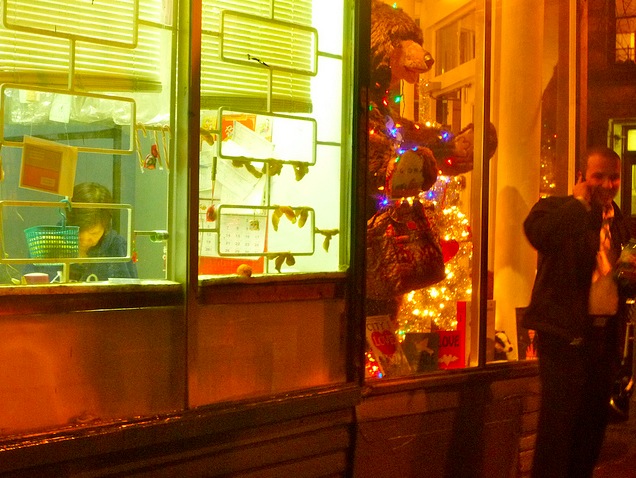
For years, every time I passed a certain laundromat on West 4th and Bank Street, I'd take its picture. Especially at night.


There's something sad and a little bit romantic about a laundromat at night.


But I also took the laundromat's photo because I worried about it vanishing. It has that look--old and shabby, and therefore real, a Velveteen Rabbit of a place.

The woman who works there could often be seen at a makeshift desk by the laundromat's rightmost window, working behind the shop's odd, geometric metal grill. She would regularly hang the grill with orange peels. Over time, the peels dried and created a sort of abstract art. I loved seeing the woman and I loved seeing the orange peels. (At this time of year, she also hung candy canes.)


I worried about the laundromat because it was old, but also because it was being encroached upon. A Marc Jacobs store opened across the street and another came right next door.

The juxtaposition of the two windows at night always captured my attention--the Asian woman silently working, head bowed behind her orange peels, and on the other side of the wall, a room full of young, excited people delirious for retail. I knew it couldn't last.


The laundromat has not vanished. But it has gotten smaller. You might not notice. It's not the sort of thing you notice unless you've been paying close (perhaps obsessively close) attention. And you might not think it's worth bothering about--the laundromat is still in business, so what does it matter if it's a few feet smaller?

But the window with the orange peels is gone. And that made all the difference.

The ever-expanding Marc Jacobs empire has expanded a bit more, broken through the laundromat's wall, and taken over the woman's former spot. "Little Marc Jacobs" got much bigger and the laundromat got much smaller--in size, yes, but mostly in feeling. With her window gone, you won't see the woman anymore, sitting at her counter at night, taking a little space for herself at the end of a long day of hard work. All you'll see now in that space is more expensive stuff to buy your kids for Christmas.

Today

Lost Laundromats:
Lee's Laundry
Harry Chong's
Chin's Laundry

Tuesday, December 11, 2012

Movie Star News Now

It didn't take long for the landlord to find a new, higher-priced tenant for the space previously occupied by Movie Star News on West 18th.

We learned in July that the venerable shop would be closing after 73 years of history in the city. By the end of that month the owner had packed up and sold Irving Klaw's entire Bettie Page collection to a Las Vegas collectibles company.


The space, once loaded with bins full of colorful movie posters and towering shelves overflowing with Hollywood glossies, has been gutted and turned into a pure, white hollow. A paper taped inside the window says Lefroy Brooks is coming.

Lefroy Brooks sells luxury bathroom fixtures. They have one elegant collection of faucets, towel bars, soap dishes, and toilet paper holders called "Kafka."

Is this all a bit Kafkaesque?


Franz Kafka's biographer, Frederick R. Karl, defined the term "Kafkaesque" to the Times: "What's Kafkaesque is when you enter a surreal world in which all your control patterns, all your plans, the whole way in which you have configured your own behavior, begins to fall to pieces, when you find yourself against a force that does not lend itself to the way you perceive the world. You don't give up, you don't lie down and die. What you do is struggle against this with all of your equipment, with whatever you have. But of course you don't stand a chance. That's Kafkaesque."


Read more about Movie Star News:
The long history
The closure
The move to Vegas