Monday, August 27, 2018

Silver Spurs to Morgenstern's

The Silver Spurs coffee shop had been around since 1979. The last survivor shuttered on LaGuardia this past March. At the time, Kiki the manager told me their replacement would be an ice-cream place. “Expensive," she said.

Recently, Morgenstern's ice-cream shop papered the windows, announcing their arrival in the spot.


Important to note--they also announce they are "credit card only." No cash allowed. When you're forced to put a $4.50 ice-cream cone on credit, you know the dystopian future has already arrived.

They're not alone. Van Leeuwen ice cream is also no cash accepted. SweetGreen is another one (and they took the space of a great coffee shop on University Place). It's a growing, disturbing trend.


Cashless retail is discriminatory and exclusive. The Guardian recently reported that local government in Washington, DC, is trying to put a stop to it with The Cashless Retailers Prohibition Act of 2018.

They wrote: "A report last year by the Washington City Paper found that 27% of people in the US would have trouble using only a credit card to purchase products, and that the percentage in Washington DC is even higher. 'I’m concerned with more and more restaurants, businesses and shops going cashless because you’re systematically excluding a group of people who are already disadvantaged and disenfranchised,' Linnea Lassiter, an analyst at the DC Fiscal Policy Institute, told the paper. 'And now they can’t have access to this restaurant?'"

One good thing about all those vanishing coffee shops like Silver Spurs? They took our cash.


Den Re-Done

The Village Den was a comfortable, accessible diner in Greenwich Village for 36 years. It shuttered this past May.

A sign went up in the window soon after, announcing that something new was coming: "Better Den You Remember." But the Den I remember was quite wonderful, so probably not.


Now the Times reports that the Den is being re-done by Queer Eye's food and wine expert Antoni Porowski.

The "theme" of the new place will be comfort food, except it won't be the actual comfort food previously served at the theme-free original Den.

It also might not feel as accessible to everyone as the old place. The Times reported: Porowski's "target audience is people like him: the '30s health and fitness' crowd, he said, noting that the restaurant is near an Equinox gym."


Wednesday, August 22, 2018

Star Struck Vintage

VANISHING

Whenever I walk past it on Greenwich Avenue, I remember buying my first suit there in 1994, and I wonder how it can possibly still exist. The store, not the suit, which is long gone.


photo via International Traveller

On their Facebook page, Star Struck has announced:

"We would like to take a moment to let you know that after 38 years Star Struck Vintage in NYC will be closing. We will be forever grateful to all of our customers, for you have shown us the true meaning of loyalty. Many of you have become part of our family over the years; and although we will miss you all very much, we are looking forward to retirement. The store will be closing August 31st."


Tuesday, July 31, 2018

Appropriating the Neighborhood

Today I published over at the Village Voice, writing about Target, neighborhood appropriation, and hyper-gentrification.


Excerpt:

What the colonizers desire and replicate is gritty New York without the grit. Punk and jazz and poetry without the enlivening shock of unpredictability. It’s a neat trick that works in part because we are starving for reality and a connection to history. Homesick for our lost city, we can be easily seduced by imitations of life.

At Target’s grand-opening event, it wasn’t the pseudo-CBGB that really got to me. I keep thinking about that fake stoop. The stoop, so utterly urban, normally brings the inside out; facing the street, it engages residents with the sidewalk ballet. But in today’s homogenized city, the new developments turn away from the street, like suburban developments often do, shielding their residents inside controlled private spaces that reject the communality and chaos of city life. Target’s fake stoop haunts me as a ghost of the unreal, an empty representation recalling a reality that is slipping away. As urbanist M. Christine Boyer has written, in her essay “Cities for Sale,” “these tableaux are the true nonplaces, hollowed out urban remnants, without connection to the rest of the city or the past, waiting to be filled with contemporary fantasies, colonized by wishful projections, and turned into spectacles of consumption.”

A haunted feeling is part of the package in today’s commodified cities. Hyper-gentrification is a horror movie mash-up. An invasion of the body snatchers, it zombifies what went before. It kills and then reanimates its victims, sanitized and tamed, to sell itself and expand into further territory, all while working to convince us that it has the best intentions and means no harm. It just wants to be part of the community. Part of the family. One of us, one of us. Like a vampire at the door it asks, with a seductive smile: Won’t we please let it in?

Read the whole article at the Voice

Monday, July 23, 2018

Paperbacks

The paperback edition of Vanishing New York is in bookshops this week--starting tomorrow. Get 'em while they're hot!


There will be plenty on hand at the paperback launch event this Friday night, July 27 at 7:30 p.m., at Books Are Magic. That's at 225 Smith Street in Brooklyn. I'll be signing books and talking about Vanishing New York with Jason Diamond, author, journalist, and founder of Vol. 1 Brooklyn.

You can read more about it at the Facebook invite and the bookstore's Events page.


Here's what people have to say about the book:

“Essential reading for fans of Jane Jacobs, Joseph Mitchell, Patti Smith, Luc Sante, and cheap pierogi.”
--Vanity Fair

“A full-throated lament for the city’s bygone charms.”
--Wall Street Journal

“A wrenching, exhaustive chronicle of the ‘hypergentrification of New York’ [. . .] Every page is charged with Moss’s deep love of New York. It is both a vital and unequivocally depressing read.”
--Molly Fitzpatrick, The Village Voice

“Moss won me over almost immediately and has written a cri de cœur that is essential reading for anyone who loves this city.”
--Michael J. Agovino, The Village Voice

“The pleasure […] of reading Moss is his purity.”
–The New York Times Book Review

"Moss, a cantankerous defender of the city he loves, chronicles its disconcerting metamorphosis from cosmopolitan melting pot to bland corporate lounge with passion and vigor; New York is lucky to have him on its side." --NewYorker.com

“a remarkable atlas charting where New York has gone, and why.”
--The New Republic

“a compelling and often necessary read.”
--The Daily Beast

“An impassioned work of advocacy on behalf of a city that’s slipping away.”
--Guernica

“There is much embitterment, snark, and rhapsodizing about egg creams to satisfy the downright romantic here […] his humanist odes to bygone businesses can move a reader to tears […] But the book is much more than a nostalgia trip.”
--Citylab

“Moss’ book is very much in the tradition of Jane Jacobs’ The Death and Life of Great American Cities, with a more acerbic outrage suited to our nasty, barbaric times. […] His glimpses of New York can be engagingly personal and eloquent.”
--Los Angeles Review of Books

“Passionate, sprawling.”
--Slate

“A vigorous, righteously indignant book that would do Jane Jacobs proud.”
--Kirkus

“A very good, angrily passionate, and ultimately saddening book [. . . ] brilliantly written and well-informed.”
--Booklist

“A passionate case against the luxury vision of New York that characterized the Bloomberg years […] likely to stir a lot of emotions.”
--Publishers Weekly

“I haven’t read a more impassioned book in over a decade. Jeremiah Moss writes like a man who has lost the love of his life to a junk bond trader. Vanishing New York is angry, incredulous, but also full of insight into a city of legend, where every legend happened to be true.”
--Gary Shteyngart

“Jeremiah Moss came to the party that is New York City just in time to see it turn into a wake. The New York of poets and weirdos and cranks and outsiders and keepers of various flames--and of ordinary hard-working sorts with no aspirations to stardom or wealth--has pretty much receded into memory now, and Jeremiah has become that memory. His book is lucid, eloquent, phenomenally detailed, and terribly sad. Future generations, assuming there are any, will read it in wonder and disbelief.”
--Luc Sante

“Meticulously researched, thoroughly reported, at once a call to arms and a soul cry, Vanishing New York is a love letter to originality and the human spirit. Grab a knish and settle in.”
--Charles Bock, New York Times bestselling author of Alice and Oliver

“I can’t stand going on vanishingnewyork.com and seeing what’s next to go.”
--Andy Cohen, TV personality/ Executive VP at Bravo

Saturday, July 21, 2018

Targeting the East Village

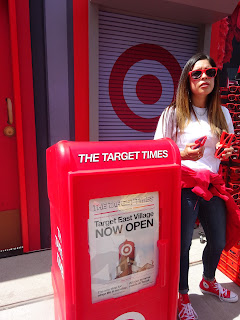
Jane Jacobs is rolling in her grave today. The Target chain has opened a store on 14th Street and Avenue A, and for their grand celebration they have committed what might be the most deplorable commodification of local neighborhood culture I’ve ever witnessed.


Along the first floor of Extell’s luxury monster, known as EVGB for the Trumpian claim of “East Village’s Greatest Building,” Target has constructed a simulacrum of the hyper-local New York street--the sort of street that is being wiped out by corporations and developers--and it comes complete with all the signifiers.

The façade is draped in vinyl sheets printed with images of tenements, the same sort of buildings that get demolished to make room for such developments. Here they sit, hollow movie-set shells, below the shiny windows of the high-end rentals. They are the dead risen from the grave, zombies enlisted to work for the corporation.


A red newspaper kiosk announces the opening of the store with a fake newspaper (decorated with a bull’s-eyed water tower, as if hunters have it in their sights), and it brings to mind the lost kiosks of the vanished Village Voice.

There’s even a fake fire hydrant and red-painted park benches.

In front of an Alphabet City bull’s-eye mural, you can pose for pictures with props—a guitar, a record album, a slice of pizza printed on foamcore--the stuff of the once iconoclastic East Village.


Who are the people in your neighborhood?

There’s a storefront gypsy telling fortunes with Target-branded Tarot cards.

And on a pseudo stoop is a hip-hop dancer, his leg encircled with a Target-branded bandanna. At his feet are red buckets, marked with the Target logo, maybe for someone to later play with drumsticks in the style popularized by bucket drummer Larry Wright.


But worst of all, there’s a simulated CBGB, the celebrated punk club shuttered by a rent hike in 2006, replaced by the luxury John Varvatos store, and replicated in the Newark Airport as a theme restaurant for tourists.

This one boasts the famous awning, but it's printed with TRGT -- in the club’s iconic typeface, the western-style lettering created by owner Hilly Kristal’s ex-wife. (Restaurateur Daniel Boulud tried this in 2007 with DBGB on the Bowery, and the CBGB estate’s lawyer sent a cease-and-desist letter.)

Inside, TRGT is printed on t-shirts, but you can't buy those. You can only get free "bands."


However, it's not rock music bands they’re giving out, it’s hair bands, Band-Aids, and resistance bands.

I asked, “What kind of resistance?” thinking of the political climate at the moment, and the woman answered, “They’re resistance bands for doing exercise.”


This Potemkin Village from Hell is guarded by three private security guards, all dressed in black suits with Secret Service-style earpieces, and one officer from the NYPD. All the workers are relentlessly sunny, like actors at Disneyland.

And people are streaming in for the free stuff—who doesn’t want free stuff?—happy to adorn themselves with the red sunglasses and branded bandannas as they rush into the store, where the commodification continues.

An East Village-themed mural provides a backdrop for the cash registers, decorated with street signs and hot dogs, more tenements, "NYC Nuyoricans," Theatre 80 St. Marks, and a book with the words “Poets Café.”

To see the artifacts of my own life, my cultural and spiritual awakening, my home, displayed above the cash registers in a Target store is to be cast into a state of confusion and dystopic dysphoria. What am I seeing? Who are these people? What happened to the world?


Meanwhile, down the block, EVGB has spray-painted the sidewalk with ads promoting their amenities and their worldview with the slogans:

GREATEST BUILDING
GROUP BONDING
GORGEOUS BATHROOMS

GET BUFF
GET BUSY
GO BIG


They’ve constructed a bright arc of balloons and they're giving out free cotton candy with "snappy toppings" like Pop Rocks, Sparkle, and Mango Pixie Dust.

Many of the people in line can't afford the apartments here, which start at $3,695 per month for a studio. They are neighborhood residents who've lost a number of affordable local businesses to this development, places like the Stuyvesant Grocery, a laundromat, a hair salon, the Rainbow discount store, Bargain Express, and the Blarney Cove.

But today there is a bright and shiny simulation of the real and the local. There is cotton candy and free trinkets. Bread and circuses that appease--and even win over. And everyone is having a terrific time.

As Margaret Thatcher said, "Economics are the method; the object is to change the heart and soul."


Thursday, July 12, 2018

Coffee Shop

VANISHING

After 28 years on Union Square, Coffee Shop is closing.


From The Post:

Co-owner and President Charles Milite says:

"The times have changed in our industry. The rents are very high and now the minimum wage is going up and we have a huge number of employees.”

Personally, I never went there except once or twice. It was too expensive and full of models. But, you know, the rent. And God save that neon sign.