Tuesday, April 2, 2013

The Village Barn

Reader Herb W. sent in this shot of a souvenir photo envelope he'd recently come upon. He wonders what was the Village Barn and its "big doins"?


A little Googling and a visit to Ebay brings us to a plethora of images and souvenirs from this Western-themed restaurant, once at 52 West 8th Street. Wikipedia tells us that it was opened in 1930 by Meyer Horowitz, and went strong for 37 years.


It was a big basement space decorated with wagon wheels and saddles, with a stage that featured performances by Dell O'Dell "Mistress of Mystery," Zingo the Hollywood Horse, and Lou Mosconi "The Loveable Idiot" (performing nitely), along with much, much more.


The inside of the club's matchbook calls it "New York's ONLY Country Nite Club," complete with hobby horse races, square dances, musical chairs, turtle races, and dollar dinners (suppers just 75 cents).

They also had air conditioning.


And who was leading the calls on those square dances and games? Why, it was none other than "Piute Pete." Smithsonian Folkways calls Piute Pete "


No child of the Ozarks, however, Piute Pete's real name was Morris Kaufman, and he was born on the Lower East Side. Wrote Mel Heimer in the Titusville Herald in 1955:

"...many men and women enjoy this abortive pastime [of square dancing], possibly the way others like to eat opium or collect postage stamps. There are a handful like this in Manhattan and, together with great hordes of visiting firemen who presumably don't get enough of these ridiculous didoes at home, they find their way to the Village Barn and square dance to their dark heart's content."

After outing Piute Pete as a Jewish Lower East Sider, Heimer says, "Personally, I like to think of Morris Kaufman, rustic as all get-out, slapping his thigh and crying out the orders for his childish dances and reels—and then putting on his camel's hair coat when work is through and going up town to Tandy's for some strawberry cheesecake, and a quick thumbing-through of Variety."


1939 Brooklyn Daily Eagle

Whatever became of the Village Barn? Ephemeral New York explains: "When the Village Barn closed in the late 1960s, it became Electric Lady Studios, where Jimi Hendrix, The Clash, and pretty much every other rock group recorded. Above ground was the late, great 8th Street Playhouse, which ran cult classics and revivals until it shut its doors in 1992."


NYU archive photo, c. 1946


Monday, April 1, 2013

Mob The Hat

In February we got word that Ludlow Street's El Sombrero, aka The Hat, is "on its last legs." Longtime waitress (and artist and actress) Regina Bartkoff let us know all about it, and the fact that The Hat really needs our patronage. So with Regina's help, we've organized a Cash Mob for The Hat.


Date: Sunday, April 7
Time: 6:00 pm
Place: The Hat, at Ludlow and Stanton

Regina will be there to welcome you and she'll be serving up burritos, tacos, and the whole nine yards with her special flair. Plus! There's an extra incentive. Tell them "Jeremiah sent me" and you will get a free small margarita. Woo! If you know The Hat's margaritas, a small one's enough to get you off and running.

You'll also get a sense of deep satisfaction and righteous superiority just knowing you showed up to help save a Lower East Side institution, defying the evil forces of hyper-gentrification as they squeeze every last drop of soul from this city.

Be there! Eat, drink--and please help spread the word.


24 Heures

Talking about the High Line with Switzerland's 24 Heures:


Friday, March 29, 2013

Capucine's Restaurant

VANISHING

I don't know Capucine's Restaurant on 2nd Avenue and 19th Street, but I passed by last night and saw this sign in the window:


Thirty-three years in business, but now the rent is too high to afford. It's the same old story all over again. And what kind of place is this? The kind of place that keeps getting the boot in Bloomberg's New York.

The description from New York Magazine makes it sound like a place I'd like to visit, with its shopworn tuxedos and dolled-up seniors:

"So enamored was he of Capucine, the French film beauty, that Gino Bossio named his old-school Italian restaurant for her in 1982. When Bossio passed away in 2005, wife Daryl assumed the reins, taking courtly two-decade veteran waiter Henry Julevic as partner. Aside from those personnel changes, a new TV at the bar, and a few coats of paint, Capucine’s hasn’t changed much since it was founded. It’s the kind of continental place you might take your parents, with middle-of-the-road Northern Italian staples delivered by deferential servers in slightly shopworn tuxedos. Iceberg lettuce dominates salads, olives taste canned, and entrees such as chicken cacciatore and shrimp scampi lack any kick. But pastas arrive perfectly al dente, and meats are cooked to buttery tenderness. In any case, diners return here for comfort, not culinary wizardry. Dolled-up seniors from nearby Peter Cooper Village and Stuy Town fill up the room on weekends, along with neighborhood families marking birthdays and anniversaries."

That's not going to happen at the next 7-Eleven.

Thursday, March 28, 2013

XXX on 14th and 3rd

Back in 2011, I wrote up an extensive post about the Sahara Hotel that once stood on the northeast corner of 14th Street and 3rd Avenue, along with the prostitutes that used to roam the neighborhood.

In the post, I refer to the XXX peep joint on the first floor of the Sahara (now a Duane Reade in an NYU dorm). Photos of that peep joint are rare finds, but I just came upon two of them in the magnificent online archive of photographer Gregoire Alessandrini who maintains the blog New York City 1990s, a must-see.


photo: Gregoire Alessandrini

Sometimes, when I find images of a lost place that is hard to find in photos, I like to post them, to sort of reconstruct the place as much as possible. The one photo I found prior to these was black and white, but here we see the lavender hue of the ALL MALE ADULT VIDEO shop.

In the next shot, we see the western side of the peep joint, along 3rd Avenue.

For more about this corner in the 1990s, read my post on the Sahara Hotel. For more amazing images of New York at that time, see Gregoire's New York City 1990s.


photo: Gregoire Alessandrini

And one more, sent in after this post was posted, from Gregoire. A wider view, it shows the whole corner with its--not one, but two XXX video joints:


photo: Gregoire Alessandrini

Wednesday, March 27, 2013

Snowy City

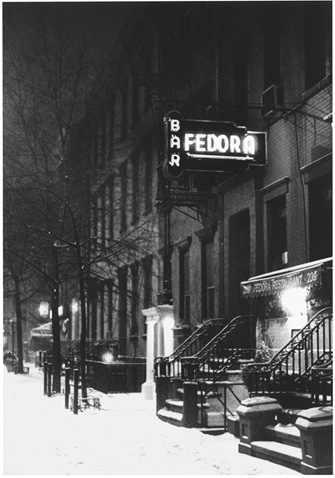
If you're not quite ready to let go of winter in New York, check out Michael Magill's snowy photos of the city in the 1980s and 90s.


In the gusts and the drifts, you can't make out many businesses, but a few stand out, like the neon and awning of the old Fedora in 1993, before Gabe Stulman upscaled it.

Now another Stulman restaurant (Joseph Leonard), in 1991 this snowy corner of Waverly was Pierre's Les Douceurs de Paris.


In a blizzard, the pre-upscaled Minetta Tavern shines with its neon sign in 1998, before McNally got his hands on it, back when you used to be able to just walk in for a drink, enjoy the neighbors, the comfort, the peace and quiet.

There's nothing quite like sitting in a quiet bar or cafe on a snowy afternoon in New York City. Until next year...


Tuesday, March 26, 2013

Children's Zoo

The following is a guest post, written by JVNY reader Donica O'Bradovich, a writer and "lifelong New Yorker who can't quite get the city out of her despite a desperate desire to move to California."

Back in December, the Daily News reported on yet another victim of Hurricane Sandy, a demise that wouldn’t mean anything to anyone except the baby boomers who grew up in the New York City in the 60s and 70s. Jonah’s Whale, AKA Whaley, the one-time centerpiece of the 1961 Central Park Children’s Zoo, and unofficial Rockaway Beach mascot since 1996, had been swept out to sea, leaving only its tail behind. I hadn’t thought about that old zoo for years, but lately, I’ve been on a quest to bring it back, if only in my mind. I kept wondering what had happened to all the other gloriously whimsical Disney-like structures, which were lovingly financed by former Governor Herbert Lehman and his wife for their 50th anniversary, and if anything had been preserved.


When it first opened, the Lehman Zoo was a big hit. Walking through the ornamental Lehman gates (which are still there) and then through a small pavilion, kids were deluged with eye candy. Culled from Biblical tales, fairy tales, children’s songs, and even great literature, the zoo’s gorgeous structures were interactive and housed many small animals. You could walk up the plank to a Noah’s Ark sitting on a duck filled pond; visit a the Three Little Pigs house; climb up through an "enchanted" castle; wander through the Hansel and Gretel cottage; pet some animals at the Old MacDonald’s farm; or wrangle an invitation from the White Rabbit to the Alice in Wonderland tunnel.

Screen captures from an episode of the 1960s series “Naked City”--a treasure trove of vanished New York--show just how beautiful the zoo once was. And besides, where else could you find Robert Duvall and Whaley onscreen together?


But alas, time wasn’t kind to the zoo. By the time I was visiting in the 1970s, it had fallen into shocking disrepair. Whaley’s mouth aquarium was empty and broken, and the place was covered in garbage and filth. The animals that were still there had fallen into the same gloomy despair that had overtaken the entire economically strapped city. It was so badly decomposed that the city shut it down in the early 1990s. 

As it lay in ruins, financing came through and it was decided that a new children’s zoo would be constructed. But controversy soon swelled around the little old zoo, as battling factions tried to decide what would be best for the kids. Modernists wanted a dignified educational space, while preservationists pleaded to save the old structures. Others even made the absurd argument that the Jonah’s Whale and Noah’s Ark were inappropriately religious. Modernity eventually won out, and in 1997, a new zoo opened. Baby boomers were heartbroken, life moved on, and the old zoo became a forgotten relic of a bygone era. Or did it?


A New York Times article from the 90s gave me a hint: “Some of the zoo's old structures were given to the Museum of the City of New York, but the two largest, the whale and Noah's Ark, were promised to the Rockaways. The Ark crumbled to a heap of memories before it could be moved. But on an unusually cool and windy summer night, a truck carrying the whale left for the Rockaways.” Indeed, two photos in the Times archive show just how badly decomposed the Ark and the enchanted castle had become.

I emailed the Museum of the City of New York to see if they really had anything left. Much to my utter shock and delight a very informative archivist worked with me to provide another piece to the puzzle. Sure enough, the museum has quite a few items in their collection: a “Do Not Feed the Animals” sign; some tulip-shaped street lamps; and, best of all, a fully intact White Rabbit.


But after that tiny victory and many more dead ends, I decided to stop. I was getting more and more angry at the way the zoo was dismissed as a silly, outdated artifact instead of the charming wonderland that made generations of us kids very very happy. If all I have left are Google images, “Naked City” screen grabs, and some lovely memories, then I’m satisfied.