"Local" discovers dive bars--finds them not as luxurious as hotel bars and Keith McNally restaurants, which don't smell yucky like a Bikram yoga class. No coat hooks! Icky bathrooms! "Disparaging phrases" like Die, Yuppie Scum! [LEV]
On the new Gehry: "as the tallest luxury residential tower in the city’s history, it seemed to epitomize the skyline’s transformation from a symbol of American commerce to a display of individual wealth." [NYT]
E. 2nd loses an autobody shop, gets a condo with a roofdeck covered by creepy scalies, aka "people textures," which is about right. [EVG]
The mystery of the Toynbee Tiles explored in new film. [BB]
Hey Cabby! 1986 taxi stories for sale. [ebay]
Freddy's O'Finn to Bloomberg: "you've got to step back and realize that the best neighborhoods are the ones that generate income and generate business. And those neighborhoods are not made by corporations." [HPS]
Subway schedules and routes turned into real-time art. [Stupefaction]
On the history of "I Heart NY." [PG]
Thursday, February 10, 2011


Mean Streets 2011
With all the recent agita about the San Gennaro Feast, with the pressure from the new Nolitans to shorten it, to stop it, to turn it into an "artisanal" festival like the Hester Street Fair (basil popsicles! pesto cupcakes!), a reader spotted this T-shirt by the Built by Wendy boutique in "Nolita."

The shirt design recalls Scorsese's 1973 film Mean Streets and shows De Niro and Keitel in front of a Little Italy and San Gennaro backdrop. Behind them is the sign for the Built by Wendy boutique, which did not exist in 1973, and the revolver-shaped sign of perhaps the Jovino gun shop, which did exist, for over 80 years, pretty much where the boutique is now.
Underneath is a quote from Mean Streets: "I hate this feast with a passion." It sells for $45.

The quote is from the scene where Johnny Boy and Charlie are driving through quiet streets and Johnny Boy says, "Ah, feels good, huh, Charl'? Streets are empty. Nice. Minchia, thank God, I mean, with that feast on, ya can't even move in your own neighborhood now. I hate that feast with a passion."

screenshots from Mean Streets
I keep hearing this quote from people who want to talk about how residents of Little Italy have hated the feast for as long as recorded history, as evidenced by Mean Streets.
Hey, minchia, nobody said everybody always loves the feast. As for Johnny Boy, he hated a lot of things. He probably would've hated the Nolitan boutiques, too.
Besides, having Robert De Niro, in the character of Johnny Boy Civello, utter these words written by Martin Scorsese about the Feast of San Gennaro is kind of like saying, "I hate my mother." He can say it--that's his mother--but don't anybody else dare say it.
Context is everything.

Taking context into account, the quote in the film symbolizes more than mere annoyance at being inconvenienced.
Writes Vincent LoBrutto in his Scorsese biography, to Johnny Boy the feast "is an invasion of privacy.... The eyes of the world are on Little Italy during its run and this is a community that functions in secrecy."

Author Robert Casillo, in Gangster Priest, says that Johnny Boy's passionate hatred of the feast "displays an aggressive ill will antithetical to the Passion of Christ and the deeds of the martyr" Saint Gennaro.
If Johnny Boy is for darkness, the feast is for light. Ultimately, says Casillo, it is a light that cannot totally banish the darkness: "rituals and festivals commemorate and simulate sacrificial violence so as to inoculate society against it. The festival fails to do so, and violence erupts" among the young men of Mean Streets.

The light of the feast permeates Mean Streets. With its music, it spills into every alley and shadow it can reach. It fills the nearby apartments, a background thrum to the arguments inside the bedrooms, kitchens, and hallways of the tenements above. It shines on the windows where people lean out to see. But its reach has limits.

As Scorsese's camera flies up and up, high above the sparkling archways, we see the expanse of urban darkness that surrounds the feast. The lights are like the solitary brightness of a campfire in the wilderness where the dark expands ever outward, giving cover to nature's red tooth and claw.
Today those streets are still mean, but instead of violence, they are laced with pettiness.


The shirt design recalls Scorsese's 1973 film Mean Streets and shows De Niro and Keitel in front of a Little Italy and San Gennaro backdrop. Behind them is the sign for the Built by Wendy boutique, which did not exist in 1973, and the revolver-shaped sign of perhaps the Jovino gun shop, which did exist, for over 80 years, pretty much where the boutique is now.
Underneath is a quote from Mean Streets: "I hate this feast with a passion." It sells for $45.

The quote is from the scene where Johnny Boy and Charlie are driving through quiet streets and Johnny Boy says, "Ah, feels good, huh, Charl'? Streets are empty. Nice. Minchia, thank God, I mean, with that feast on, ya can't even move in your own neighborhood now. I hate that feast with a passion."

screenshots from Mean Streets
I keep hearing this quote from people who want to talk about how residents of Little Italy have hated the feast for as long as recorded history, as evidenced by Mean Streets.
Hey, minchia, nobody said everybody always loves the feast. As for Johnny Boy, he hated a lot of things. He probably would've hated the Nolitan boutiques, too.
Besides, having Robert De Niro, in the character of Johnny Boy Civello, utter these words written by Martin Scorsese about the Feast of San Gennaro is kind of like saying, "I hate my mother." He can say it--that's his mother--but don't anybody else dare say it.
Context is everything.

Taking context into account, the quote in the film symbolizes more than mere annoyance at being inconvenienced.
Writes Vincent LoBrutto in his Scorsese biography, to Johnny Boy the feast "is an invasion of privacy.... The eyes of the world are on Little Italy during its run and this is a community that functions in secrecy."

Author Robert Casillo, in Gangster Priest, says that Johnny Boy's passionate hatred of the feast "displays an aggressive ill will antithetical to the Passion of Christ and the deeds of the martyr" Saint Gennaro.
If Johnny Boy is for darkness, the feast is for light. Ultimately, says Casillo, it is a light that cannot totally banish the darkness: "rituals and festivals commemorate and simulate sacrificial violence so as to inoculate society against it. The festival fails to do so, and violence erupts" among the young men of Mean Streets.

The light of the feast permeates Mean Streets. With its music, it spills into every alley and shadow it can reach. It fills the nearby apartments, a background thrum to the arguments inside the bedrooms, kitchens, and hallways of the tenements above. It shines on the windows where people lean out to see. But its reach has limits.

As Scorsese's camera flies up and up, high above the sparkling archways, we see the expanse of urban darkness that surrounds the feast. The lights are like the solitary brightness of a campfire in the wilderness where the dark expands ever outward, giving cover to nature's red tooth and claw.
Today those streets are still mean, but instead of violence, they are laced with pettiness.

Wednesday, February 9, 2011
*Everyday Chatter
The Homemade A Effect is sort of like the Hundredth Monkey Effect, whereby "learned behavior spreads instantaneously from one group of monkeys to all related monkeys once a critical number is reached." Not sure we've reached 100 just yet, but an eyeglass store on 8th Street adds to the number with a trio of homemade A's. Is it officially the birth of a trend?

San Gennaro Feast organizers offer their stage to Nolitans--the boutique owners say "no thanks," the Feast is too smelly for their merch. [DNA]
Ominous Dumpster arrives at 35 Cooper Square. [EVG]
The dead ends of Staten Island. [FNY]
When the Lower East Side was Poverty Hollow. [ENY]
The AP profiles New York's abundant "snow garbage." [HP]
The Worst Buildings in the City list--mostly in Queens--including "a dirty mattress next to a plastic jar filled with urine." [QC]
A recent Sunday at Mars Bar. [GL]
Very important question: Which side of the sidewalk do you walk on? [Gothamist]

San Gennaro Feast organizers offer their stage to Nolitans--the boutique owners say "no thanks," the Feast is too smelly for their merch. [DNA]
Ominous Dumpster arrives at 35 Cooper Square. [EVG]
The dead ends of Staten Island. [FNY]
When the Lower East Side was Poverty Hollow. [ENY]
The AP profiles New York's abundant "snow garbage." [HP]
The Worst Buildings in the City list--mostly in Queens--including "a dirty mattress next to a plastic jar filled with urine." [QC]
A recent Sunday at Mars Bar. [GL]
Very important question: Which side of the sidewalk do you walk on? [Gothamist]
Penguin Pool Murder
Thanks to reader Fabulous for turning us on to the 1932 film The Penguin Pool Murder, which features several rare interior shots of the old New York City Aquarium, which you can read about here.

The Aquarium was closed by Robert Moses in 1941, when he planned to build a bridge at Battery Park, so these scenes are from its final decade, after being a showplace since 1896.

Moses called the Aquarium an "ugly wart." In The Penguin Pool Murder, it's clearly no such thing.

The film footage not only shows the Aquarium as a backdrop to the drama (murder! mystery!), it lingers over its details, highlighting many of the fish and other occupants, with close-ups of their tanks, including action shots of an octopus grabbing its prey, and feeding time at the (itty-bitty) seal tank.

It appears that every inch of the Aquarium is on this film--the director's office, behind the tanks, even inside the men's restroom where you can enjoy the sight of 1932 New York's paper-towel and soap dispensers.
There are also many taxidermied sea creatures hanging on the walls.

not Hildegarde
The film itself is rather sluggish, though the trailer calls it "one long, hearty laugh from beginning to end." It is known for launching the role of Hildegarde Withers, who makes the "police look like a bunch of pansies." She's a schoolteacher turned sleuth, "A lean, angular spinster lady, her unusual hats and the black cotton umbrella she carries are her trademark... Hildegarde collects tropical fish, abhors alcohol and tobacco, and appears to have an irritable disposition."
Watch the movie here on youtube or check out the trailer at TCM.

The Aquarium was closed by Robert Moses in 1941, when he planned to build a bridge at Battery Park, so these scenes are from its final decade, after being a showplace since 1896.
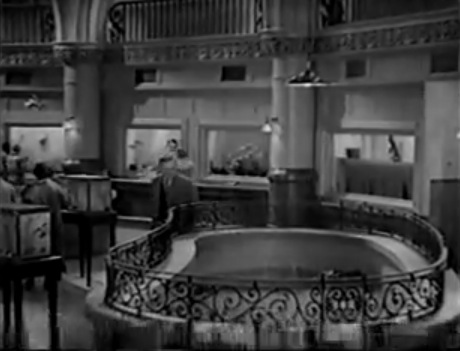
Moses called the Aquarium an "ugly wart." In The Penguin Pool Murder, it's clearly no such thing.

The film footage not only shows the Aquarium as a backdrop to the drama (murder! mystery!), it lingers over its details, highlighting many of the fish and other occupants, with close-ups of their tanks, including action shots of an octopus grabbing its prey, and feeding time at the (itty-bitty) seal tank.

It appears that every inch of the Aquarium is on this film--the director's office, behind the tanks, even inside the men's restroom where you can enjoy the sight of 1932 New York's paper-towel and soap dispensers.
There are also many taxidermied sea creatures hanging on the walls.

not Hildegarde
The film itself is rather sluggish, though the trailer calls it "one long, hearty laugh from beginning to end." It is known for launching the role of Hildegarde Withers, who makes the "police look like a bunch of pansies." She's a schoolteacher turned sleuth, "A lean, angular spinster lady, her unusual hats and the black cotton umbrella she carries are her trademark... Hildegarde collects tropical fish, abhors alcohol and tobacco, and appears to have an irritable disposition."
Watch the movie here on youtube or check out the trailer at TCM.
Tuesday, February 8, 2011
*Everyday Chatter
Indie bookshops may be making a comeback. [Crain's]
A night out with JD Salinger, New York, 1952. [Gothamist]
A look back at jazz on 52nd Street. [COS]
NY Post calls East Village Hell's Angels a bunch of gentrified "softies." [EVG]
Just in case you wandered into that East Village Gossip Girl shoot yesterday, be aware: Warner Brothers owns you now--worldwide and in perpetuity:

A look back at trashvertising in the city. [DTDB]
Hoarders holing up in Williamsburg. [BK]
Here comes Coney's newfangled coaster. [ATZ]
Chinatown scenes. [NYS]
New seats and carpets planned for Park Slope Pavilion. [LM]
A night out with JD Salinger, New York, 1952. [Gothamist]
A look back at jazz on 52nd Street. [COS]
NY Post calls East Village Hell's Angels a bunch of gentrified "softies." [EVG]
Just in case you wandered into that East Village Gossip Girl shoot yesterday, be aware: Warner Brothers owns you now--worldwide and in perpetuity:

A look back at trashvertising in the city. [DTDB]
Hoarders holing up in Williamsburg. [BK]
Here comes Coney's newfangled coaster. [ATZ]
Chinatown scenes. [NYS]
New seats and carpets planned for Park Slope Pavilion. [LM]
Homemade A's
Since the city Health Department started publicly grading restaurants in July, displaying letter grades in their windows, the blue letter A has become a seal of approval that every restaurant wants to obtain.
Now non-food businesses are getting in on the action.

Sparks deli in Queens got the first "A"
If you don't serve food, you don't get a grade, but non-food businesses--maybe feeling left out--have started to create their own letter cards to put on display. So far, they're making all A's.
Three Lives & Co. bookshop gives itself a "Literary Inspection Grade" of A+. This hand-drawn grade report was created by Elisha Cooper, illustrator of children's books like Beaver Is Lost and Bear Dreams.

The inspection placard at Philippe Liquors on 23rd Street in Chelsea is not as artistic, nor as accurate, but still gives a solid A to Philippe for keeping all its wines "in good shape" and the premises in "clean sanitary condition."

I've only spotted these two so far, but I suspect this will be a growing trend. Seen any homemade A's in your neighborhood?
Now non-food businesses are getting in on the action.

Sparks deli in Queens got the first "A"
If you don't serve food, you don't get a grade, but non-food businesses--maybe feeling left out--have started to create their own letter cards to put on display. So far, they're making all A's.
Three Lives & Co. bookshop gives itself a "Literary Inspection Grade" of A+. This hand-drawn grade report was created by Elisha Cooper, illustrator of children's books like Beaver Is Lost and Bear Dreams.

The inspection placard at Philippe Liquors on 23rd Street in Chelsea is not as artistic, nor as accurate, but still gives a solid A to Philippe for keeping all its wines "in good shape" and the premises in "clean sanitary condition."

I've only spotted these two so far, but I suspect this will be a growing trend. Seen any homemade A's in your neighborhood?
Monday, February 7, 2011
*Everyday Chatter
Murray Hill...the new Times Square? As gentrification has changed the sex trade, Murray Hill is not only the city's frat-boy center, it's also a hotbed for the sex industry. [Wired]
If you missed the Most Literary Rent Party Ever last night, you can still make a donation to support novelist Charles Bock and his family. [HuffPo]
Remember the hybrid born when the Gristede's supermarket chain took over little Jefferson Market two years ago. Now tipster John DeFore sends the following photos showing the place has shuttered:

Jefferson Market was a landmark in the Village, opened in 1929. What will become of it now? "We're considering possibly reopening it as a Gristedes," said Catsimatidis to Fork in the Road.

Freddy's Bar reopens. [Grub]
Could the banished Munson Diner be returning to the city? [HPS]
Newcomers to East Village not even scared of Hell's Angels. [EVG]
The darkest pile of snow you will ever see. [NSC]
"I do love New York in many ways, but the idea of living in a city where the best you can do is to get rich and pay people to take care of the problems you face every day is kinda depressing." --Aaron Katz, director of Cold Weather. [LM]
If you missed the Most Literary Rent Party Ever last night, you can still make a donation to support novelist Charles Bock and his family. [HuffPo]
Remember the hybrid born when the Gristede's supermarket chain took over little Jefferson Market two years ago. Now tipster John DeFore sends the following photos showing the place has shuttered:

Jefferson Market was a landmark in the Village, opened in 1929. What will become of it now? "We're considering possibly reopening it as a Gristedes," said Catsimatidis to Fork in the Road.

Freddy's Bar reopens. [Grub]
Could the banished Munson Diner be returning to the city? [HPS]
Newcomers to East Village not even scared of Hell's Angels. [EVG]
The darkest pile of snow you will ever see. [NSC]
"I do love New York in many ways, but the idea of living in a city where the best you can do is to get rich and pay people to take care of the problems you face every day is kinda depressing." --Aaron Katz, director of Cold Weather. [LM]
Subscribe to:
Posts (Atom)